8 Exercise Snacks Examples You Can Do Between Tasks
 19 min
You're standing in the kitchen waiting for the kettle, or you've just closed a call and the next one doesn't start for six minutes. You could check your phone, stay seated, and let that gap disappear. Or you could do 15 squats, climb the stairs once at pace, or hold a wall sit while the water boils. That's the whole idea behind these exercise snacks examples. They're not shortened gym sessions and they don't need workout clothes, a mat, or a plan for the hour.
Each example below works as a loggable micro-set. You'll get a clear time or rep target, an easier and harder version, and a practical trigger so you don't have to decide in the moment. I recommend picking triggers you already live by, like finishing lunch, ending a meeting, or walking past a doorway. The set itself takes seconds to a minute, and logging it turns a forgettable effort into something you can see adding up across the week.
Don't try to do all eight on day one. Start with two that fit your space, repeat them until they're automatic, then rotate. A snack you'll repeat after lunch beats a heroic routine you'll abandon by Thursday.
Table of Contents
- 1. Stair Climbing Snacks
- 2. Tabata-Style Bodyweight Intervals
- 3. One-Minute Bodyweight Circuits
- 4. Doorframe Pull-Up Snacks
- 5. Chair Dip and Kitchen Counter Push-Up Snacks
- 6. Post-Meal Bodyweight Squat Snacks
- 7. Desk Sit-to-Stand and Calf Raise Snacks
- 8. Isometric Wall Sit and Glute Bridge Holds
- 8 Exercise Snacks at a Glance
- Stack Your Snacks: Turning a Day of Gaps Into a Training Week
1. Stair Climbing Snacks
Take the stairs fast enough that you couldn't comfortably hold a conversation at the top. That's your snack. One to three flights, 30 to 60 seconds, then walk back down slowly and get on with your day. No equipment, no floor space, and no change of clothes if you keep the first week sensible.
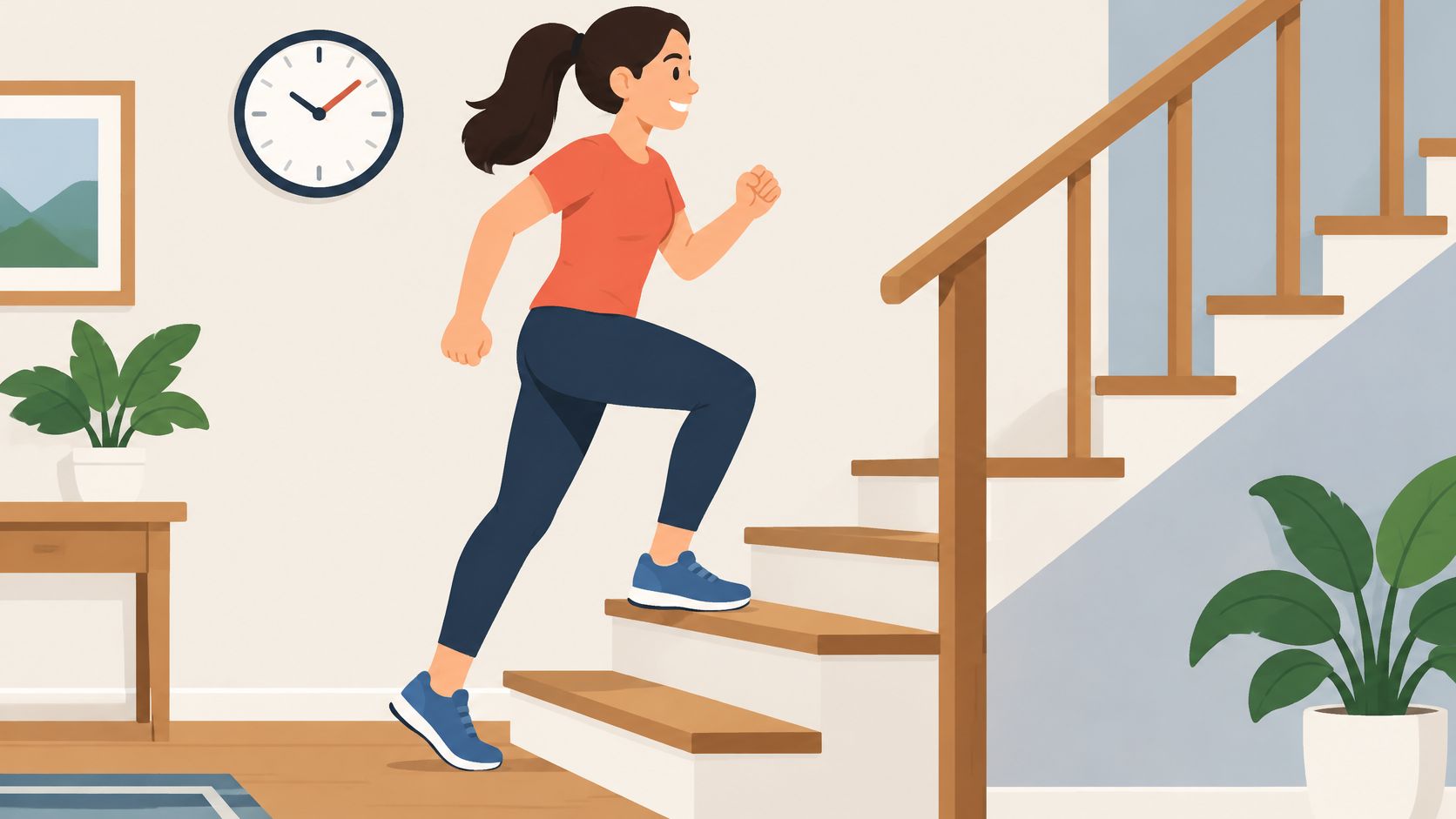
The best studied version is deliberately brief and separated. In a 2024 controlled trial of stair-climbing exercise snacks, inactive adults did three 30-second all-out bouts per day, each covering six flights and 126 steps, with more than one hour between bouts. Relative peak oxygen uptake rose by 7%, a mean gain of 2.5 mL·kg⁻¹·min⁻¹, while the control group declined. You don't need six flights to start, but the structure matters. Brief, hard, and separated beats one exhausted climb.
How to scale it
- Easy start: One flight at a brisk but controlled pace, hand lightly on the rail.
- Moderate: Two to three flights without stopping, then an easy walk down.
- Challenging: Repeat the climb after a short pause at the bottom, keeping steps quick and quiet.
Say you work on the second floor. Climb to the fourth after your morning call, walk down, and log one stair set before you sit. If you want a lower, controlled alternative at home, a step deck workout gives you the same stepping pattern without needing a full staircase.
The trade-off is impact and sweat. Fast stairs aren't ideal in hard shoes, on sore knees, or five minutes before a client meeting. Hold the rail when you're pushing pace, take the descent slowly, and stop if you feel dizzy or unusually breathless. Log each climb as a single tile so three small efforts read as a real training day.
2. Tabata-Style Bodyweight Intervals
Twenty seconds on, ten seconds off. Repeat that eight times and you're done in four minutes. That format, developed by Izumi Tabata and colleagues in the 1990s for trained athletes, is the most intense option on this list, and I don't recommend it as your first snack if you're starting from zero.
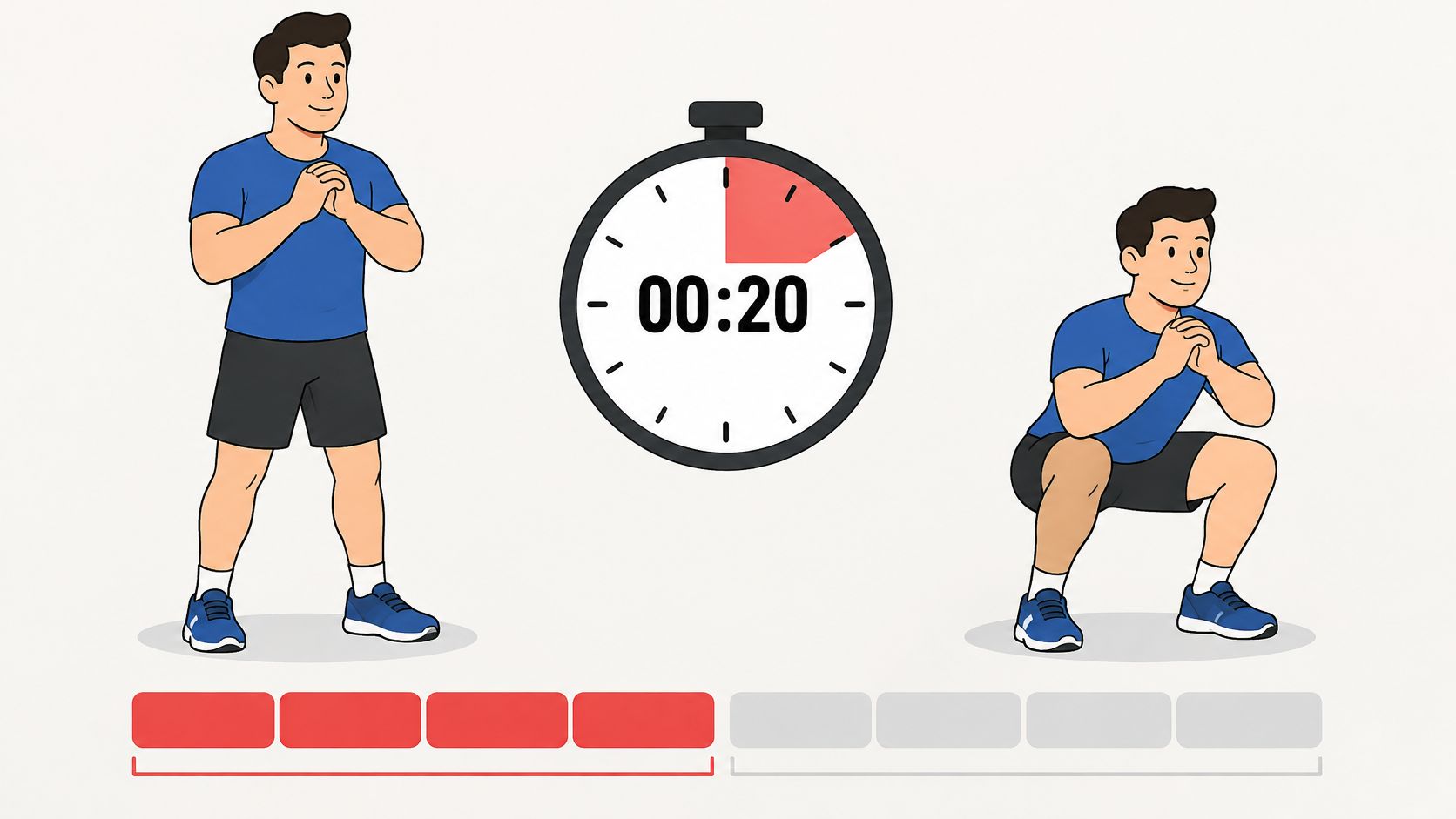
Pick one movement you can do cleanly when tired. Bodyweight squats work well. Push-ups work if you can keep your trunk straight for all eight rounds. Burpees look impressive and usually fall apart by round five, which is why you get more from squats. Set a timer with sound, stand where you have space, and count reps only in the first and last rounds to check whether your pace collapses.
A workable first version
Do four rounds instead of eight for your first two sessions. Work at about eight out of ten effort, not a true maximum. If your squat depth shrinks or your knees cave in, slow down or end the set. Form you can't repeat isn't a training target, it's just fatigue.
Practical rule: If you need to lie on the floor afterward, you turned a snack into a test. You should be breathing hard and able to walk back to your desk within a minute.
Use this format two or three times a week, not several times a day, and leave a rest day between sessions. It's efficient, but it's also the easiest snack to overdo. A kitchen floor push-up version between tasks can work well once a day. Three maximal Tabatas plus your normal training usually doesn't.
Log it as one tile with the movement and rounds completed. Next time, aim to match the reps with better form before you add rounds. That small progression is visible, honest, and much easier to sustain.
3. One-Minute Bodyweight Circuits
Set a timer for 60 seconds and cycle through two simple moves at a steady pace. Ten squats, five push-ups, repeat until the timer ends. Or alternate glute bridges and bird dogs on the bedroom floor before bed. You're not racing the clock. You're filling one minute with clean, repeatable work.
This is the most flexible format here because you control both the movements and the effort. That flexibility also creates confusion about what counts. A review of what counts as an effective exercise snack notes bouts ranging from roughly 20 seconds to 5 minutes, from twice daily to several times daily, at intensities from moderate to near maximal. A few comfortable squats can break up sitting, but they aren't the same stimulus as a vigorous stair protocol. Match the effort to your goal.
Three one-minute pairings
- Desk reset: Squats and counter push-ups, alternating every five reps.
- Floor reset: Glute bridges and bird dogs, slow and controlled.
- Harder reset: Reverse lunges and floor push-ups, stopping two reps before failure.
Say you're between calls at home. You stand up, start the timer, and do squats and push-ups until it beeps. You sit back down warmer, not wiped out. That's the right intensity for a snack you'll repeat later in the day.
Rotate the pairing so you don't hammer the same muscles every time. Legs and pushing in the morning, glutes and trunk control in the afternoon. Record each minute in SuperStrong as its own set, and you'll see steady tiles appear on days when a full workout never had a chance.
The limit is obvious. One easy minute won't replace your weekly activity on its own. Treat it as accumulated practice and a way to interrupt sitting, then build frequency before you chase intensity.
4. Doorframe Pull-Up Snacks
Every time you walk through the doorway, you do a few reps. That's the system. Two or three pull-ups while coffee brews, two more after lunch, a slow negative before dinner. No single set feels like a workout, but your back, biceps, and grip get frequent practice across the day.
Check the setup first. The frame or bar has to be sturdy, fixed, and rated for your weight. Test it with a partial hang, feet still close to the floor, before your first full rep. If it flexes, creaks, or shifts, don't use it. A proper bar is cheaper than a repair, and options for pull-up and dip bars are worth reviewing if your doorframe wasn't built for this.
Scale by ability
- Can't do a pull-up yet: Jump to the top position and lower for three to five seconds.
- Can do one or two: Do singles spread across the day, always leaving one rep in reserve.
- Can do five or more: Do sets of three with a brief pause at the top.
A resistance band looped over the bar can assist the hardest part at the bottom. Keep your ribs down, pull your chest toward the bar, and lower under control instead of dropping. If your shoulders shrug to your ears, the set is over.
Frequent easy reps build pull-ups better than one daily set to failure. Stop while the next rep would still look clean.
Add one rep to one set when the current target feels easy for several days, not one rep to every set at once. Log each doorway set separately. By evening you'll often find you've done twelve quality reps without ever scheduling a back workout. Rest the movement entirely on non-training days so elbows and shoulders recover.
5. Chair Dip and Kitchen Counter Push-Up Snacks
Your kitchen already has the equipment. A stable counter gives you an incline push-up. A sturdy chair gives you a dip. Both train chest, shoulders, and triceps in under a minute, and both fit naturally around cooking, boiling water, and clearing plates.
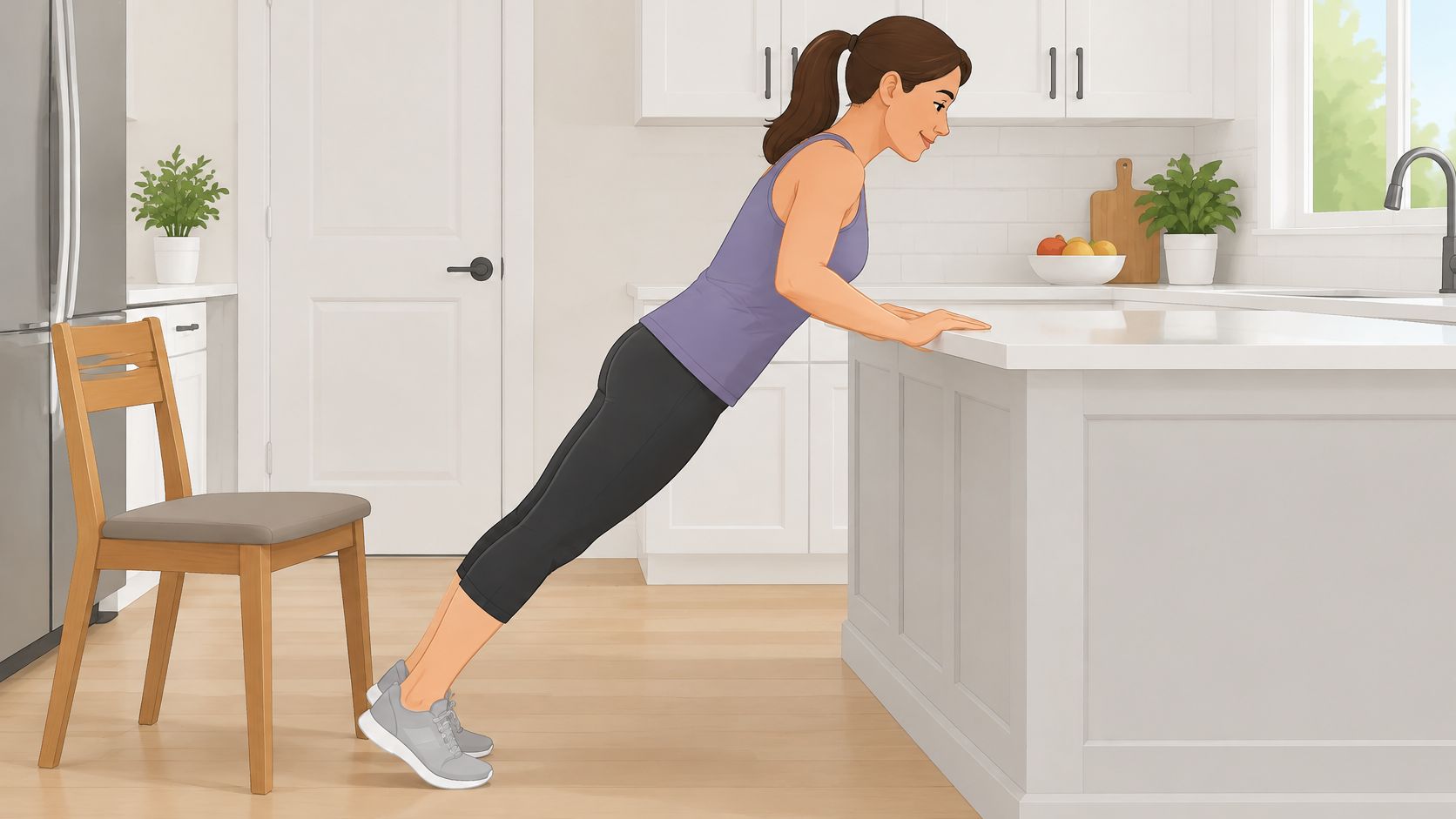
Start with counter push-ups if floor push-ups are still inconsistent. Hands under shoulders, body in one line, lower until your chest approaches the edge, then press away. Do eight to twelve reps while dinner is in the oven. Walk your feet farther back to make it harder, or move to a lower surface as you get stronger.
For chair dips, sit on the edge, hands beside your hips, feet on the floor with knees bent. Slide forward and lower only until your upper arms approach parallel. Keep elbows pointing back, not flaring wide, and press through your palms. Five controlled reps while the kettle boils is enough for a first snack.
Setup checks that matter
- Chair stability: Back it against a wall so it can't slide.
- Wrist comfort: Use the counter edge or handles if flat palms bother you.
- Shoulder depth: Stop the dip before you feel a pinch in the front of the shoulder.
If dips feel good and you want a purpose built option, home dip bars give you a more stable grip than most chairs. Household furniture is fine for starting, though. Log push-ups and dips as separate tiles, because they progress at different rates and you'll want to see which one is improving.
6. Post-Meal Bodyweight Squat Snacks
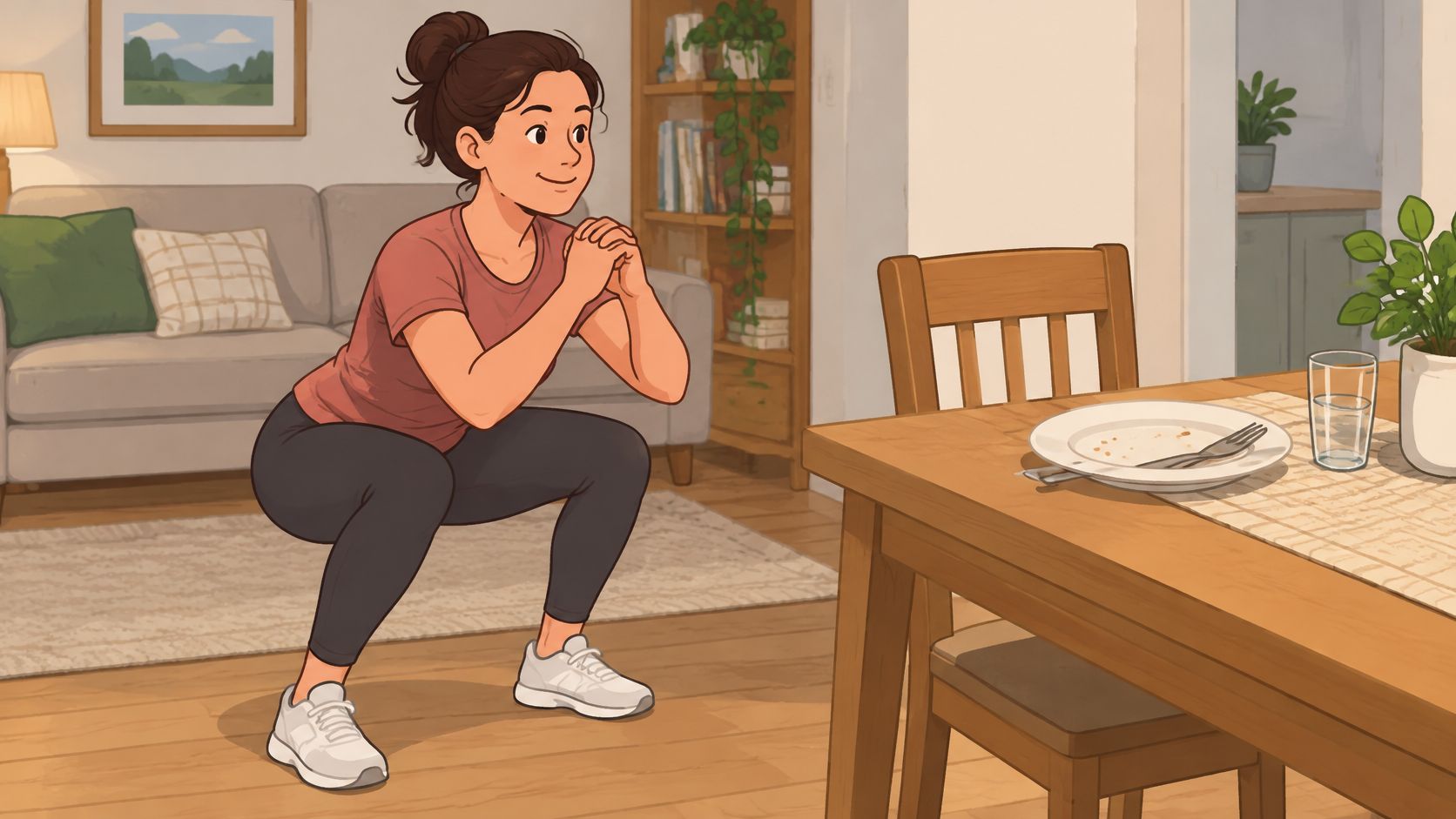
Finish eating, clear your plate, then move for a few minutes before you sit back down. Fifteen bodyweight squats by the table. A short walk to the mailbox plus ten squats when you return. The meal itself becomes the trigger, which removes the hardest part, remembering.
There's a reason this timing gets attention. A large review and expert consensus on short-bout accumulated exercise defines the pattern as sessions of 10 minutes or less, repeated at least twice daily with at least 30 minutes between bouts. Across 27 systematic reviews and 135 studies, it found benefits for more than 20 health outcomes and concluded accumulated bouts were superior to one continuous session for acute glycemic control, especially when interrupting prolonged sitting. That supports the habit of moving after meals. It doesn't justify promising a specific blood sugar result from one set of squats.
Wait a few minutes after a large meal before you squat. Start with a walk if you feel full, then add squats at a comfortable depth, using a chair behind you as a target if balance is an issue. Ten to fifteen reps is a sensible first target.
Make it automatic
Attach the snack to one meal first, usually lunch or dinner. Same place, same rep target, logged immediately. Once that tile appears reliably for a week, add a second meal. Trying to cover every meal from day one usually lasts about three days.
Keep the effort moderate. You're aiming to use large leg muscles and break up post-meal sitting, not to train to failure on a full stomach.
7. Desk Sit-to-Stand and Calf Raise Snacks
This is the lowest friction snack in the list. You don't leave your desk, change clothes, or need floor space. You stand up from your chair without using your hands, sit back down with control, and repeat. Then you rise onto your toes for calf raises while a file loads or a call connects.
Do fifteen sit-to-stands during a long video call with your camera off, or immediately after it ends. Feet flat, knees tracking over toes, chest tall. If that's easy, slow the lowering phase to three seconds. If it's hard, use a higher chair or lightly touch the desk for balance. The goal is clean reps you'll repeat hourly, not a leg day.
For calf raises, stand behind the chair and hold it lightly. Rise onto both toes, pause for one second, lower slowly. Twelve to fifteen reps is enough. Single leg raises are the harder version once two legs feel trivial.
Set the trigger, not a schedule
- After every call: Ten sit-to-stands before you open the next tab.
- While waiting: Calf raises during downloads, printing, or kettle time.
- Hourly phone reminder: One short set, then back to work.
These movements suit people who need low impact options. A review of safe and sustainable exercise snacks at home describes protocols using repeated bouts every 1 to 4 hours and reports adherence rates of at least 92% in several interventions. That fits what works in practice. Easy, joint friendly snacks get done. Supported squats, sit-to-stands, and wall push-ups are legitimate starting points if jumping or sprinting isn't appropriate for your knees, balance, or health history.
Use this snack as a warm-up before a harder set later, or as your main movement on a heavy desk day. Either way, log it. Small tiles on a sedentary day still tell a true story.
8. Isometric Wall Sit and Glute Bridge Holds
Not every snack needs reps. Slide down a wall until your thighs are working, hold still, and breathe. Or lie on the floor, lift into a glute bridge, and keep your hips level for thirty seconds. Isometric holds build strength and endurance without joint movement, which makes them useful when space is tight or impact is off the table.
Start with 20 seconds. For a wall sit, place your back flat against the wall, feet forward, knees bent to a position you can hold without sliding. Shallower is fine at first. A 45 second hold while reading email is a later target, not a first attempt. Stand up slowly when the timer ends, especially if you feel lightheaded.
For a glute bridge hold, drive through your heels, ribs down, and squeeze your glutes without arching your lower back. Hold 20 to 30 seconds on the bedroom floor before sleep. If your hamstrings cramp, bring your feet a little closer to your body.
Progress without adding equipment
- Add time first: Five extra seconds per hold each week.
- Add a second hold: Rest briefly, then repeat once.
- Pair it: Follow a wall sit with sit-to-stands for a dynamic finish.
Form check: If you're holding your breath and shaking from second five, the position is too hard. Raise the wall sit or shorten the hold.
The trade-off is specificity. Holds build strength mainly near the angle you train, so combine them with squats, bridges through a full range, and walking across the week. They're also intense for blood pressure during the effort, so breathe continuously and skip maximal holds if you've been told to avoid straining. Log the seconds held. Watching a 20 second tile become a 40 second tile is clear, satisfying progress.
8 Exercise Snacks at a Glance
| Item | Typical Duration | Main Muscles Targeted | Equipment Needed | Best For |
|---|---|---|---|---|
| Stair Climbing Snacks | 30–60 seconds per burst | Legs, glutes | Stairs | Quick cardio and lower-body work during daily breaks |
| Tabata-Style Bodyweight Intervals | 4 minutes | Depends on chosen movement | None; timer optional | Time-efficient, high-intensity conditioning |
| One-Minute Bodyweight Circuits | About 1 minute | Multiple muscle groups, depending on movements | None | A quick, full-body movement break |
| Doorframe Pull-Up Snacks | Brief set of a few reps | Back, biceps, grip | Sturdy doorframe or pull-up bar | Building upper-body pulling strength at home |
| Chair Dip and Kitchen Counter Push-Up Snacks | Brief set of 5–10 reps | Triceps, chest, shoulders | Stable chair or kitchen counter | Beginner-friendly upper-body exercise at home or work |
| Post-Meal Bodyweight Squat Snacks | Brief set or short walk | Legs, glutes | None | Adding light activity after meals |
| Desk Sit-to-Stand and Calf Raise Snacks | Brief set of 10–15 movements | Legs, glutes, calves | Stable chair or desk | Breaking up sitting during the workday |
| Isometric Wall Sit and Glute Bridge Holds | 20–60 seconds per hold | Quadriceps, glutes, core | Wall or floor | Low-impact strength and endurance work |
Stack Your Snacks: Turning a Day of Gaps Into a Training Week
The skill isn't surviving one heroic four-minute Tabata. It's stringing small, repeatable efforts across ordinary days until they become your normal routine. A stair climb after a morning call, fifteen sit-to-stands after lunch, counter push-ups while dinner cooks. None of those moments looks like training on its own. Together, across three training days, they cover legs, pushing, pulling, trunk control, and a genuine rise in heart rate.
Start by matching snacks to your environment instead of copying someone else's day. If you work in an office with stairs, that's your aerobic snack. If you're home with a sturdy doorframe, pull-up singles fit your doorway passes. If your knees dislike impact, sit-to-stands, wall sits, and glute bridge holds give you a full lower body menu without jumping. I recommend choosing two or three snacks and one fixed trigger for each. More variety sounds better and usually produces less consistency.
Then think in terms of a week, not a perfect day. SuperStrong uses a rhythm of three training days and four rest days, with a small goal on each training day that you can increase when it feels easy. That structure suits snacking well. You can push stair pace on Monday, repeat doorway pull-ups on Wednesday, and keep Friday to desk and isometric work if you're tired. Rest days still count as part of the plan, because elbows, knees, and motivation all need them.
Logging is what stops these efforts from vanishing. A set you don't record feels like nothing by evening, even if you did four of them. A set logged in seconds becomes a tile on a shared wall, sized by effort, visible to up to four friends who can acknowledge it with a sticker. There's no points table to game and no graph to decode. You just see the wall fill across days, weeks, and months, and you can spot a personal best when it's flagged. That visibility does two jobs. It proves to you that the small work is accumulating, and it gives your friends a reason to notice when you show up.
Be honest about the limits, too. Light desk snacks break up sitting and build a habit, but they don't automatically deliver the fitness gains of vigorous stair bouts. One snack a day is a start, not a complete program. If a snack causes sharp pain, dizziness, or unusual breathlessness, stop and get appropriate advice rather than pushing through because the set is short. Short doesn't mean risk free, and it doesn't have to mean maximal. Most of your snacks should feel like work you could repeat later the same day.
So pick your first gap tomorrow. After breakfast, do fifteen squats. After your first call, climb one flight fast. Log it before you sit down. By the end of one week you'll have a wall that shows what your busy schedule allowed, and a much clearer answer to the question of whether you have time to train. Usually, you did. It was just spread across the day in pieces too small to notice until you started collecting them.
Turn the gaps in your day into logged sets with SuperStrong, where every squat, push-up, and stair snack lands as a tile on a shared wall with up to four friends on iPhone. Pick two snacks from this list, attach them to a meal or a meeting tomorrow, and watch a week of small efforts become visible progress.