Step Deck Workout Routines You Can Do at Home in Minutes
 14 min
You're standing in the living room with ten minutes between calls, the laptop still warm, and you want something more demanding than a walk but nowhere near a full gym session. A step deck workout fits that gap well. It gives you a low-equipment way to raise your heart rate, and it can be scaled from a floor march to a sharper interval session without turning your day upside down.
Table of Contents
- What You'll Get From This Guide
- Why the Step Deck Works for Short Home Sessions
- Setting Up Your Step Deck the Right Way
- A 10-Minute HIIT Step Deck Circuit
- A Steady-State Interval Routine for Cardio Days
- When to Push Height, Cadence, or Duration
- Micro-Bouts and What Step Deck Workouts Can Realistically Do
What You'll Get From This Guide
If you've got a step platform, a sturdy stair, or a low household substitute, you can turn a short window into useful training. The point isn't to recreate a 45-minute studio class at home. The point is to choose the right height, cadence, and duration for the time you have.
You'll get three formats that work in real life, not just on paper. One is a quick circuit, one is a steadier cardio session, and one is a micro-bout you can use between calls or after lunch. If you want a broader no-equipment foundation alongside stepping, this pairs well with an at-home no equipment workout.
Practical rule: pick the version that matches your recovery, not your ego. A short bout done cleanly beats a longer bout done sloppily.
By the end, you'll know how to choose a safe starting height, when to add cadence instead of height, and how to fit two or three short sessions into a normal week. You'll also know what a useful five-minute window looks like, so you can start fast instead of overthinking it.
Why the Step Deck Works for Short Home Sessions
A step deck was built for controlled stepping first. That matters in a five-minute window, where you need a tool that raises effort without turning the session into a full production.
The format grew out of rehabilitation before it became a mainstream exercise style in the late 1980s. Atlanta instructor Gin Miller used an 8-inch porch step to rebuild knee strength after injury, after finding an 11-inch plastic milk crate too high for comfortable rehab. Miller and Connie Collins Williams later built around 250 step-based movements and formed Bench Blast in late 1988, using wooden platforms between 6 and 12 inches high. Reebok's physiology trials at San Diego State University in 1989 helped push the format into commercial health clubs, and the Step Reebok rollout around 1990 sped up its spread in the United States. By 1995, participation had reached an estimated 11.4 million people, which shows how widely the format had landed.
Why that history still matters at home
That background explains why the deck still works for short home sessions. You get a small platform that scales effort without machines, weights, or much floor space. A step deck workout fits a kitchen corner, a garage, or the gap between calls, and it works even when the goal is only to wake up your legs and breathing.
The useful part is control. You can make a session harder by changing height, by moving faster, or by extending the work bout a little, and those dials do not have to change together. A low deck with quicker cadence can feel demanding without punishing your joints, while a taller setup asks more from balance and knee tolerance.
That trade-off matters in real life. After lunch, a short bout with moderate height and steady rhythm can clear the fog without leaving you wrecked for the afternoon. Before bed, the same deck can be used at a gentler pace so you still get movement without driving yourself too hard. The point is not to chase the highest platform, it is to match the session to the time and recovery you have.
The value is control, not nostalgia.
A few minutes is enough when the work is specific, repeatable, and easy to stop. That is why the step deck holds up for home use better than a lot of equipment that only makes sense when you have a full hour.
Setting Up Your Step Deck the Right Way
The biggest mistake is treating a taller platform like an automatic upgrade. It isn't. Height changes mechanical demand as well as challenge, so the best setup depends on your joints, balance, and how long you're training, not just how hard you want the session to feel.
Start low, then build one dial at a time
For most beginners, a low platform around 4 to 6 inches is the cleanest starting point. That lets you raise your heart rate without making every step a test of balance or knee tolerance. If you're returning after time off, or you're cautious about the knees or ankles, low and repeatable usually beats high and shaky.
Cadence is a separate dial from height. You can keep the platform low and make the session more demanding by stepping faster, or you can keep cadence modest and extend the work bout a little longer. The progression rule that holds up best is to change one variable at a time, first duration, then cadence, then height.
Use simple setup checks before you start:
- Footwear: flat, non-slip shoes help you stay planted.
- Surface: pick a stable, level floor. Skip rugs and wobbly spots.
- Warm-up: spend 2 to 3 minutes marching or stepping easy before your first work bout.
- Household substitutes: a sturdy stair or low bench can work, but only if it's stable, wide enough, and doesn't slide.
If you want a practical comparison for home setup, the same logic applies to up-and-over exercise choices, where stability matters as much as effort.
Pick your starting setup
| Level | Platform Height | Starting Cadence | Workout Length |
|---|---|---|---|
| Beginner | 4 to 6 inches | Comfortable, conversational pace | 5 to 8 minutes |
| Returning after a break | Low step, stair, or sturdy low bench | Smooth and controlled | 8 to 12 minutes |
| Experienced | Moderate height only if form stays clean | Brisk but repeatable | 10 to 15 minutes |
Keep your stance quiet and controlled. If your foot can't land fully on the platform, the setup is too aggressive for today.
A 10-Minute HIIT Step Deck Circuit
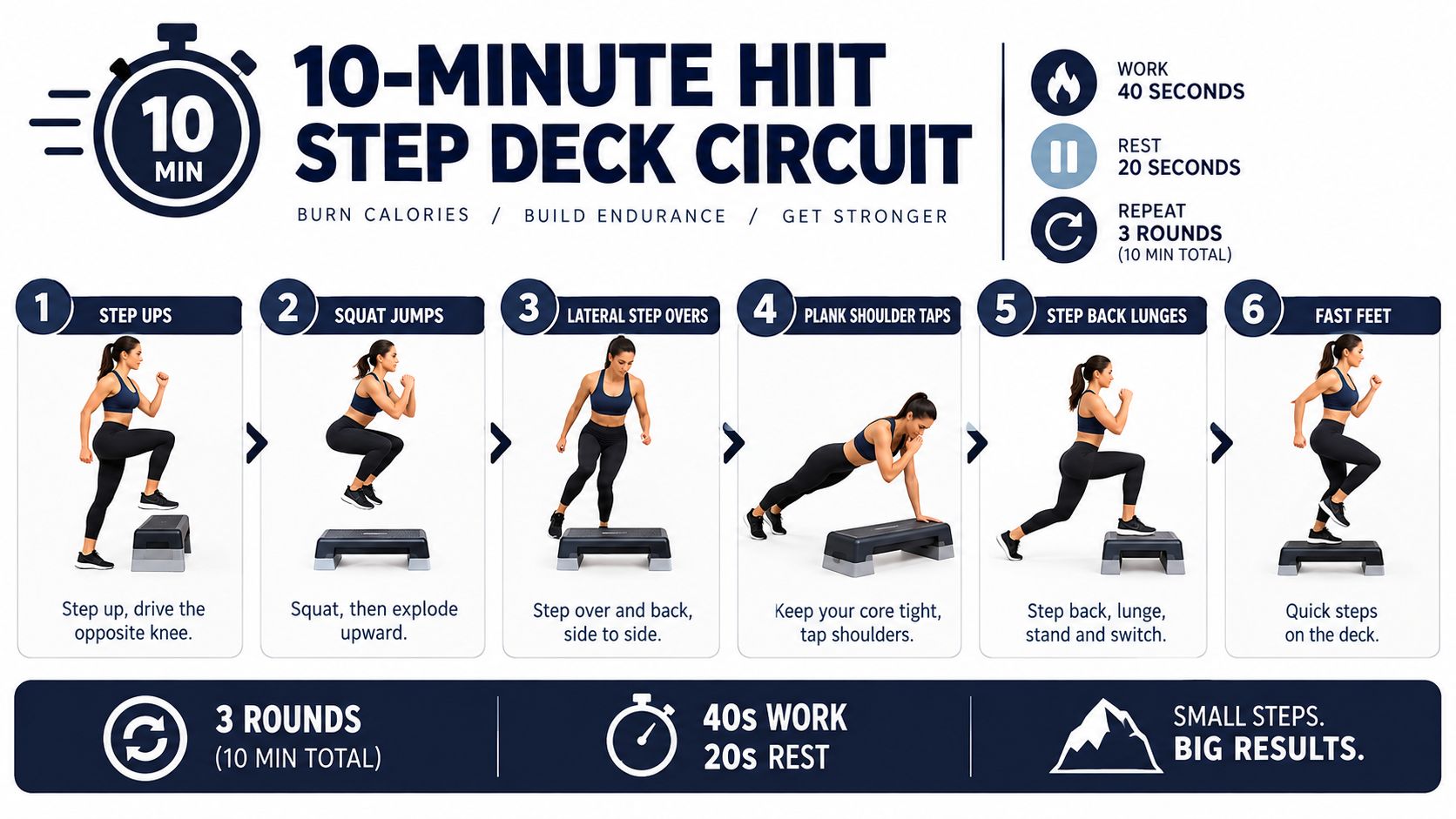
This format is for the day you want a hard, efficient session and you don't want to fuss with equipment changes. Use 40 seconds on, 20 seconds off, then move through four exercises and repeat the sequence once. Keep the rest short so your heart rate stays up.
The circuit
-
Basic step. Step up, step down, alternating lead legs. Keep your chest tall. Common error: rushing the feet and losing rhythm.
-
Knee drive. Step up and drive one knee forward at the top. Think “lift, don't fling.” Common error: leaning back or shrugging to fake height.
-
Lateral step-up. Face sideways and step up with control. Keep the working foot flat. Common error: letting the knee cave inward.
-
Step-down with squat. Step down softly, then sit into a shallow squat. Common error: jumping off when fatigue makes alignment sloppy.
Form cue: step down soft every time. The moment you start jumping down, the session gets noisier, harsher, and less controlled.
If your knees are sensitive, swap the knee drive for a march in place and swap the lateral step-up for a calf raise. That keeps the circuit moving without turning it into a different workout category.
A Steady-State Interval Routine for Cardio Days
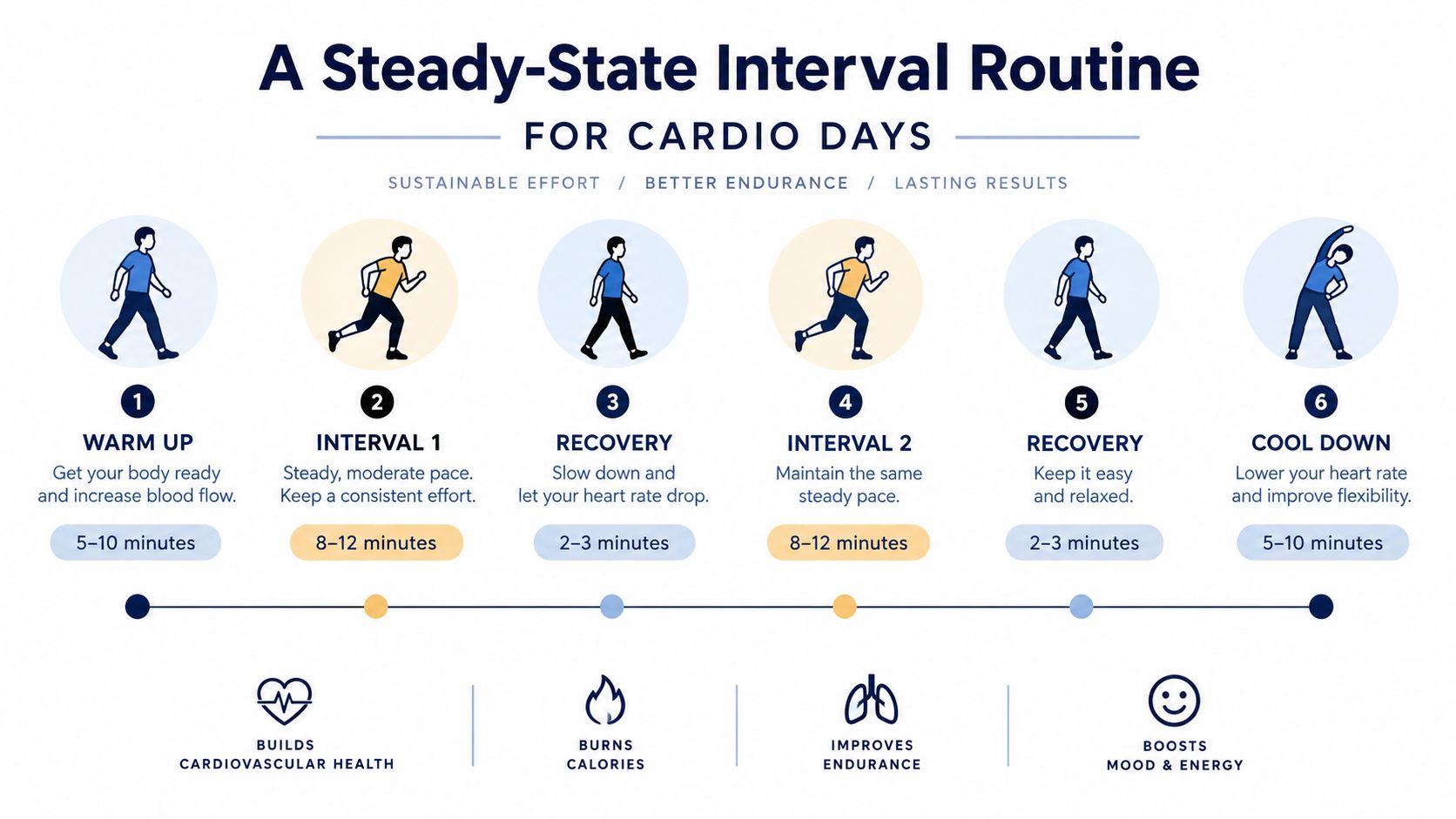
Some days call for steady work, not spikes. This version fits well after lunch, before dinner, or in that small window before bed when you want to move without the sharper feel of HIIT. Set the step deck for a pace you can hold, work for 3-minute stepping bouts, then take up to 3 minutes of easy recovery. Repeat that four to six times.
How to set the pace
A practical starting point is 100 steps per minute if you already have decent rhythm and balance. If that feels rushed, drop to 90. If you finish each round cleanly and still have room to work, 110 can be the next step later. Exercise-prescription research on step cadence and workload used cadences from 80 to 110 steps per minute, so that range gives you room to scale without guessing. The same research proposed intensity near 8.8 METs for appropriately conditioned adults, but that is not a universal starting target because age, fitness, step height, and balance all change the load. Exercise prescription research on step cadence and workload
Keep the platform height conservative until your cadence and posture stay steady. A taller deck is not an automatic upgrade, because it changes joint stress as well as effort. In short home sessions, that trade-off matters more than chasing the highest possible platform.
This format usually fits inside a 25 to 35 minute window once warm-up and recovery are included, which is a realistic length for a home cardio day. Session analysis of step exercise found average sessions around 38.6 minutes, an average stepping rate of 134.6 beats per minute, about 4,194 loading cycles per session, and peak ground-reaction force around 1.40 times body weight. That is a lot of repeat exposure, so the goal is controlled effort, not noisy footwork. Session analysis of step exercise loading
Keep recovery honest. If your footwork gets sloppy, extend the easy interval instead of forcing the next round.
On lighter days, a walk out exercise can serve the same low-pressure role.
When to Push Height, Cadence, or Duration
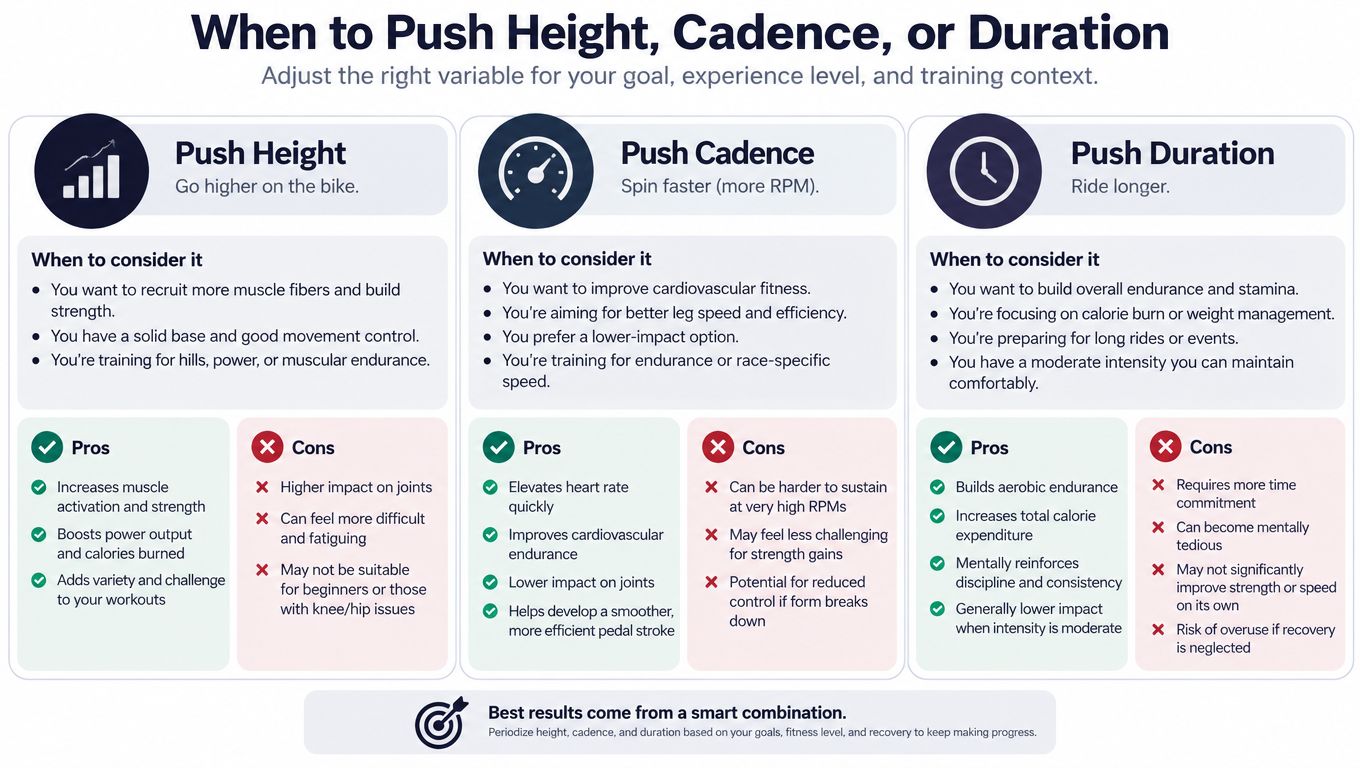
Progression works best when you stop asking, “What's harder?” and start asking, “What can I change without breaking form?” In a step deck workout, that usually means choosing between duration, cadence, and height based on the outcome you want.
Use duration first
If the goal is to build more total work without adding much extra complexity, add time before you add intensity. Longer stepping bouts increase cardiovascular load while leaving each step mechanically familiar. That makes duration the safest first dial for the majority of lifters.
Use cadence second
Once your feet are moving cleanly, cadence is the next place to progress. Faster stepping raises demand without requiring a higher platform, but only if your breathing, balance, and foot placement stay controlled. The moment your knees start collapsing inward or your torso starts rushing ahead of your feet, the pace is too aggressive.
Use height last
Height should move up slowly, especially if you're heavier, deconditioned, or returning after knee or ankle issues. Biomechanical research has found that peak impact force rises as step height rises, and it supports low step heights for novices, even while noting that the link between ground-reaction forces and injury isn't conclusive. That's the right level of caution. The problem isn't that height is bad, it's that height changes stress, and people often increase it before their movement quality is ready. Biomechanical review of step height and impact force
Practical rule: if you can't keep the whole foot on the platform, the next step should be slower, not higher.
Micro-Bouts and What Step Deck Workouts Can Realistically Do
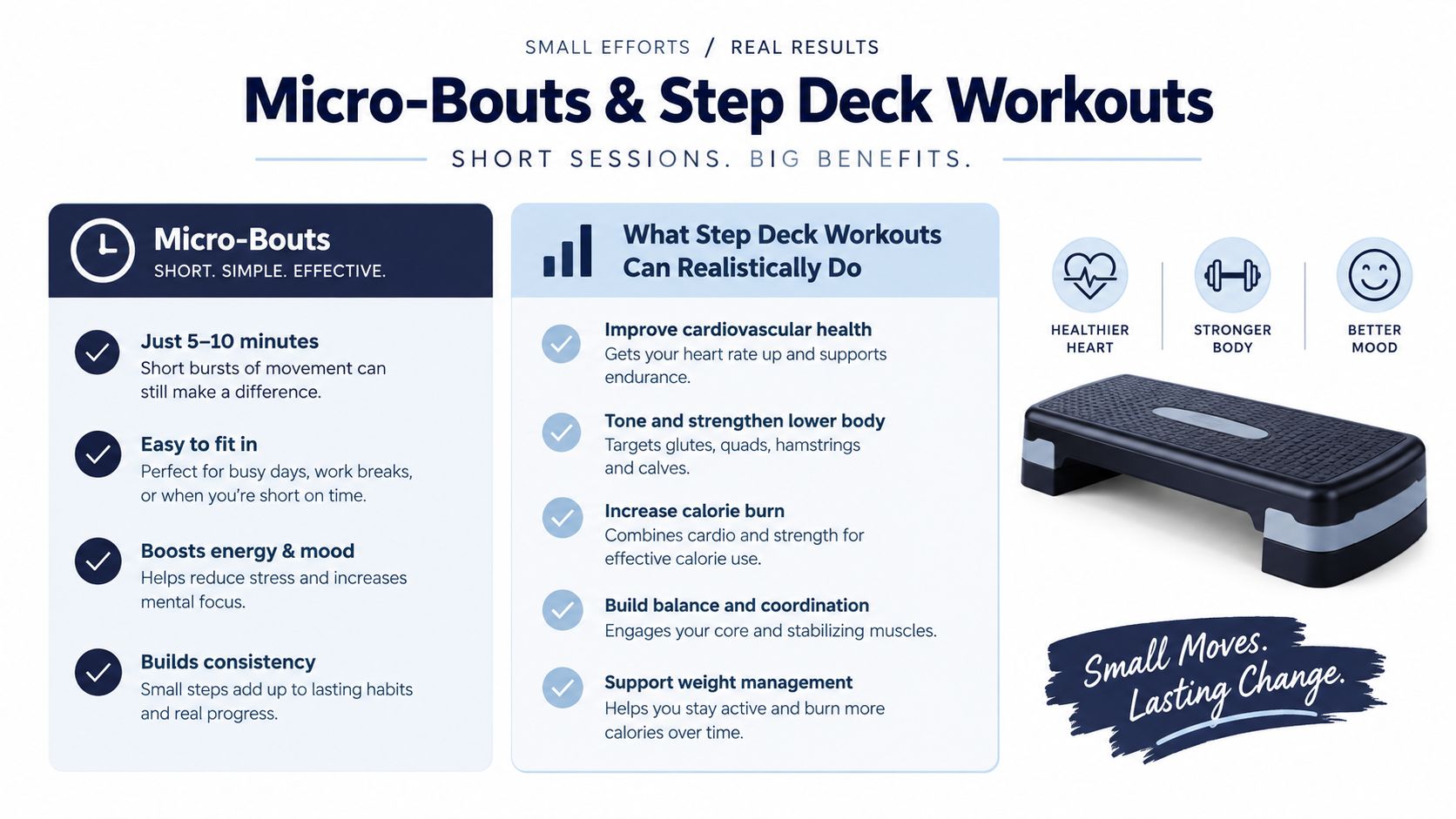
A short step session fits into real life. That is the main reason it works. A step deck workout can be a practical way to lift your heart rate, break up sitting, and build a repeatable habit when you only have a few minutes between calls, after lunch, or before bed.
The evidence for short bouts is encouraging, but it stays specific. A 2025 systematic review of 11 randomized trials involving 414 participants found improved cardiorespiratory fitness in inactive adults, but no clear effect on lower-limb strength or outcomes like body composition, blood pressure, or blood lipids. Certainty was moderate for fitness and very low for muscular endurance in older adults. Stepping helps, but it does not replace everything else. A broader 2025 meta-analysis on exercise snacks found benefits for several cardiometabolic measures, yet the evidence was mixed enough that short bouts should not be treated as a guaranteed route to fat loss or disease prevention. Exercise snacks review and synthesis
What short bouts can do well
A few minutes of stepping can move an inactive day in the right direction. It can raise heart rate, interrupt long sitting stretches, and make consistency easier because the session feels manageable. That matters when the goal is to keep moving, not to build a full class around the clock.
What they won't replace
Step work does not cover full-body resistance training the way loaded lifts do. It also does not replace longer aerobic sessions if endurance is the target. Body composition changes need more than scattered micro-sessions on their own.
Height, cadence, and recovery are separate dials. A taller platform adds stress, faster cadence adds demand without changing the platform, and shorter recovery turns the same drill into a sharper bout. Treat them that way. If your knees feel fine but your breathing falls apart, adjust pace. If your pace is controlled but the joint load feels rough, lower the deck. If you want a light reset instead of a full step bout, a walk-out exercise can fill the same role on easier days.
The cleanest weekly pattern is simple. Use two short step sessions and one longer interval session across three training days, then keep the other four days for recovery or light movement. If you are just starting, let the short sessions act as the floor and keep the longer one low and controlled until the pattern feels automatic.
Before you start tomorrow, run this quick check:
- Foot placement: whole foot on the deck.
- Knee tracking: knees track in line, not collapsing inward.
- Step-down: soft and controlled, never a tired jump.
- Breath: steady enough to speak in short sentences.