8 at Home No Equipment Workout Routines
 19 min
You've got six minutes before the next call, a kitchen to tidy, or a child who needs your attention. That's enough time to move, but not enough time for a complicated program, a commute, or a full gym session. The best at home no equipment workout is the one you can start without negotiating with your calendar, then repeat often enough to build capacity.
The eight approaches below solve different problems. Some fit between tasks, some keep noise low in an apartment, and others prioritize cardio, full-body strength, a specific movement pattern, or long-term progression. They aren't interchangeable. A quiet isometric session serves a different need from an all-out conditioning circuit, and a push-up routine won't solve the pulling gap by itself.
If you want a simple way to record short bodyweight sets, SuperStrong lets iPhone users log effort as visual tiles on a shared wall with up to four friends. The app is optional. The routines are the important part, and each one starts with a session you can do today.
Table of Contents
- 1. Calisthenics Circuit Training
- 2. HIIT
- 3. Push, Pull, and Legs Split
- 4. Minimal Equipment Strength Training
- 5. Full-Body Workout Routines
- 6. Isometric and Static Hold Training
- 7. Bodyweight Cardio and Conditioning Circuits
- 8. Progressive Overload Bodyweight Progressions
- 8-Method Comparison: At-Home No-Equipment Workouts
- Turn Small Sets Into a Repeatable Week
1. Calisthenics Circuit Training
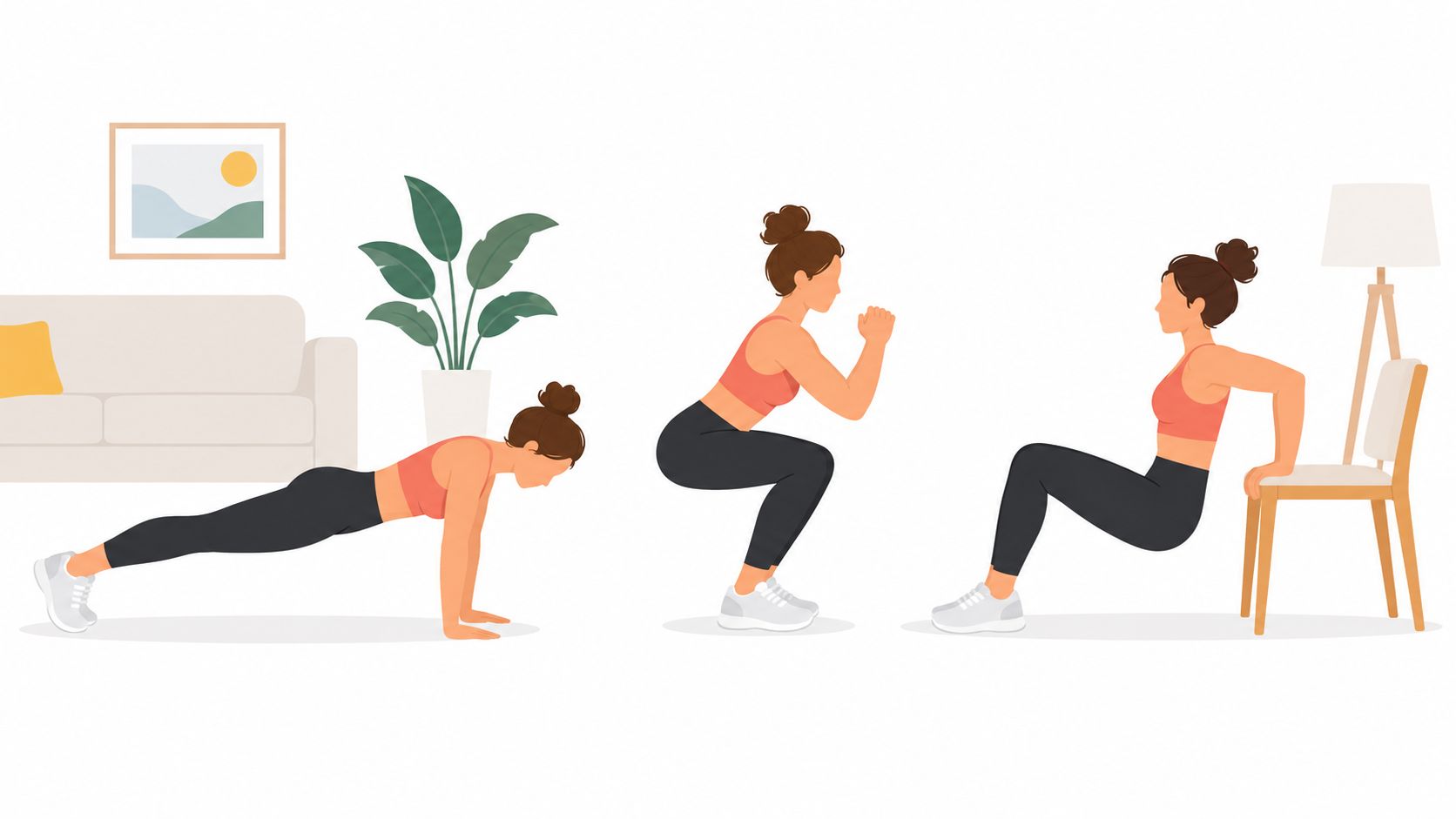
Calisthenics works well when you want a compact session that combines strength practice with a steady rise in breathing. Move from one bodyweight exercise to the next with limited rest, but don't turn every circuit into a race. Controlled repetitions usually give you more useful practice than rushed reps that lose position.
Try this three-minute starting circuit:
- Push-ups: Perform a manageable set with your hands beneath your shoulders. Use an incline or knee variation if the floor version breaks down.
- Squats: Lower under control, keep your feet planted, and stand without locking into a rushed bounce.
- Chair-supported dips: Place a stable chair against a wall and use a shallow range until your shoulders tolerate the movement.
- Step-ups: Use a stair if you need a lower-impact leg option.
You don't need all four movements immediately. Start with two or three, complete one round, and stop while your technique is still dependable. That makes the routine easier to repeat between meetings or chores. Log the circuit as one tile in SuperStrong if you use the app, then compare the quality and size of later efforts rather than chasing exhaustion.
Make short circuits harder without adding time
Slow the lowering phase, pause briefly at the hardest position, or choose a more demanding variation. A two- to three-second descent can make a familiar push-up or squat more challenging without increasing the number of repetitions. Rotate emphasis across sessions so your shoulders, knees, and wrists aren't exposed to the same stress every day.
Practical rule: Leave enough energy to repeat the routine later in the week. A circuit that makes tomorrow impossible isn't efficient training.
2. HIIT
A packed workday can still allow a focused cardio session. High-intensity interval training alternates demanding work with planned recovery, giving the hard effort a clear endpoint. Use it when you want a short, challenging workout and can recover afterward, rather than making every training day high intensity.
Set up the timer before you begin:
- Work: Perform mountain climbers, high knees, or step-back burpees for twenty seconds.
- Recovery: Rest for forty seconds.
- Repeat: Complete several rounds while keeping each movement controlled.
This one-to-two work-to-rest ratio gives beginners time to settle their breathing and protect technique. Move toward equal work and recovery only when your form stays consistent across every round. Keep the session quiet in an apartment by choosing marching high knees, step-ups, shadow boxing, or step-back burpees. Jump squats and standard burpees demand more landing control and create more impact.
Set the effort by quality
“Maximum effort” means working hard within a range you can control. Reduce the impact or shorten the work interval if your landings become loud, your back sags during mountain climbers, or you stop midway through each round. The session should challenge your breathing without letting fatigue dictate poor positions.
A simple test helps: finish the final interval with enough control to repeat the movement, even if the pace drops. Record the session as one effort in SuperStrong if you use it. Its tile can mark a demanding cardio workout without inviting direct repetition comparisons with a slower strength session.
Plan easier movement or rest afterward, especially if your legs feel heavy. On a poor-sleep day, or when stress and joint discomfort are already high, a low-impact circuit or short walk may serve you better.
3. Push, Pull, and Legs Split
A push, pull, and legs split suits weeks when you want each workout to solve one clear training problem. Push exercises train the chest, shoulders, and triceps. Pull work targets the back and biceps, while leg exercises train the lower body. Separating these patterns also prevents every session from becoming another cycle of push-ups and squats.
Use the split when you can give each day deliberate attention:
- Push day: Choose push-ups, pike push-ups, and chair-supported dips. Track one main movement so progress remains visible.
- Pull day: Use a safe pull-up setup, sturdy-table row, or controlled doorway row. Without a reliable pulling surface, use isometric scapular work rather than treating push-ups as a substitute.
- Leg day: Combine squats, reverse lunges, glute bridges, calf raises, or step-ups.
A Monday, Wednesday, Friday schedule leaves recovery between demanding sessions for the same muscle groups. Keep the goal small, such as improving one main movement while leaving the rest of the workout unchanged. On a busy day, complete only the assigned pattern instead of abandoning the week.
Plan around the pulling gap
No-equipment training naturally favors pushing, legs, and core. Practical guidance on workouts without equipment also identifies pulling as a common gap. Doorway rows, sturdy-table rows, and properly installed pull-up bars can address it, but test every household fixture before placing your body weight on it.
A full split is not required for a short session. If you have only a few minutes, perform one focused movement day and record what it trains. The approach works best when each pattern receives deliberate attention, not when three labels create the appearance of balanced strength.
4. Minimal Equipment Strength Training
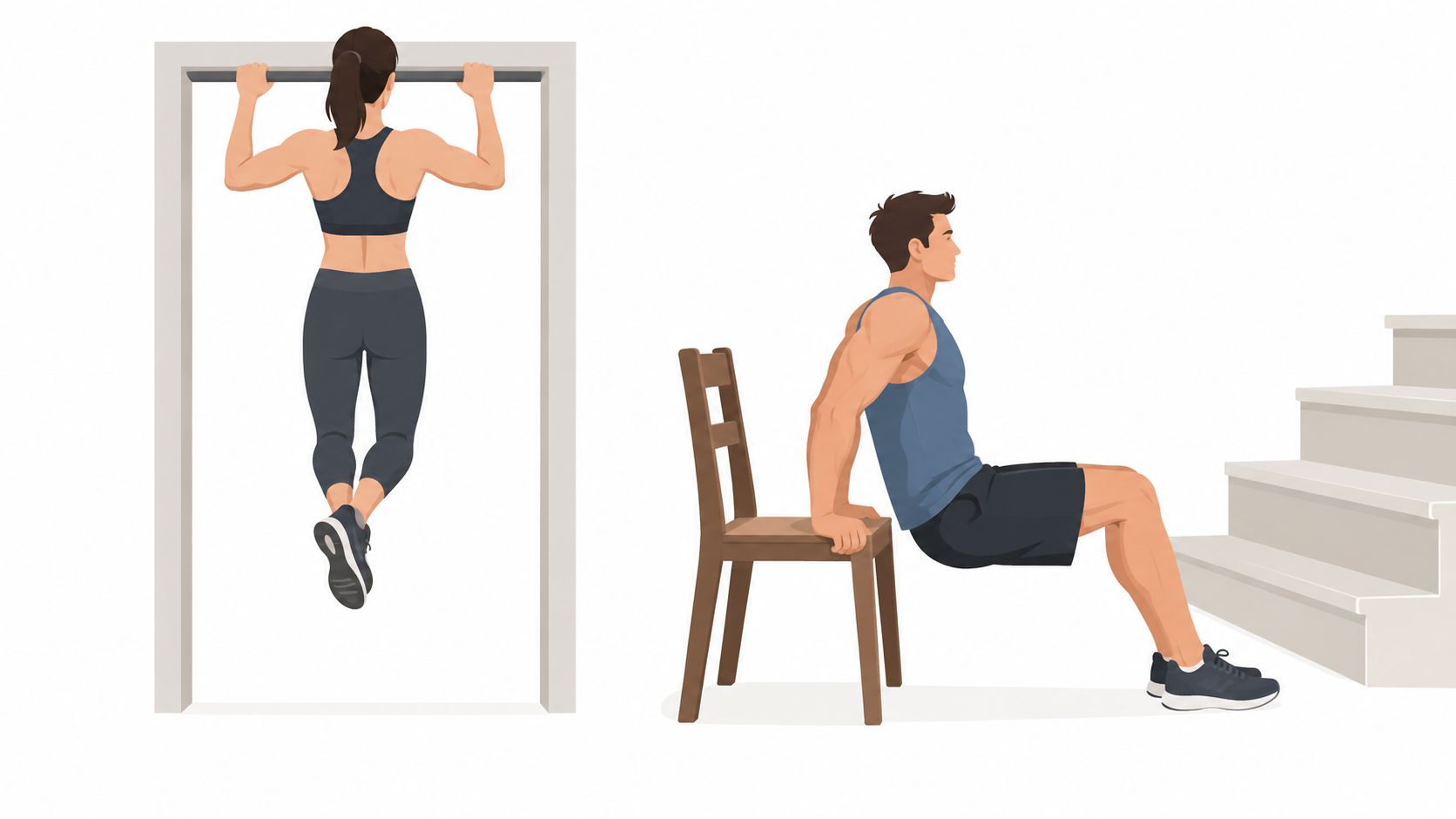
Strictly speaking, this approach uses household fixtures, not equipment-free training. It belongs in the plan because a doorway, stair, or stable chair can solve movement problems that floor exercises can't, especially the need for pulling and increased mechanical advantage.
Begin with a safety check before loading anything. A doorframe that flexes, a loose chair, or a slippery stair isn't a training tool. Test contact gradually, keep furniture against a wall when appropriate, and stop if the fixture shifts.
Build a fixture-based session
Use one movement from each line:
- Pull: Perform assisted pull-ups or rows only from a secure setup.
- Push: Use chair-supported dips or decline push-ups, with the chair stabilized.
- Legs: Perform step-ups on stairs, alternating the lead leg.
- Static strength: Add a wall sit or a supported hold.
The progression should come from cleaner repetitions, a longer range of motion, less assistance, or a slower tempo. Don't add difficulty by using an unsafe surface. A wall sit may be less exciting than a risky dip, but it gives you a controllable way to challenge the legs.
A doorway and chair bodyweight demonstration can help you visualize the setup. Keep the surrounding area clear, and avoid high-repetition work until you've tested the fixture with gradual pressure.
Once you've checked your setup, the following video can provide another visual reference for doorway-based movements.
5. Full-Body Workout Routines
A full-body routine suits days when your schedule leaves one reliable training window. Each session covers several movement patterns, so you can train consistently without maintaining a complicated weekly split. The trade-off is local fatigue. Pushing every exercise to failure can turn the final movements into rushed, low-quality repetitions.
Build the session around a simple sequence:
- Main upper-body movement: Begin with push-ups, rows, or pull-ups while your upper body is fresh.
- Lower-body movement: Follow with squats, reverse lunges, or step-ups that you can perform with stable balance.
- Core and supporting work: Finish with glute bridges, bird dogs, planks, or controlled dips.
For a busy day, complete push-ups and a safe row first, then perform squats before finishing with glute bridges and bird dogs. Use variations that allow clean repetitions and choose one target before starting. Improve the row while keeping the other movements steady, or add a little work to the squat without changing the entire session. This keeps progression measurable and fatigue manageable.
Keep a record of the complete workout. A bodyweight workout journal guide can help if you prefer logging sets rather than relying on memory.
Record the session as one substantial effort in SuperStrong, or list the main movements separately when you need more detail. A repeatable full-body plan is easier to sustain when each training day follows a familiar structure. On rest days, use gentle mobility, walking, or easy stretching to support recovery without creating another demanding workout.
6. Isometric and Static Hold Training
Static holds suit days when space, noise, or time is limited. Wall sits, planks, hollow holds, push-up pauses, and supported hangs build tension without repeated movement, so they work well in an upstairs apartment or a narrow room.
Use a hold that lets you breathe steadily and keep your alignment. A technically sound twenty-second plank provides more useful practice than a longer hold with a collapsed lower back. Set the wall sit at a knee angle you can control, and attempt a doorway hang only after checking that the surface and frame can support it safely.
Track quality before adding time. Increase the hold gradually only while your position stays stable. You can progress a plank from the wall to a raised surface and then to the floor. For a squat hold, lower the position after the easier angle feels controlled. A harder push-up pause can follow the same rule. Reducing rest between holds adds density, but use it only when you recover well enough to repeat clean efforts.
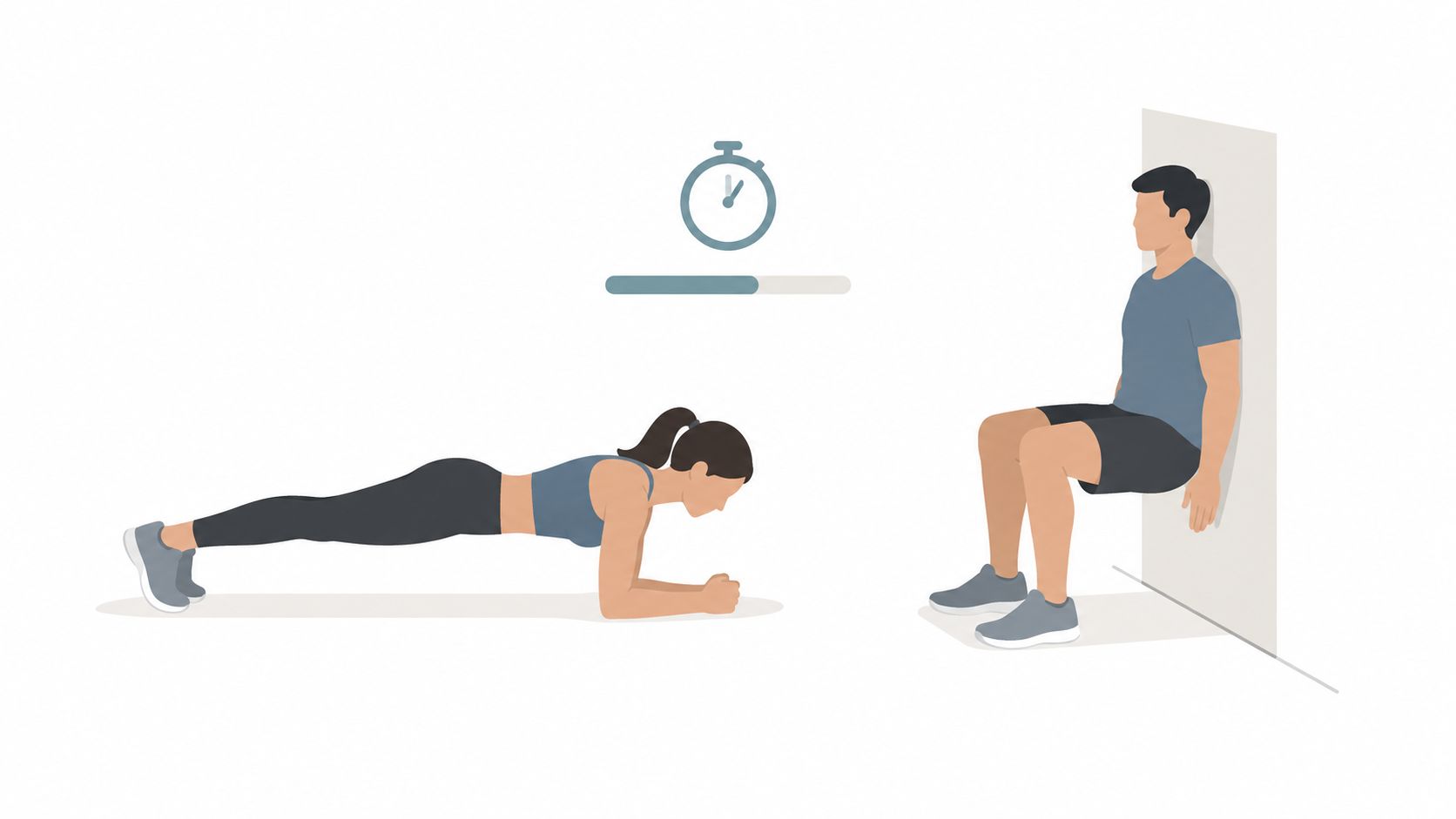
For a short, quiet session, perform a wall sit, a plank, and a hollow hold with controlled transitions. Stop if you feel pain, numbness, or sharp discomfort, and seek individualized guidance for an existing injury. Isometrics challenge a limited joint angle, so they cannot replace dynamic strength work through a full range of motion.
Combine one hold with one moving exercise when you need broader training. Pair a plank with controlled push-ups, or alternate a wall sit with reverse lunges. SuperStrong can record hold duration as a visible effort, while alignment and breathing still require your attention during each set.
7. Bodyweight Cardio and Conditioning Circuits
A conditioning circuit fits the gap between steady cardio and all-out HIIT. Keep moving at a pace you can sustain, letting your breathing rise without turning each round into a sprint. This approach suits busy days when you want cardiovascular work without maximal efforts or repeated hard landings.
For a small-room session, use high knees, mountain climbers, shadow boxing, and step-ups. Continue through the sequence at a moderate pace, then rest until your breathing is controlled enough to repeat it. Choose step-back burpees or marching versions if jumping irritates your joints or sends noise through the floor.
Set the session to match the setting:
- Quiet apartment: Use shadow boxing, marching, step-ups, and controlled mountain climbers.
- Small room: Keep every movement in place rather than traveling sideways.
- Strength blend: Insert push-ups, glute bridges, or squats between cardio exercises.
- Floor-based option: Follow this bear crawl exercise guide, provided you have clear space and your wrists tolerate the position.
Keep the pace repeatable
Track total time, completed rounds, or clean repetitions. A fast first round followed by poor form means the opening pace was too aggressive. Reduce speed or rest longer so the final round still looks controlled. The goal is a demanding session that leaves you able to train again, not complete exhaustion.
Log one measure after each workout. Increase duration or clean repetitions while keeping the circuit unchanged, then adjust the exercise selection when the format no longer challenges you. Schedule leg-heavy circuits away from demanding lower-body strength sessions if fatigue changes your technique.
8. Progressive Overload Bodyweight Progressions
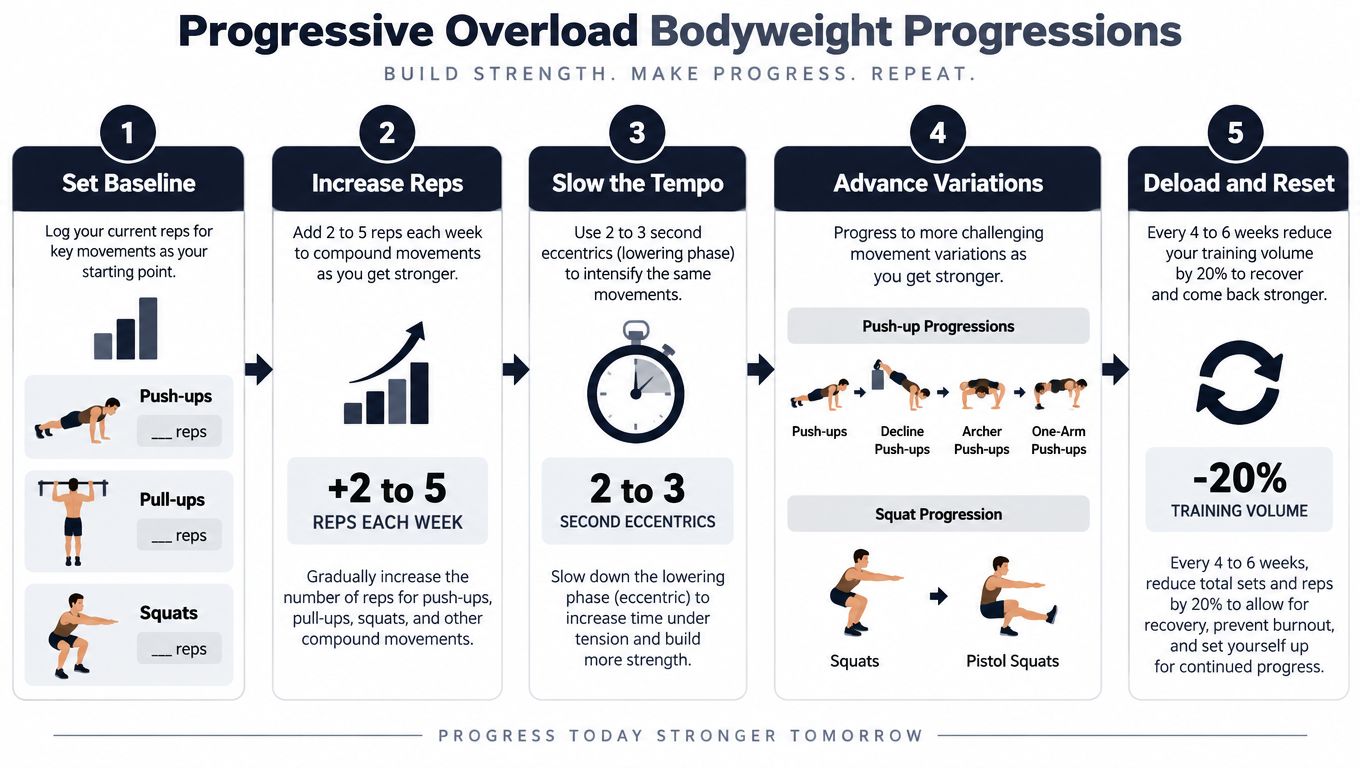
A bodyweight routine needs a clear next step once the current version feels easy. Progress does not require longer workouts. Change one demand at a time: body position, tempo, range of motion, pause length, assistance, or exercise variation.
Build progressions around the movement you already perform. Incline push-ups can move to floor push-ups, then decline or archer variations. Controlled squats can develop into split squats, single-leg work, and eventually a pistol-squat pathway. For pulling, reduce assistance before chasing more repetitions. Advance only when your range, alignment, and control remain consistent.
Use a single-variable progression
Keep the exercise familiar when adding repetitions. If you slow the lowering phase, leave rest and exercise selection unchanged for that training week. This isolates the reason for improvement and makes excessive soreness easier to trace.
A five-part record keeps the next session clear:
- Baseline: Write down the variation, repetitions, tempo, and assistance.
- Next target: Add a small amount of work or improve control.
- Quality check: Occasionally film a set to review range and alignment.
- Adjustment: Repeat the same level when technique has not caught up.
- Readiness: Progress only after the target feels repeatable across sessions.
Pulling requires more planning than pushing or squatting. A back-focused progression needs a secure row, hang, or pull-up setup. Check the fixture before loading it, and stop if it shifts or causes joint discomfort. If your room cannot support a safe pulling option, train the movements you can perform and recognize that a balanced long-term plan may require additional equipment.
Record small wins with SuperStrong's workout journal app. Tiles can show completed effort, while a personal-best badge marks a new result without requiring a complex graph. Use the log to choose the next manageable challenge, not to force a harder variation prematurely.
8-Method Comparison: At-Home No-Equipment Workouts
| Method | 🔄 Implementation complexity | Resource requirements | 📊 Expected outcomes / ⭐ | Ideal use cases | 💡 Key advantages / tips |
|---|---|---|---|---|---|
| Calisthenics Circuit Training | Moderate, sequence planning and form coaching | Bodyweight only; minimal floor space | Builds functional strength + cardio endurance; visible weekly progress · ⭐⭐⭐⭐ | Quick 5–15 min micro-workouts at home or office | ⚡ Fast setup; 💡 start with 2–3 exercises, rotate weekly |
| HIIT (High-Intensity Interval Training) | High, interval pacing and maximal effort management | Bodyweight; small clear area | Max cardiovascular/metabolic impact with afterburn · ⭐⭐⭐⭐⭐ | Busy professionals wanting max effect in 10–30 min | ⚡ Very time-efficient; 💡 use low-impact mods for joints or apartments |
| Push/Pull/Legs (PPL) Split | Moderate, requires exercise categorization and scheduling | Bodyweight; pull bar or creative alternatives preferred | Balanced muscle development; focused progression per session · ⭐⭐⭐⭐ | Users who want focused, structured 3×/week training | ⚡ Reduces decision fatigue; 💡 assign small, measurable goal per day |
| Minimal Equipment Strength (Doorway Workouts) | Low–Moderate, creative setup and safety checks | Household fixtures: doorframes, chairs, stairs, walls | Solid strength gains for most; limited heavy-load progression · ⭐⭐⭐ | Renters, travelers, apartment dwellers with no gym access | ⚡ Zero cost; 💡 safety-test fixtures and secure chairs before use |
| Full-Body Workout Routines | Moderate, exercise ordering and fatigue management | Bodyweight; modest space | Efficient whole-body stimulus supporting strength and recovery · ⭐⭐⭐⭐ | Beginners and busy users who train 3×/week for balanced gains | ⚡ High efficiency; 💡 do compound moves first and log session as one tile |
| Isometric & Static Hold Training | Low, simple positions but strict form needed | None/minimal space | Time-efficient strength at specific angles; low joint stress · ⭐⭐⭐ | Injury recovery, quiet apartment training, short holds between tasks | ⚡ Extremely time-efficient; 💡 increase hold time gradually, prioritize form |
| Bodyweight Cardio & Conditioning Circuits | Moderate, pacing and exercise sequencing | Space for movement; minimal/no equipment | Builds aerobic endurance and metabolic conditioning; sustainable effort · ⭐⭐⭐⭐ | Users prioritizing cardio/endurance without max-intensity sprints | ⚡ Sustainable cardio sessions; 💡 use step alternatives to lower impact |
| Progressive Overload Bodyweight Progressions | High, requires tracking, programming, and gradual progressions | Bodyweight; occasional simple props for advanced variations | Long-term measurable strength and hypertrophy gains; clear PRs · ⭐⭐⭐⭐⭐ | Users committed to continuous strength improvement and tracking | ⚡ Compounding gains over time; 💡 add 2–5 reps weekly, deload every 4–6 weeks |
Turn Small Sets Into a Repeatable Week
Choose the routine that matches the constraint you face. If your schedule breaks into gaps between calls, start with calisthenics circuits or exercise snacks. If noise is the issue, use isometric holds, marching, shadow boxing, and controlled strength work. If cardio is the priority, choose conditioning circuits before jumping into repeated all-out intervals. If strength is the priority, use full-body sessions or a focused split, then plan how you'll address pulling and progression.
Short sessions can produce meaningful outcomes, but their limits matter. A 2025 systematic review and meta-analysis found that exercise snacks improved maximal oxygen uptake and reduced body fat percentage, while body mass and triglycerides did not meaningfully change, as reported in the published review of exercise-snack research. That distinction keeps expectations realistic. A few minutes of movement can be valuable, but it isn't proof that every fitness goal can be solved with the same tiny routine.
Another study involving people living with type 2 diabetes found that four one-minute bouts of vigorous bodyweight exercise in a day produced small but statistically significant improvements in postprandial glucose regulation and glycaemic variability. The 2026 real-world study supports the practical value of breaking movement into everyday sessions, but it doesn't mean everyone should train vigorously after every meal or ignore medical advice.
Start with a rhythm you can protect
A three-day weekly rhythm is a sensible starting point for many people. For example, use full-body strength on the first day, quiet holds or mobility on the second, and a conditioning circuit on the third. When a full session won't happen, use a shorter set rather than abandoning the entire day.
Exercise-snack protocols are commonly described as brief one- to five-minute bouts repeated during long sitting periods, and reviews have associated them with improvements in measures such as VO2max, peak power output, total cholesterol, and LDL-C. The review of exercise-snack protocols also reinforces the value of repeatable movement rather than a single dramatic workout.
Progress one variable at a time. Add repetitions, extend a hold, slow the tempo, or choose a harder variation, but don't change everything together. If you're returning after a long break, have a health condition, or feel pain rather than normal effort, scale the routine and get qualified medical or exercise guidance.
SuperStrong is an optional tracking tool for iPhone users who want to log bodyweight sets, see effort accumulate on a shared wall with up to four friends, and celebrate personal bests without relying on streaks or complicated graphs. Its three-training-day and four-rest-day rhythm can provide a simple framework, while your actual routine should still reflect your fitness level, space, and recovery.
SuperStrong lets iPhone users log short at-home bodyweight sets as visual tiles, share progress with up to four friends, and mark personal bests as training accumulates. If you want a simple record for your next no-equipment routine, visit SuperStrong and start logging your first set.