How to Start Working Out Again After a Long Break in 2026
 14 min
Your workout clothes are ready, but you're still deciding what to do. The routine you remember feels too ambitious, the beginner workout feels almost embarrassing, and you don't want to spend the next several days struggling to get downstairs.
Learning how to start working out again after a long break means separating what you remember from what you can comfortably recover from today. Start with a manageable session, check your response, and earn the harder work. You don't need a comeback workout that proves anything.
Table of Contents
- Pick Your Starting Point by Break Length
- Set Goals You Can Hit in the First Month
- Micro-Workouts That Rebuild the Habit
- Tell Normal Soreness From a Stop Sign
- How to Progress Load Week by Week
- Keep Yourself Accountable on a Shared Wall
Pick Your Starting Point by Break Length
| Break length | Week-one plan | Sessions per week | Sets per movement |
|---|---|---|---|
| Under two weeks | Resume familiar movements with noticeably less total work than before | Alternate training and recovery days | Finish before fatigue changes technique |
| Two to six weeks | Cut back substantially and keep technique strict | Use nonconsecutive training days | Start with an easy set, then assess recovery |
| Two to six months | Take a comfortable walk and practise easy bodyweight movements | Separate strength sessions with recovery days | An easy introductory set |
| Over six months or after illness | Begin with short, comfortable walks and obtain clinical guidance when appropriate | Let symptoms, recovery and clinical advice set the schedule | Introduce movements individually, without straining |
Treat these break-length categories as planning prompts, not medical thresholds. A short holiday without training is different from time away because of surgery, persistent fatigue or illness. When circumstances overlap, choose the more cautious starting point.
Your break length should guide the opening workload more than your old personal best. Remembering how to squat doesn't establish how much squatting your knees and muscles currently tolerate. The familiar movement can make an excessive workload feel reasonable until afterward.
Record a baseline without testing your limits
Before your first workout, try this example baseline check once, provided you're well enough to exercise:
- Walk briskly for ten minutes, or stop earlier if it feels uncomfortable. Record whether you can speak comfortably.
- Try wall push-ups. Count only clean repetitions and finish before you strain.
- Hold a knee plank. Stop when you can't maintain your position or breathe normally.
- Try chair squats without pausing. End the set when you need momentum, your knees hurt or your technique changes.
Log the comfortable stopping point, not an all-out maximum. During the opening fortnight, treat those results as ceilings rather than targets to beat. If the baseline itself leaves you unusually sore, your workout should be easier.
Your previous fitness is useful experience, not permission to resume your previous workload.
The avoidable mistake is adding more because the opening set feels familiar. That can leave you too uncomfortable to repeat the session, which defeats the purpose of restarting.
Being able to speak in full sentences during the session and sleeping normally afterward are encouraging signs. Neither guarantees that the workload was appropriate, so also check how your joints and everyday movements feel before training again.
Set Goals You Can Hit in the First Month
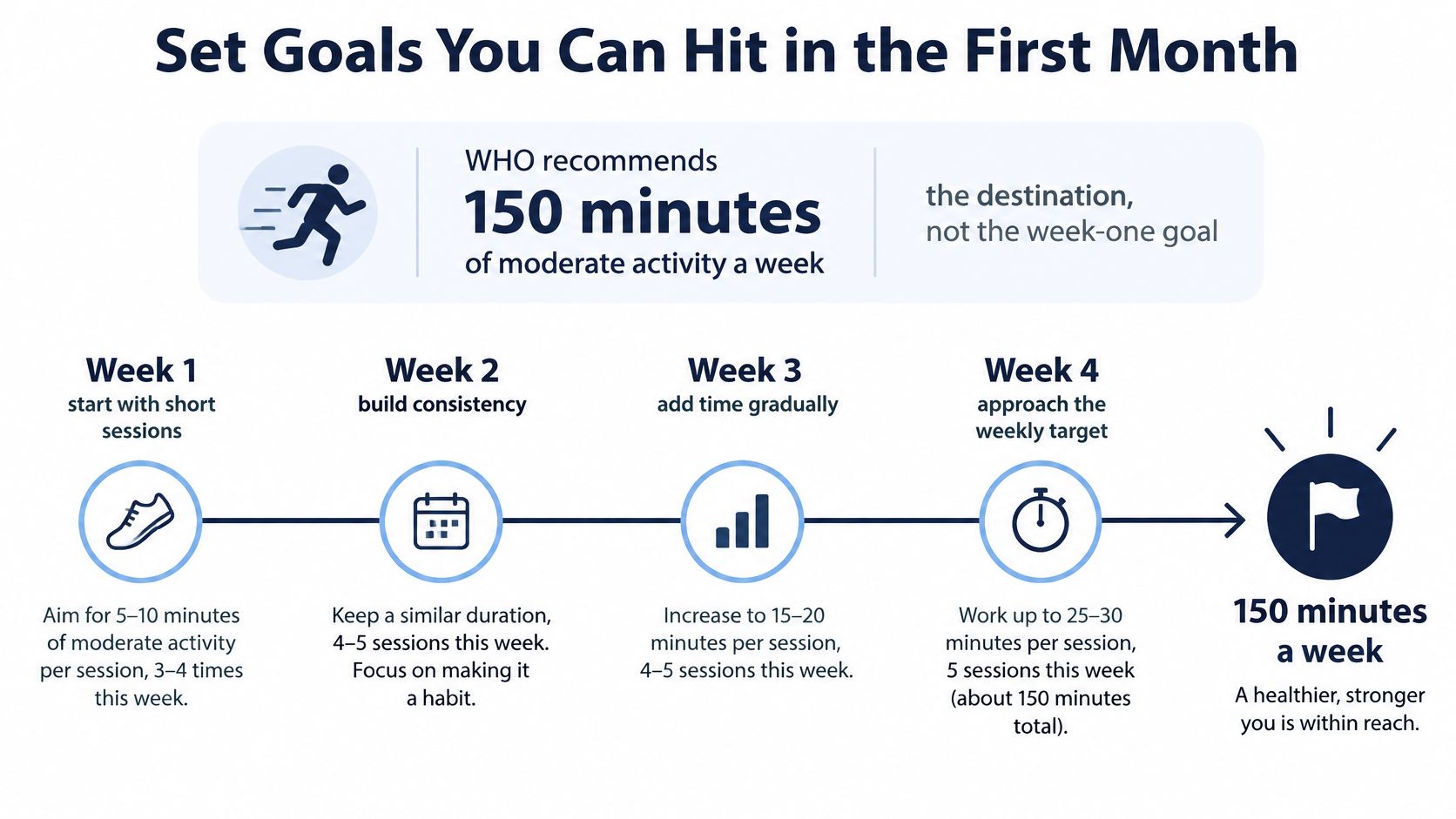
The World Health Organization recommends at least 150 minutes of moderate-intensity activity each week. That's a destination, not your opening assignment. You can rebuild activity through manageable bouts rather than forcing a demanding workout into every day.
Choose goals you can complete when work runs late. A plan that requires perfect energy, uninterrupted evenings and unusually good sleep isn't a useful restart plan.
Build a ladder you can adjust
The following is an illustrative schedule, not a requirement or a promise that everyone should progress this quickly:
- Week one: Schedule three ten-minute sessions on alternating days.
- Week two: Keep those appointments and extend them to fifteen minutes if recovery is comfortable.
- Week three: Try an additional short activity break, perhaps a lunchtime walk, without making the other sessions harder.
- Week four: Consider three sessions of twenty to twenty-five minutes, plus a comfortable fifteen-minute daily walk.
Use this visual as a reminder of the direction, not a deadline.
That example combines walking and strength practice. Don't automatically count every minute of resting between bodyweight sets toward your moderate-activity total. Keep the activity target separate from the habit of showing up.
Put completion ahead of performance
Write your training appointments into your calendar before starting. Include a backup window, such as after dinner if lunch disappears into meetings.
For this month, track completed sessions rather than pace or personal records. You can record repetitions to manage workload without making a higher number the definition of success.
If you miss a week because life gets busy, return to the last manageable schedule instead of compensating with extra work. If illness caused the interruption, reassess your readiness rather than assuming the calendar tells you what to do.
Micro-Workouts That Rebuild the Habit
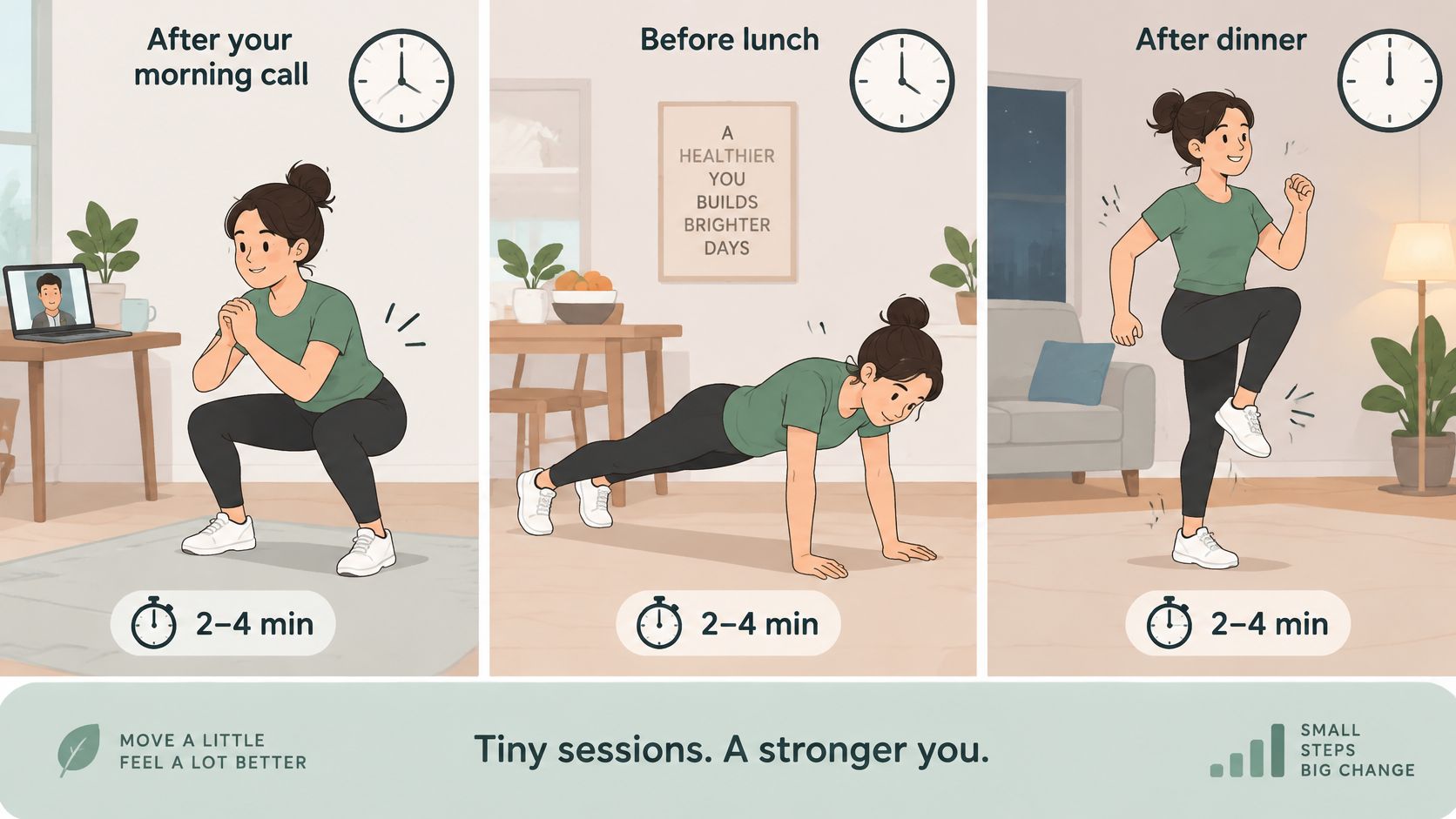
Say your day has no clear workout window. An example micro-workout day might include a comfortable chair-squat set after a morning call, a knee plank after lunch and wall push-ups before dinner. Each bout ends while you still feel in control.
The format is simple: attach a small amount of exercise to something already happening. You don't need to change clothes or turn every break into a circuit.
These movements illustrate how short bouts can fit between daily tasks.
A 2024 review indexed in PubMed found that exercise snacks appeared feasible and safe for adults and older adults, but the evidence consisted largely of small studies and other limited designs. Treat them as a practical re-entry method, not proof that brief bouts replace every benefit of structured training.
Choose movements you can control
Use this menu to select appropriate movements, not as a requirement to perform everything listed.
| Movement | Easy starting version | Starting sets | Rest between sets |
|---|---|---|---|
| Squat | Chair squat to a seat you can stand from without pushing off | An easy set | Until breathing and leg control recover |
| Push-up | Wall push-up, progressing to a stable kitchen counter | An easy set | Until you can repeat the same technique |
| Glute bridge | Comfortable bridge without arching your lower back | An easy set | Until the muscles feel ready |
| Row | Supported row using purpose-built equipment or a verified load-bearing setup | An easy set | Until grip and shoulder control recover |
| Dip | Assisted, shallow chair dip only if comfortable; otherwise substitute incline push-ups | An optional introductory set | Until shoulders feel settled |
| Plank | Knee plank with normal breathing | A comfortable hold | Until you can brace without straining |
| Pull-up | Foot-assisted pull-up on a securely installed bar | Optional assisted practice | Until grip and movement control recover |
Dips and pull-up lowering aren't automatically beginner exercises. If you can't control them comfortably, leave them out. Don't improvise rows from a loose doorframe or lightweight table.
For a movement demonstration, use the video as a reference rather than an instruction to match someone else's workload.
Move smoothly and finish with clean repetitions still available. Log completion, then return to your day instead of adding another round because you haven't broken a sweat.
The common traps are escalating because a short session felt easy and treating soreness as evidence that it worked. Choose additional exercise-snack examples for variety only after your starting movements feel manageable.
Tell Normal Soreness From a Stop Sign
Is this an ordinary muscle ache, or something you shouldn't train through? That decision matters more than whether you completed the planned repetitions.
Use the sensation, location and effect on movement to decide what happens next. This is a screening framework, not a diagnosis.
| Sensation | What It Usually Means | What to Do |
|---|---|---|
| Mild, fairly even muscle soreness that fades | A response consistent with unfamiliar exercise | Repeat or reduce the next session |
| Joint ache that appears during a set | The movement or load may exceed current tolerance | Stop that movement; only try an easier version if it's comfortable |
| Sharp, localized pain that gets worse | Possible injury | Stop that exercise and get it assessed if it persists |
| Chest pain, dizziness or unusual breathlessness | A possible medical warning sign | Stop; seek urgent help for severe, persistent or concerning symptoms |
| Numbness, tingling or swelling | A symptom needing assessment, not ordinary training soreness | Stop and consult a clinician |
Judge the pattern, not your toughness
Mild muscle soreness that settles is different from pain that becomes more focused or changes how you walk, reach or squat. Don't use warming up as an excuse to ignore a symptom that keeps returning.
Push-ups, dips and pull-ups can feel manageable to your lungs while asking too much of your shoulders or elbows. Comfortable breathing doesn't establish joint readiness. Short sessions also aren't a guarantee of broad health changes: a 2025 systematic review and meta-analysis found fitness benefits but no clear improvements in body composition, blood pressure or blood lipids.
Recovery check: If discomfort changes your movement, don't solve the problem by pushing harder.
Before repeating a movement, check that ordinary tasks feel normal, your sleep hasn't deteriorated and you're not unusually fatigued. Leave recovery time between strength sessions rather than repeatedly loading a sore movement.
Poor sleep or unexplained fatigue is a reason to hold steady or reduce work, not add difficulty. Persistent symptoms deserve professional assessment even when your log shows that you completed everything.
Speak with a doctor before starting if you have a medical condition, symptoms or prolonged inactivity, especially before vigorous exercise. Our policy is to check with a doctor before beginning an exercise programme: we provide a log, not coaching or medical advice.
How to Progress Load Week by Week
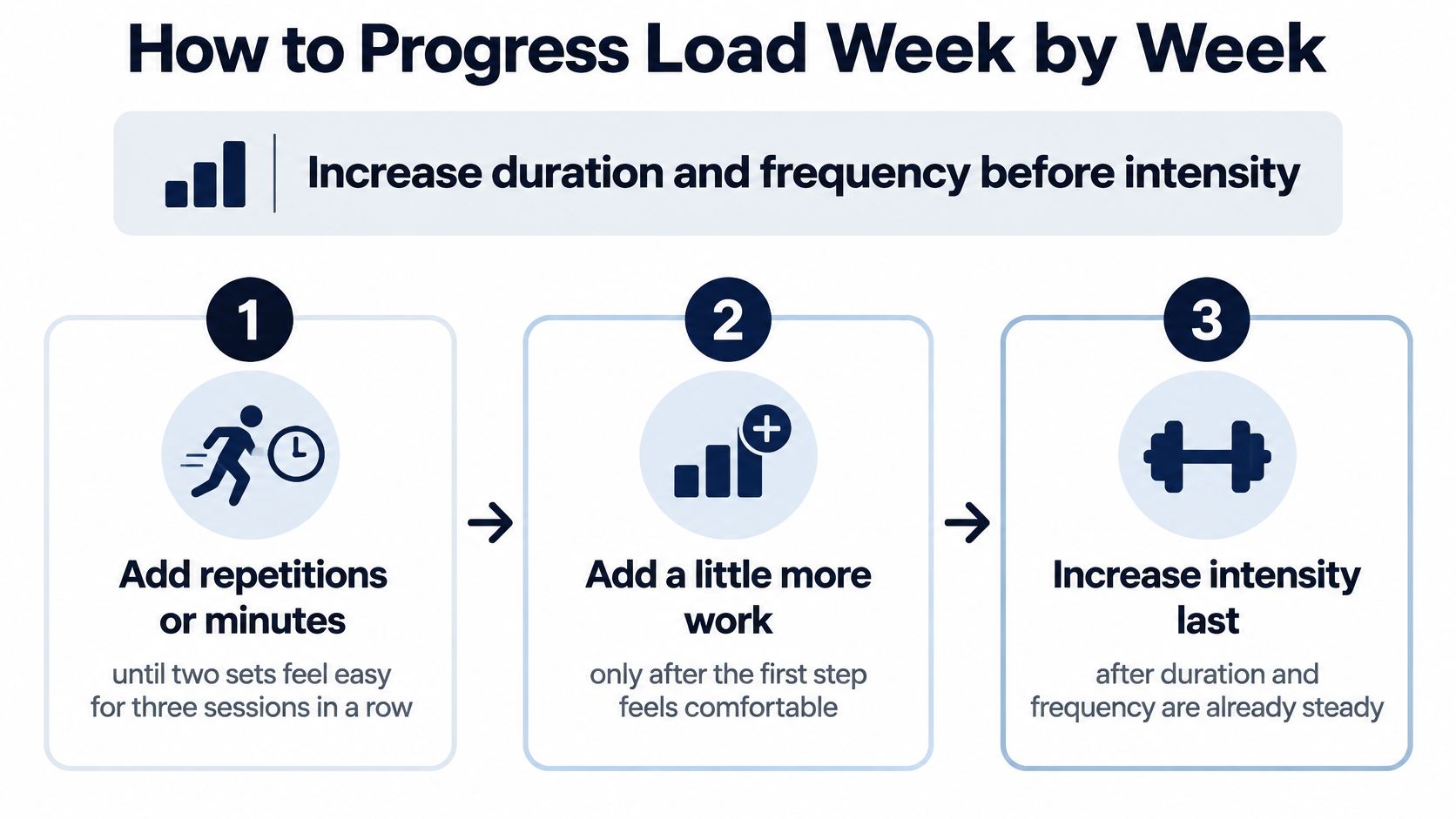
Increase duration and frequency before intensity. Stay with familiar, manageable movements while you build enough repeatable work to judge your recovery.
The U.S. Physical Activity Guidelines give a walking example: begin with five-minute walks several times daily, progress toward ten-minute sessions three times daily, and then gradually increase walking speed. The important distinction is the order, not a requirement to follow that exact schedule.
Change one variable at a time
Use this practical progression, adjusting the pace to your response:
- Add repetitions or minutes first. Extend a comfortable set or walk slightly while keeping the movement and effort similar. Don't turn the final repetition into a grind.
- Establish a repeatable schedule. Consider another activity day only after the existing schedule fits your life and you recover comfortably between sessions. That extra day can be walking rather than another strength workout.
- Add a set selectively. Increase work for a movement you recover from well, rather than adding sets to every exercise at once. Keep the other movements unchanged so you can identify what caused any setback.
- Make the movement harder last. Progress from wall to counter push-ups, use a lower stable incline, or adjust a row's body angle. A slower lowering phase also increases the demand, so don't combine it with extra repetitions and sets.
This visual summarizes the progression order.
Make the next session an informed decision
Suppose counter push-ups feel controlled and your shoulders feel normal afterward. At the next suitable session, you could add a little work while leaving the incline unchanged. If you also lower the support and shorten your rest, you won't know which change was too much if discomfort follows.
Warm up with comfortable walking and easy practice versions of the movements you're about to perform. The warm-up is preparation, not another workout to exhaust yourself through.
You don't need equipment purchases to create every progression. Understanding whether bodyweight training is enough helps you distinguish useful increases in difficulty from collecting more exercises.
Last year's numbers can remain a longer-term ambition, but they shouldn't determine today's starting load. Your present movement quality and recovery are more useful than an old training record.
Move to the harder week when the current week feels easy. If a joint complains, don't advance the calendar and hope your body catches up.
Repeating a manageable week gives you more practice without forcing an increase. Reducing the workload after a difficult week is also a training decision, not a failed comeback.
Keep Yourself Accountable on a Shared Wall
A visible commitment gives friends something concrete to support. Instead of announcing that you're getting fit again, agree to share completed sessions, including the unremarkable ones.
A 2024 systematic review indexed in PubMed reported adherence of at least 92% in the five studies that measured adherence to supervised or unsupervised physical-activity-snack interventions. That supports the practicality of short bouts, but it doesn't establish that a shared wall causes adherence.
Agree on what support looks like
Set up your group around attendance rather than competition:
- Choose supportive people. Invite friends who won't turn an easy session into a contest.
- Agree on a small minimum for training days, with room to reduce it when recovery requires.
- Share completion, not rankings. A controlled introductory set deserves acknowledgement.
- Post a short note when a session was difficult to fit in. That context matters more than pretending every workout felt effortless.
A visible gap can prompt a helpful check-in, but it can also feel like shame. Agree that missed sessions get reported without a lecture and resumed at the next appropriate opportunity. Don't reward only bigger workloads.
Keep logging simpler than training
SuperStrong is an iPhone app that records bodyweight sets as tiles on a wall shared with up to four friends. To log a set, tap the big key, pick the exercise, set repetitions or seconds for a hold, and confirm. The tile lands beside the others.
Use the bodyweight workout journal approach to record enough context to make the next decision sensible, especially when you changed a movement or felt discomfort.
Keep the opening-week decision straightforward: advance when the work feels easy and recovery is comfortable. If it felt like a fight, repeat or reduce it rather than trying to impress the group.
SuperStrong gives you a simple way to record short bodyweight sessions and share the effort with friends while you rebuild your routine. Visit SuperStrong, choose a manageable starting goal, and log your first comfortable set instead of chasing your old best.