Knees to Elbow Exercise: Form, Progressions and Logging
 16 min
You opened a workout and saw knees to elbow sitting next to push-ups, and you are not sure if that means a crunch on the carpet, a knee drive from a plank, or hanging from a bar until your grip fades. That mix-up is where many people start. The label covers three different exercises, and the wrong one pinches a shoulder, a wrist, or the lower back before the abs ever get tired.
I would choose the version you can already control, then count only the reps that still match the first one. A sloppy twentieth rep is not the same exercise as a clean fifth. Separate the versions first, then use the cues, the ladder, and a log that records what you did.
Table of Contents
- Choose the Knees to Elbow Version You Can Do Safely
- Floor and High-Plank Knee-to-Elbow Form
- How to Do a Strict Hanging Knee-to-Elbow Rep
- Progressions and Regressions by Skill Level
- Common Mistakes and How to Fix Them
- Sets and Reps for Micro-Workout Routines
- Logging Each Set in the iPhone App
- Start Your First Strict Session Today
Choose the Knees to Elbow Version You Can Do Safely
Knees to elbow is not one standardized move. A Zing Coach exercise guide shows at least two patterns under the same name, a hanging variation from a pull-up bar and a high-plank variation where the knee travels toward the same-side elbow. Home workouts add a third, the floor knee-to-elbow sit-up, where the torso rises and twists so one elbow approaches the opposite knee.
| Version | Equipment | Main demands | Start here if |
|---|---|---|---|
| Hanging knees to elbows | Pull-up bar | Grip, scapular control, trunk compression, hip flexors | You can hold an active hang and raise your knees with control |
| High-plank knee to elbow | Floor only | Shoulder support, anti-rotation, hip mobility | You can hold a straight, controlled 30-second plank |
| Floor knee-to-elbow sit-up | Floor only | Abdominal and oblique work, hip flexors, lumbar control | You can do a controlled crunch without pulling on your neck |
The plank version asks for sustained shoulder support, anti-rotation, and hip mobility. The hanging version stacks grip, scapular control, and full bodyweight suspension on top of the trunk work. The floor sit-up stays on your back, so it is the choice when you have no bar and a plank still shakes.
Three questions people bring to the first session
No bar. Use the floor sit-up. Move to the high-plank knee drive only after the plank test is already easy.
Easiest regression. A slow crunch with the hands off the neck, or a short hollow shape on the floor, comes before any hang.
When to stop. End the set at the first sharp shoulder, wrist, or back discomfort. Muscle burn in the abs is the work. Joint pinch is the exit.
That same guide recommends a straight, controlled 30-second plank before the plank variation. For the bar, I would wait until you can hang with the shoulders pulled down, not shrugged into the ears. Pick the row your strength supports and stay there until the standard feels ordinary.
Floor and High-Plank Knee-to-Elbow Form
Use these steps when the bar is the wrong tool today. Both versions live on the floor, but they load the trunk in opposite directions, one from your back and one from a supported plank.
Floor knee-to-elbow sit-up
- Lie on your back with the knees bent and the feet flat. Rest the hands lightly at the temples or across the chest. Never pull the neck.
- Brace, then lift the shoulders while the lower back stays controlled. The legs should not slide or kick.
- Rotate so one elbow travels toward the opposite knee. Slow enough that the hips do not twist with you.
- Pause briefly at the top, then lower to the start before you switch sides.
A moderate knee bend beats locking the legs straight or yanking them flat. Joint angle and the twist decide which muscles work, so chase a smooth rotation, not a knee tap at any cost.
High-plank knee to elbow
- Set a high plank with straight arms stacked under the shoulders and the hips level. If that shape collapses, go back to the push-up position plank until the line holds.
- Drive one knee toward the same-side elbow without letting the hips spin open, then place the foot and switch sides.
- Pass the plank entry test before you add knee drives. If the shoulders shrug or the lower back sags in the hold, the knee drive will only magnify that fault.
Practical rule: If the hips rotate to "help" the knee reach the elbow, the rep does not count. Shorten the range until the pelvis stays square.
These floor patterns do not transfer their setup to a hang. Treat them as their own exercises, with their own standard, not as a warm-up you rush through on the way to the bar.
How to Do a Strict Hanging Knee-to-Elbow Rep
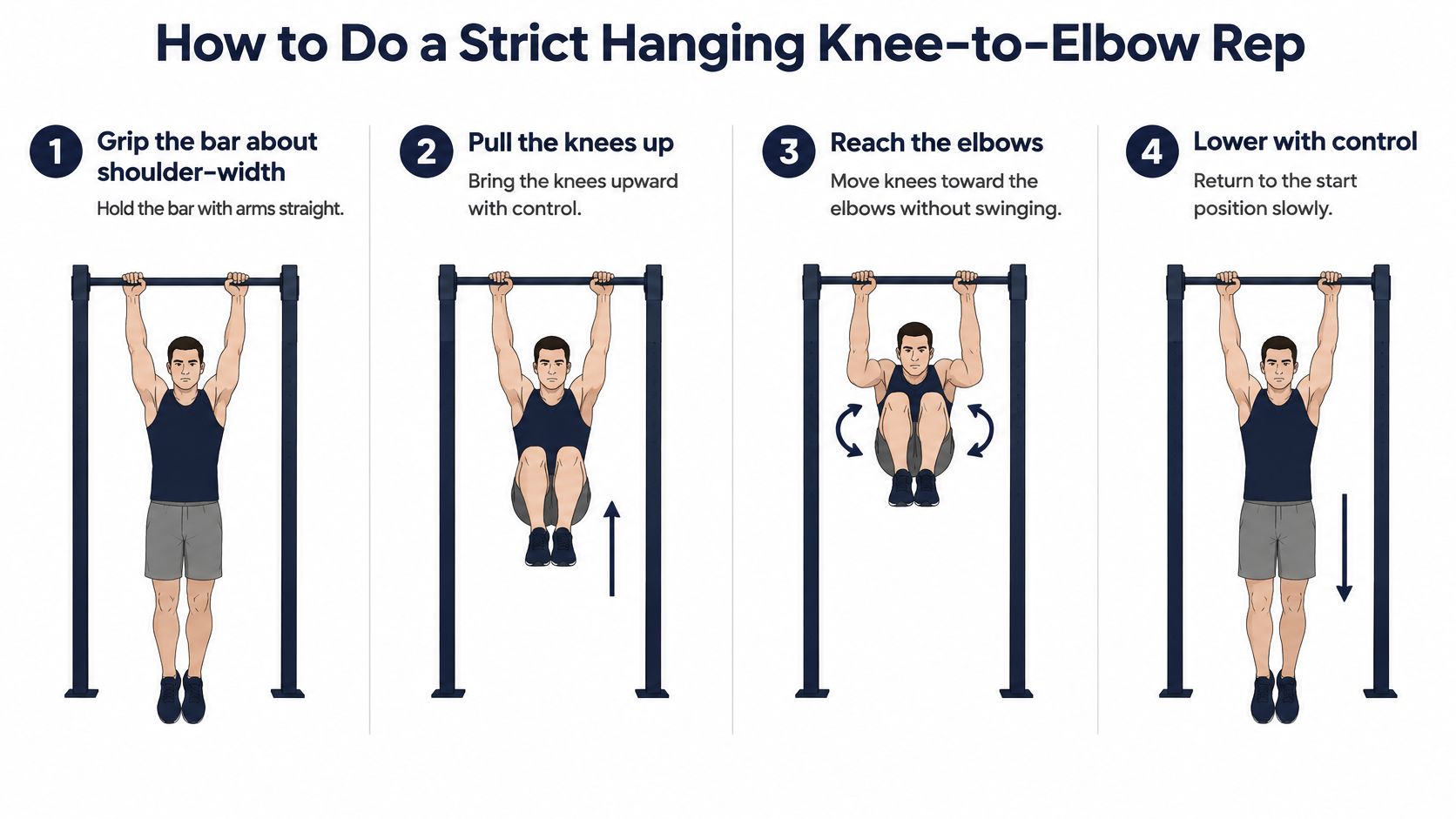
Strict hanging knees to elbows is the version most logs mean, and it is the one that falls apart when people chase reps. A CrossFit gymnastics seminar guide starts the rep from a controlled active hang, straight arms, shoulders depressed, trunk braced, and a hollow-body shape already set.
The rep, in order
- Grip about shoulder width with straight arms, then pull the shoulders down away from the ears. That active hang is the start, not a dead hang you fix later.
- Brace and hollow by drawing the ribs down so the lower back stays controlled. The guide notes that many lifters struggle to raise the knees without the hollow and the lats, and that the same action gets easier once both are on.
- Set the lats before the knees move, so the torso does not swing open as the legs rise. A stable bar setup, the kind you build for a pull-up bar with dips, matters here because a loose shoulder turns the rep into a pendulum.
- Compress the hips, bend the knees, and curl the pelvis so both knees meet the arms near the elbows. Cue ribs toward pelvis, knees high, and curl the pelvis. The posterior tilt is what brings the knees up. Swinging the legs only looks like the same finish.
- Exhale as the knees rise and keep any swing small. If the body rocks, the hip angle never really closed.
- Lower under control and inhale as the legs and arms return to the start. Do not drop into a passive hang between reps.
A rep you can log shows visible contact at elbow level, then full extension before the next one starts. Anything short of that overstates the volume. There is no validated global success-rate benchmark for this skill, so do not treat a percentage as a target. Record strict, scaled, and kipping reps as separate exercises.
Build it in that order too. Hollow control on the floor, then supported or partial-range knee raises, then strict knees to elbows, and only afterward a small kip. The principal misses are a passive shoulder hang, a big lumbar arch, bent elbows that shorten the range, and legs that swing instead of closing at the hip. Each one cuts the trunk demand and makes two people's rep totals impossible to compare.
Progressions and Regressions by Skill Level
Treat strict knees to elbows as a high-skill pull-and-compression pattern. A beginner who cannot keep the ribs down, the shoulders active and the legs under control gets more from an easier rung than from a rep target. Healthline's hanging knee raise guidance gives a reasonable starting point for basic sets; the quality gate below decides whether you advance.
| Level | Variation | Sets x reps | Move up when |
|---|---|---|---|
| Starting | Hollow-body hold on the floor | 3 x 20-30 seconds | The shape holds with no lumbar arch for the full time |
| Regression | Hanging knee raises | 3 x 5 | The hang stays active and each knee raise is controlled |
| Regression | Supported captain's chair knee raise | 3 x 5 | The full range is controlled and the trunk stays stable |
| Intermediate | Strict knees-to-elbows | 3 x 3-5 | Every rep reaches elbow-level contact and full extension |
| Target | Strict knees-to-elbows | 3 x 8-12 | Every rep looks identical from the first to the last |
| Harder | Straight-leg raises or toes-to-bar | 3 x 3 | The target strict set is clean across several sessions |
Start strict work at 3 sets of 3-5 and stop the set when grip, shoulder position or pelvic control slips. Move toward 3 sets of 8-12 only after every rep hits the same contact and the same extension. If that quality is not there, drop to hanging knee raises, partial-range raises, or a supported captain's chair, then retest strict reps after several sessions.
What makes a rung harder
Lever length. Straighter legs and a longer reach to the bar raise the load on the hip flexors and the grip. A bent-knee raise is not a lesser exercise if it is the version you can keep strict.
Shoulder stability and pelvic control. A shrug or an anterior tilt steals the rep from the abs. The costly fault is swapping lumbar extension for real abdominal compression.
Hamstring flexibility. Tight hamstrings pull the pelvis into that arch as soon as the legs straighten, which is why straight-leg raises and toes-to-bar come last.
Do not advance two rungs at once. A beginner who can hold a hollow shape and do controlled hanging knee raises but cannot touch elbows should stay on knee raises until contact is repeatable. Rep totals mislead here: five strict contacts at elbow level tell you more than fifteen high knee raises that never reach the arms.
Good coaching practice is to count a set only when every rep looks technically identical, and to scale when that standard will not hold. For a group challenge, consistency beats a max set. Use the quality gates and labels in the table instead of a population percentage.
Common Mistakes and How to Fix Them
A rep can look busy and still train very little. On the floor, joint position matters as much as the touch. A biomechanics study of the knee-to-elbow sit-up found the strongest abdominal activation when the lower-leg angle to the ground was about 48–64 degrees, with the rectus abdominis and both obliques reported as maximally activated in that range. The same paper's overall recommended lower-extremity angle was about 42–64 degrees. Those numbers belong to the floor sit-up, not to a hang, and they argue for a controlled twist instead of a rushed tap.
On the bar, match each fault to one fix.
- Passive shoulders: Pull the shoulders down before every rep, or the lats never get a chance to hold the torso.
- Excessive lumbar arch: Brace first, then use a posterior pelvic tilt so the ribs move toward the pelvis.
- Bent elbows: Straighten the arms before the rise. Bending them shortens the range and inflates the count.
- Swinging legs: Slow the tempo and keep the swing small so the hip angle closes.
- Anterior tilt instead of compression: Curl the pelvis. If the belly dumps forward, you left the abs out of the rep.
- Reps that never reach the elbows: Count only full contact plus a full return. Partial lifts go in a different column.
Film one set from the side and freeze the top. If the knees are still below the elbows, that rep stays off the log.
When fatigue shows up as momentum, slow down or drop a rung. Adding reps on top of a broken pattern only practices the mistake.
Sets and Reps for Micro-Workout Routines
An exercise snack is a short bout you repeat across the day, not a second full workout squeezed into a lunch break. A 2025 meta-analysis of 27 studies and 970 participants found that exercise snacks improved maximal oxygen uptake and several cardiometabolic measures, but did not significantly reduce body mass. Expect fitness and consistency. Do not expect the scale to move because you added knees to elbow between calls. Protocols in that literature differ in duration, intensity, and frequency, so pick one row and keep it for a few weeks.
| Routine | Sets x reps | Rest between sets | When to use it |
|---|---|---|---|
| Strict beginner snack | 3 x 3-5 | 60-90 seconds | Early weeks, or after a break |
| Progression snack | 3 x 8-12 | 90 seconds | Only when every rep meets the standard |
| Regression snack | 3 x 5 hanging knee raises | 60 seconds | When strict form breaks down |
| Quality-first snack | 2 x 3 strict reps | 2 minutes | Days with several short bouts |
More reps are not automatically better. Fatigue shows up as hip rotation, shoulder collapse, momentum, or a lumbar arch before the target muscles get useful work. Stop the set at the first of those signs, even if the plan still has reps left.
How the snacks fit a day
Pair this pattern with a push, a pull, and a lower-body snack rather than stacking four ab bouts. On a high-frequency day, use the regression or the quality-first row so the later sets still look like the early ones. Rest is part of the prescription. The two-minute gap on a quality-first day is there so the third rep does not become a swing.
I would rather log two clean snacks than one long set that unraveled. The training effect lives in the reps you could still recognize on video.
Logging Each Set in the iPhone App
A strict set that never gets logged is a set you will second-guess by Friday. Log during the day, between tasks, while the reps are still fresh. That habit also catches the set you meant to do and then talked yourself out of.
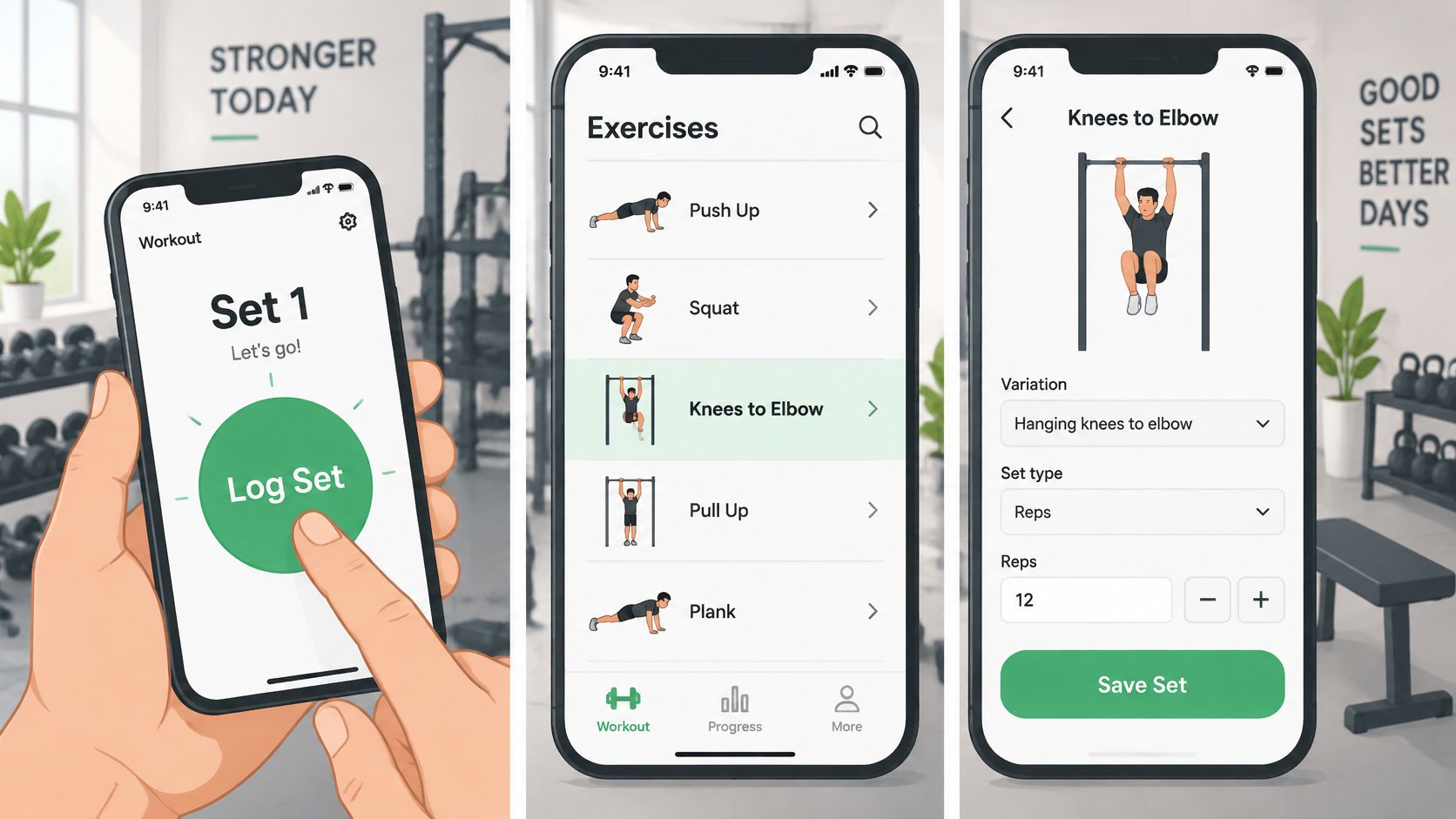
- Tap the big key.
- Pick knees to elbow, or the variation that matches what you did.
- Set the reps, or the seconds for a timed hold such as the hollow-body shape.
- Confirm, and the tile lands on the wall.
Tile size follows reps, so the wall shows at a glance whether the set was short or long. Count only reps that met contact and full extension. If the set breaks down on rep four of a planned five, log four. A target written in advance is not a completed set. The same rule belongs in a bodyweight workout journal: the number on the page should be the number a side-view video would agree with.
Keep the hanging version and the floor version as separate entries. Mixing them makes a week look stronger than the shoulders were. Keep a short training note outside the app with the version, the sets, the reps you finished, and one cue that worked, such as "curl the pelvis." The tile is the shared record; the note is where you track the cue.
When the current week feels easy, move up to the harder week of the plan. Friends on the shared wall see the tiles, which is useful on the day you would otherwise skip. The video below walks through the app's basic logging steps.
Start Your First Strict Session Today
Do one session today with the version your entry test already allows.
- Choose the floor sit-up, the plank knee drive, or the hang based on that test, not on the hardest name in the list.
- Start on the regression your strength can hold, even if that is a hollow shape or a captain's chair.
- Do 3 controlled sets and log the reps you finished, not the reps you hoped for.
Check again after two or three weeks. Move up one rung only when the rep standard holds in every set, and retest after a few sessions if the shape has slipped. No specific result is guaranteed beyond showing up with a standard you can repeat. SuperStrong is an iPhone app that logs bodyweight sets as tiles on a wall shared with up to four friends, which is a simple place to keep this pattern honest.
SuperStrong turns short knees to elbow sets into tiles on a private wall, so a strict snack between tasks stays visible to you and up to four friends. The app is built for at-home bodyweight work, including a Core / abs focus challenge when this pattern is the day's main trunk piece. Open SuperStrong and log the first set that meets your standard.