Crab Walk Workout Guide for a Quick Home Session
 13 min
You've closed the laptop between calls, but there isn't time to change clothes or start a full workout. There's a clear patch of floor beside the sofa, and you'd like to do something more useful than another distracted stretch. A crab walk workout can fit that gap, provided you treat it as controlled strength practice rather than a race across the living room.
Table of Contents
- Why the Crab Walk Belongs in a Short Home Session
- Setting Up the Reverse-Tabletop Position
- What the Crab Walk Actually Trains
- Safety Cues and Common Execution Mistakes
- A Short Crab Walk Workout You Can Do at Home
- First-Week Checklist and Quick-Start Plan
Why the Crab Walk Belongs in a Short Home Session
The appeal is practical: get down on the floor, support yourself on your hands and feet, and move deliberately. You don't need dumbbells or a complicated circuit. You do need enough attention to notice where your weight goes, which makes this a useful break from sitting and staring at a screen.
The home version doesn't have to look athletic to be worthwhile.
A Familiar Movement With an Unfamiliar Feel
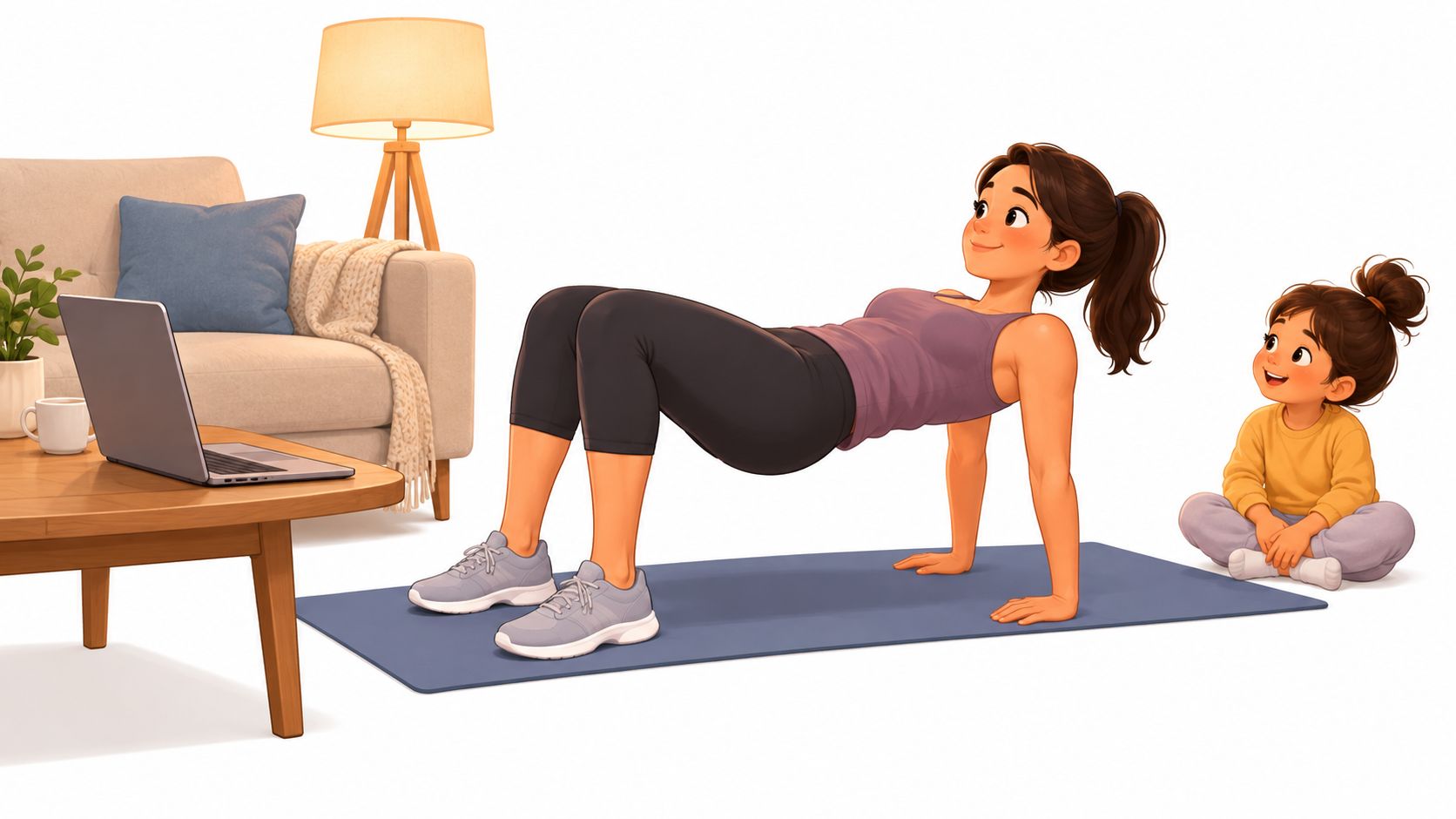
If you remember crab walking in school, the basic idea hasn't changed. Ophea's physical-education guidance describes squatting down, putting the hands behind the body with fingers pointed away, keeping only hands and feet on the floor, and moving backward. The reverse-tabletop setup below uses a seated entry and a slightly different hand-position cue.
The awkwardness usually comes from having your support behind you rather than in front. You can't watch every contact point, and trying to think through each limb separately can make the movement feel more complicated than it looks. Give yourself permission to practice instead of trying to look smooth immediately.
Practical rule: Choose a clear, nonslip patch of floor before choosing how far you'll travel.
For a short home session, the main advantage is combining several demands without changing equipment or stations. But that doesn't make crab walking a complete strength program, and it isn't automatically the right choice for someone whose wrists or shoulders dislike the starting position.
There are also different exercises hiding under the same name. The bodyweight crab walk is the belly-up movement covered here. The banded variation involves upright, squat-based lateral stepping, and it deserves its own programming decision rather than being treated as the same exercise with extra resistance.
Setting Up the Reverse-Tabletop Position
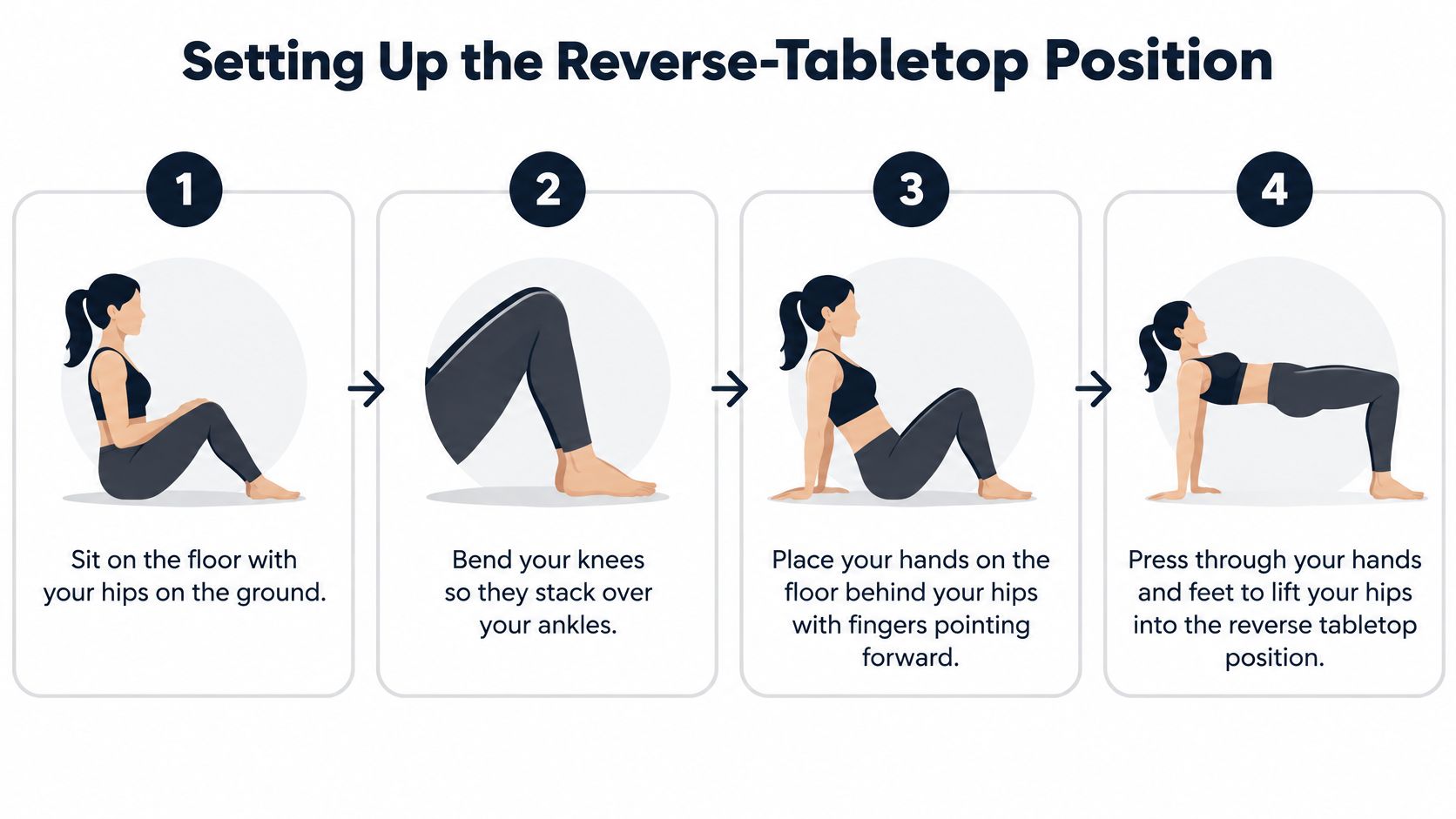
Sit with your knees bent and feet flat. Plant your hands behind your hips, with fingers facing forward or slightly outward, then press through your palms and feet until your hips clear the floor by a few centimeters. These setup cues, along with the alternating movement pattern, are described in Bustle's crab walk exercise instructions.
Use the illustration to check your starting arrangement, not to chase the highest possible hip position.
Find the Alternating Rhythm
Keep your chest open, elbows softly bent, and neck neutral. Brace your abdomen and glutes before you travel, then move your left hand with your right foot, followed by your right hand with your left foot. Think of shifting your support across the floor rather than reaching for distance.
If the coordination disappears, sit down and restart. There's no benefit in continuing a tangled sequence just to avoid interrupting the set. A clean reset is part of learning the movement, not evidence that you've failed it.
This demonstration can help you connect the setup to the traveling pattern.
Choose a Manageable Dose
The practical starting benchmark is approximately 15 feet per direction or 20 total steps, followed by 15–30 seconds of rest, with two to three rounds. Treat those alternatives as ways to organize practice, not a distance and step count you must both complete.
- Use distance when space allows. A clear hallway makes it easier to keep traveling without frequent turns.
- Use steps in a smaller room. Don't lengthen your stride just to reach an imaginary finish line.
- Delay backward travel if needed. Establish a repeatable forward pattern before adding another coordination challenge.
Those programming benchmarks belong to the same exercise guidance cited above. Steady hip height and controlled weight transfer matter more than finishing the prescribed amount, so stop early when the next step would require a scramble.
What the Crab Walk Actually Trains
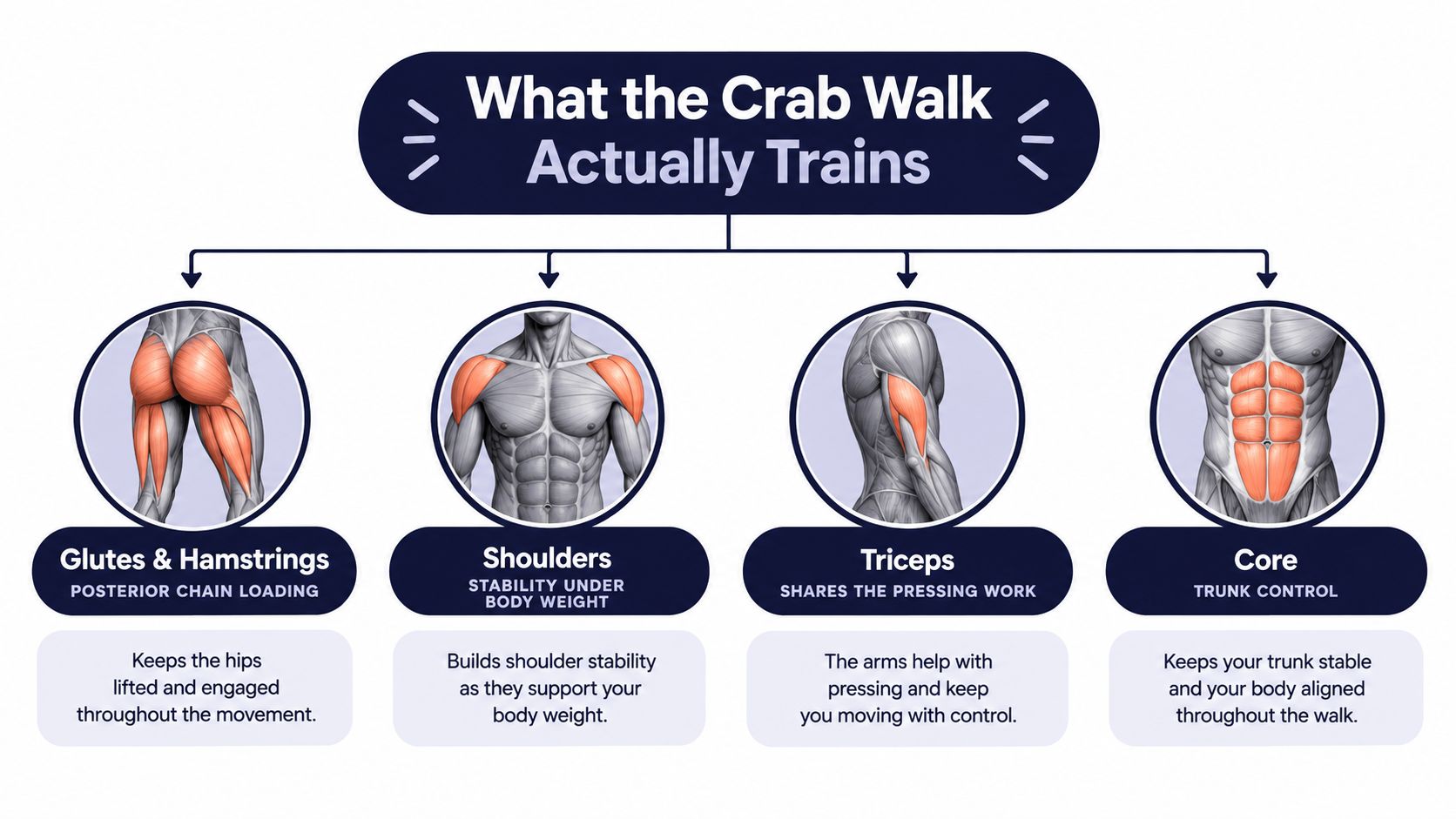
The bodyweight version is best understood as shoulder support, hip extension, and trunk control performed while traveling. Your arms share the load with your legs, and your trunk has to resist unwanted rotation as opposite limbs move. That combination explains why a short length of floor can provide plenty to concentrate on.
The muscle map is useful, but it shouldn't be read as proof that every highlighted area receives the same training stimulus.
Integration Rather Than Isolation
Think of the lifted hips as the lower-body task, the supporting arms as the upper-body task, and the alternating steps as the coordination task. The posterior-chain emphasis involves the glutes and hamstrings, while the shoulders and triceps share the supporting work. In practice, whichever part feels least familiar may limit the set before the others feel particularly challenged.
That's a coaching reason to avoid judging the exercise only by how much your glutes burn. If the goal is coordinated whole-body support, the bodyweight version makes sense. If you want to focus more directly on resisted hip-abductor work, the banded version is a different tool.
What the Banded Research Actually Shows
A 2019 laboratory study of 22 healthy adults found that gluteal activation during resisted lateral stepping increased as band placement moved from the knees to the ankles and then the feet, as summarized in TrustMe-Ed's explanation of the crab-walk study. Foot placement produced greater gluteus maximus and gluteus medius activity than knee placement; compared with ankle placement, it increased gluteal activity without increasing tensor fasciae latae activity.
That study examined a lateral, squat-based band exercise, not the reverse-tabletop walk. It measured muscle activity, so it doesn't establish long-term strength gains or prove that the belly-up version produces the same response.
Choose the variation for the job. A shared exercise name doesn't make the training demands interchangeable.
For another way to explore floor-based locomotion, use this guide to bear crawl exercises. Treat it as an alternative movement choice, not an obligation to cram every animal pattern into the same short session.
Safety Cues and Common Execution Mistakes
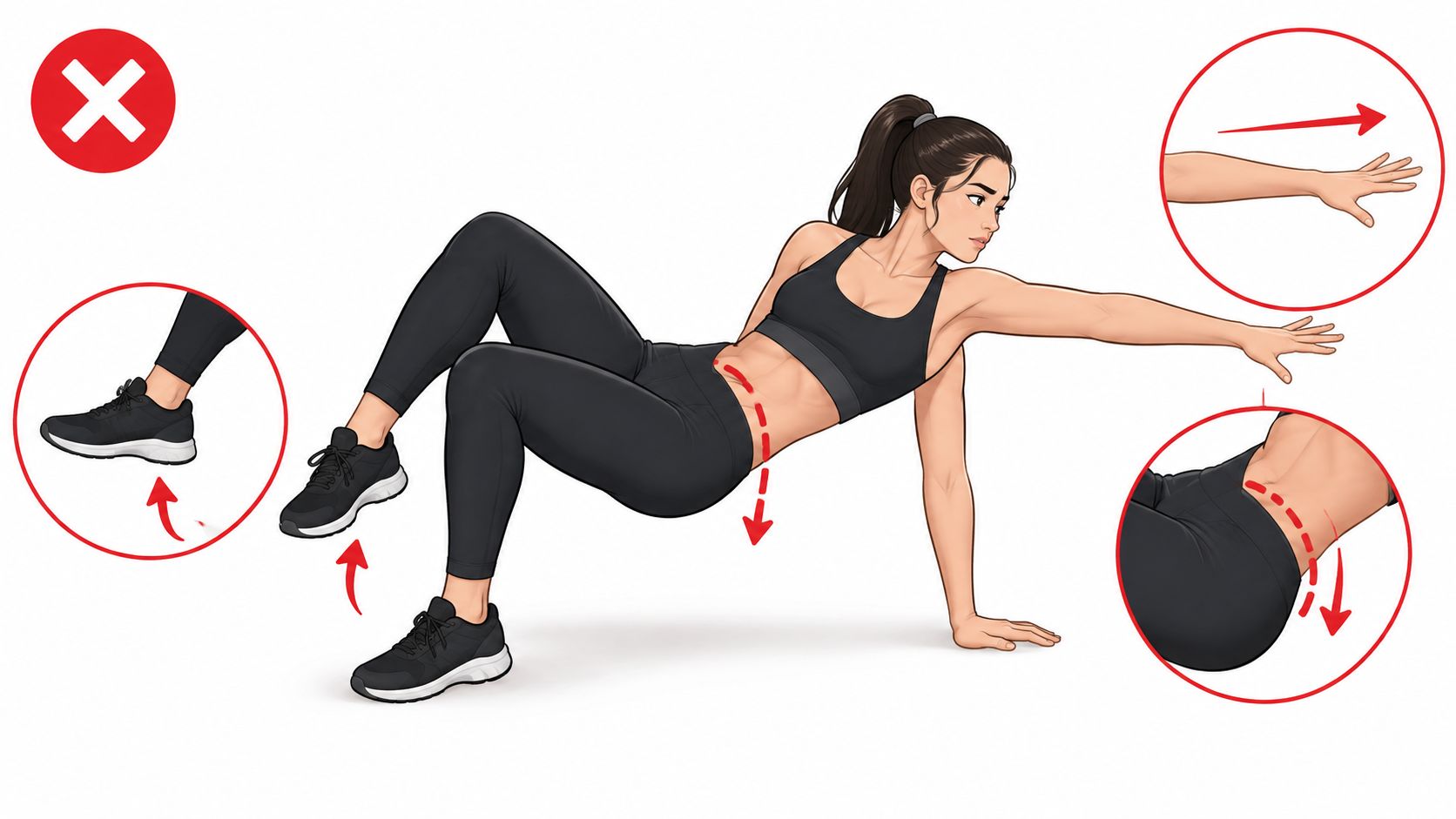
The most useful correction is often to make the movement smaller. Reaching far with the moving hand and opposite foot can destabilize the supporting shoulder and encourage the lower back to arch. Shorter, slower steps give you a better chance of maintaining the position established at the start.
Watch for changes in your shape rather than judging the set by how quickly you cover the floor.
Fix the Position Before Adding Effort
A low hip position isn't automatically a mistake. The problem is losing the height you can control, then compensating by arching your back or throwing your next step farther. Sit down, reset your brace, and resume with less travel instead of trying to rescue the set while moving.
The upper-body tension can be less obvious. You may crane your neck to see where you're going or pull your shoulders toward your ears as the arms tire. Set up a clear route beforehand so you don't need to keep searching for obstacles.
- Keep your gaze easy. Look upward without tipping your head back or forcing your chin toward your chest.
- Let your neck stay long. Notice when you start shrugging, then stop and reorganize rather than pressing through.
- Keep breathing. Try a gentle exhale with each step if you notice yourself holding your breath.
Respect Wrist Discomfort
On a hard kitchen floor, a stable yoga mat or a neatly folded towel may make palm contact more comfortable. Test the surface before traveling, because cushioning that slides or bunches creates another problem. Padding also doesn't remove the load on your wrists.
Stop signal: Joint pain isn't a cue to push harder or finish the round.
If the setup hurts, leave out the traveling exercise. Persistent wrist or shoulder symptoms, or uncertainty after an injury, call for individualized guidance rather than repeated experiments with hand angles. A movement break should be something you can repeat comfortably, not something you need to recover from reluctantly.
A Short Crab Walk Workout You Can Do at Home
Build the session around a brief preparation, controlled bodyweight practice, and an optional banded finish. Don't make a short workout complicated just to make it feel official. A clear floor and a plan for where you'll stop are more useful than a crowded exercise list.
Begin with comfortable wrist movements, gentle shoulder motion, and an easy rehearsal of lifting and lowering your hips. Use that rehearsal to decide whether today is a traveling day or a setup-practice day. If supporting yourself already feels uncomfortable, choose a different movement rather than treating the warm-up as a hurdle to get through.
Run the Main Block
Use the distance-or-step benchmark and rest interval established earlier. Complete the forward portion with deliberate contacts, then add backward travel only if you can preserve the same organization. Rest seated rather than holding yourself up between efforts.
An optional banded block comes afterward, not during the reverse-tabletop walk. Use a shallow squat-based stance and controlled lateral steps, choosing a resistance and placement you can manage without twisting or dragging the trailing foot. Lower band placement changes the demand, but harder isn't automatically better for your current technique.
Bodyweight vs Banded Crab Walk
| Feature | Bodyweight Crab Walk | Banded Crab Walk |
|---|---|---|
| Setup | Belly-up, supported on hands and feet | Upright, squat-based lateral stepping |
| Primary demand | Coordinated shoulder, hip, and trunk support | Resisted hip-abductor and glute work |
| Best use | Floor-based whole-body practice | More focused lower-body resistance work |
| Coach note | End the set before support becomes a scramble | Choose band placement you can control |
Finish Without Adding Another Challenge
After the final effort, sit down and let your breathing settle. Gently move your wrists and ease into a comfortable hip-flexor stretch if that feels useful. There's no need to force a stretch or turn the cooldown into another strength test.
For days when this setup doesn't suit your body or your available space, choose alternatives from an at-home no-equipment workout. Keep the same practical standard: a modest amount you can perform well is preferable to an ambitious circuit you rush.
First-Week Checklist and Quick-Start Plan
Your first week is a practice period, not a test of how far you can travel. The useful outcome is learning whether you can enter the position comfortably, coordinate the movement, and finish without compensating. Distance can wait until those pieces feel repeatable.
Before each session, use a short readiness check. This isn't another technique lesson, it's a way to decide whether to continue, simplify, or choose something else.
- Space ready. The route is clear, and your hands and feet won't slide.
- Setup comfortable. You can support yourself without wrist or shoulder pain.
- Pattern recognizable. You know which opposite limbs are moving together.
- Finish under control. You can sit down deliberately rather than dropping out of the position.
- Next attempt realistic. You're willing to repeat the same manageable dose instead of automatically increasing it.
Progress by Quality, Not Impatience
Start with a short practice session and leave room between attempts to notice how you feel afterward. Repeat the same workload until the movement feels less improvised. When you're ready to progress, change either the travel distance or the movement complexity, rather than increasing everything at once.
A useful progression question is simple: Did the final part look and feel like the beginning? If not, keep the dose where it is or shorten it. Adding backward travel is an option only after the basic pattern stays organized.
If you're returning to exercise more broadly, this guide to bodyweight training for beginners can help you place a small movement practice within a wider routine. Crab walking can be part of that routine without becoming the centerpiece of every workout.
Choose your next available break, clear the floor, and rehearse the starting position. If it feels comfortable, complete a controlled practice set and note what limited you. That gives you a specific starting point for the next exercise snack, rather than a vague promise to work out more.
SuperStrong is an iPhone app that organizes short at-home bodyweight sets into a shared visual wall, making small efforts visible alongside your friends' activity. Visit SuperStrong to build a simple logging habit around your home training and keep those between-task movement breaks part of your routine.