Grease the Groove Pull Ups: A Practical Daily Plan
 14 min
You can manage a few strict pull-ups, but every session turns into a test. You pull until your chin barely clears the bar, squeeze out another uneven rep, then spend the next few days waiting for your arms to feel normal. When you return, the same ceiling is still there.
Grease the groove pull-ups offer a different approach: practice the movement without making every encounter with the bar an exhausting workout. The useful version includes a readiness check, not just a daily repetition target.
Table of Contents
- What Grease the Groove Means for Pull-Ups
- Set Size and Daily Volume by Your Max
- How to Run a Grease the Groove Day
- Progressing Without Turning Sets Into Max Tests
- Recovery Signs and When to Back Off
- Start Your First Week Without Overdoing It
What Grease the Groove Means for Pull-Ups
Say your Saturday routine is to grind through your best strict set, rest, and try to repeat it. By Tuesday, you're still sore, and you've had little opportunity to practice pulling well. The problem isn't necessarily a lack of effort. You're spending most of that effort testing what you can already do.
Grease the groove, often shortened to GTG, means performing frequent, easy sets of the same movement while stopping well short of failure. You spread those sets through ordinary daily activities rather than completing them consecutively.
Strength coach Pavel Tsatsouline popularized the method, which is associated with his 2003 book The Naked Warrior, as described in FitCraft's explanation of greasing the groove. The important shift is from repeatedly demonstrating your maximum to rehearsing an efficient movement.
Practice instead of exhaustion
Pull-ups aren't just a test of how hard you can pull. You also need to coordinate your grip, shoulder blades, trunk position, and path toward the bar. Fresh repetitions give you a chance to rehearse those details without having to rescue the movement with a swing or a shortened range.
The trade-off is straightforward: less fatigue in each set, more opportunities to practice. The same distinction applies to grease-the-groove push-ups, although pulling requires particular attention to grip and elbow comfort.
- Good candidates: People with access to a bar throughout the day, limited uninterrupted training time, or inconsistent pulling technique.
- Beginners needing assistance: Use a supported variation that feels easy. An unassisted rep isn't submaximal practice if it's your hardest possible effort.
- People needing something else: If your sole priority is maximum-strength development or a peak one-set score, use structured strength programming rather than relying on practice sets alone.
Practical rule: Finish a practice set because you've completed the planned work, not because you can't complete another repetition.
GTG is skill-focused strength practice. It can sit alongside harder strength work, but that combination still needs a sensible workload.
Set Size and Daily Volume by Your Max
Start with a fresh strict maximum, not the number you once achieved with a shortened descent. Warm up, use a consistent grip, and count only repetitions that begin from a dead hang and finish with your chin clearly above the bar. Stop counting when you can no longer meet that standard.
A common starting prescription is 40–60% of maximum repetitions per set; FitBudd's GTG guide illustrates a person capable of 10 pull-ups doing 4–5 repetitions across five or six sessions, accumulating approximately 20–30 daily repetitions. That's a practical convention, not a scientifically established optimum for every trainee.
Set size and daily totals by strict pull-up max
The following is an illustrative planning table, with totals calculated from the displayed set sizes and frequencies. Its upper limits are arithmetic possibilities, not starting targets.
| Strict max | Reps per set (40–60%, with beginner rounding) | Sets per day | Daily total |
|---|---|---|---|
| 2–3 reps | 1–2 | 4–5 | 4–10 |
| 5 reps | 2–3 | 5–6 | 10–18 |
| 10 reps | 4–6 | 5–6 | 20–36 |
| 15 reps | 6–9 | 5–6 | 30–54 |
| 20 reps | 8–12 | 5–6 | 40–72 |
Choose the bottom of your row first. In the table's ten-repetition example, the lower combination produces twenty repetitions, while combining the largest set with the highest frequency produces thirty-six. Those are substantially different workloads, even though both fit inside the same row.
The beginner row needs extra caution. If your maximum is two, a double is a maximum-effort set, not easy practice. Start with a single, and use assistance if even that single demands straining. Don't round upward just to make a percentage look tidy.
A five-repetition maximum leaves similarly little room for adjustment. Small changes in set size can make a noticeable difference to effort, so prioritize how smoothly you move over landing precisely inside a calculated range.
Let the last set decide
The right target leaves your later repetitions looking like your early ones. Watch for a slower ascent, increasingly bent knees, a forward-reaching chin, or a grip that starts slipping.
A daily total is a ceiling, not a debt. If maintaining it requires changing your technique, you've already exceeded the useful dose for that day.
How to Run a Grease the Groove Day
Make the setup repeatable before making it demanding. Use a securely installed bar, leave enough clearance for your body, and keep a stable step nearby if you need help reaching it. Don't turn jumping onto a high bar into an extra challenge between work tasks.
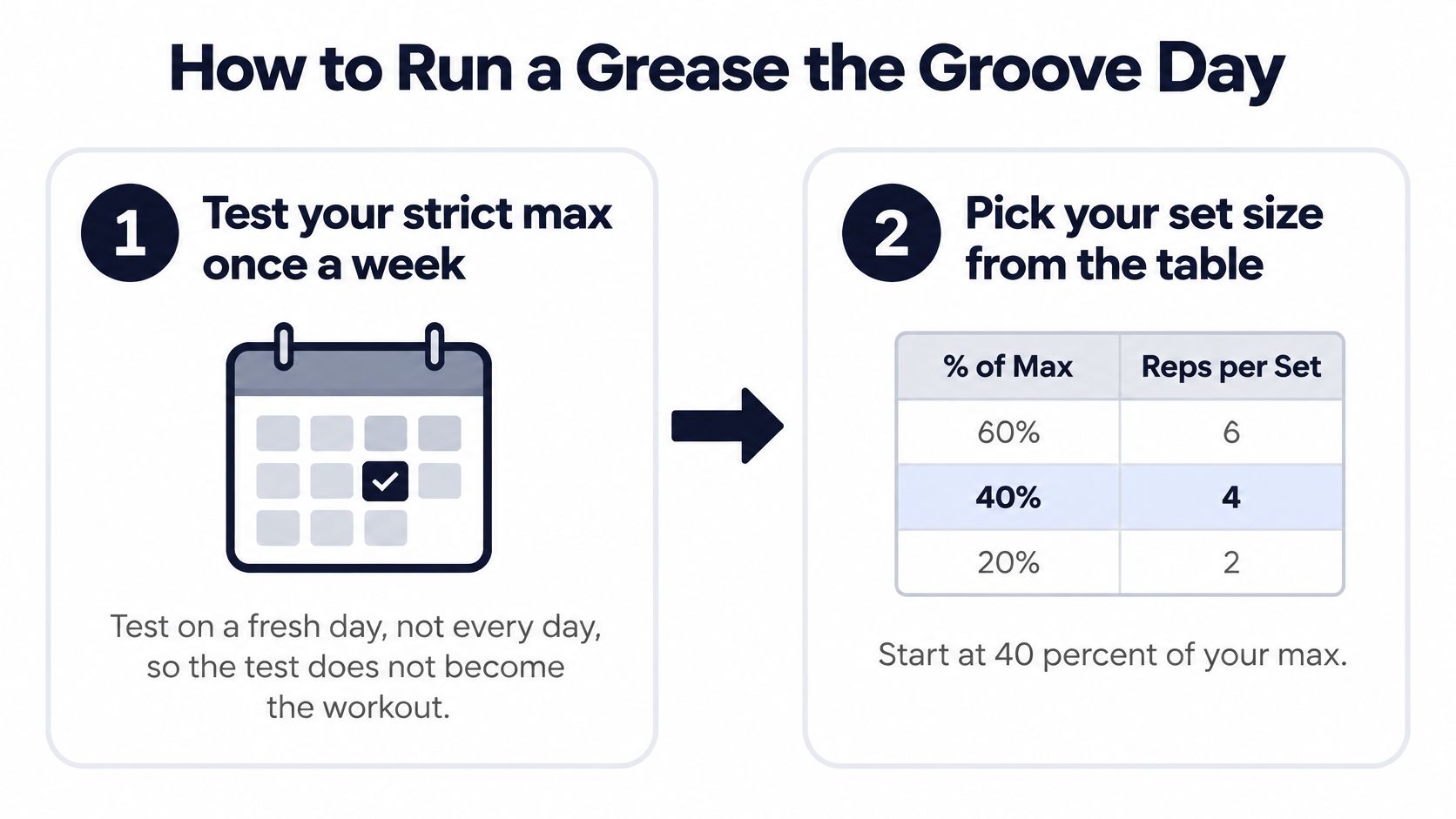
The opening decisions are simple: establish a trustworthy baseline and choose an easy practice target.
Build the day around freshness
-
Reserve a fresh day for assessment. Keep maximum testing separate from routine practice, and don't retest just because yesterday felt encouraging. Treat a scheduled test as optional if your arms feel tired or your joints aren't comfortable.
-
Choose an intentionally easy set. Start at the conservative end of your calculated range rather than finding out how much you can tolerate. The opening sessions should establish a repeatable baseline, not prove your toughness.
-
Use the same repetition standard. Begin from a controlled dead hang, pull until your chin clears the bar without craning your neck, then lower under control. Keep your legs quiet and avoid bouncing out of the bottom.
-
Separate practice opportunities. Attach sets to widely spaced events such as breakfast, lunch, finishing work, and an evening break. If you've missed an opportunity, skip it rather than squeezing the remaining sets together.
-
End the set before you need a rescue rep. A grind, kip, or shortened descent means the planned target no longer suits your readiness. Step down instead of trying another repetition to see whether it improves.
-
Record what happened. Log completed repetitions, set quality, and any discomfort, then review your accumulated workload and latest strict maximum. A planned set you skipped shouldn't appear as completed work.
The spacing matters because you want to approach the bar ready to reproduce the movement, not still recovering from your previous attempt. Doing every set in one sitting changes the session into a conventional workout. That can be useful training, but it isn't the distributed practice you're trying to organize.
Include your other training
Rows, climbing, curls, and demanding pulling sessions all matter when you judge readiness. Don't treat easy pull-ups as free work because you weren't breathing hard afterward.
The ACSM guidance document hosted by the University of New Mexico recommends training major muscle groups 2–3 days per week for general strength development, with recovery between sessions. Distributed pull-up practice is a different organizational tool, not a reason to ignore recovery or abandon a balanced program.
A good practice day ends with unused capacity, not a final set that proves you've emptied the tank.
Judge success by reproducibility. Your grip should remain dependable, your range should stay consistent, and you shouldn't need a private negotiation before approaching the bar again.
Progressing Without Turning Sets Into Max Tests
Increase the target only after your existing work stays consistently crisp, without failed repetitions, grinding, or elbow and shoulder soreness. Don't progress because you've become impatient with a number that still challenges you.
Use the weekly layout as a place to record decisions, not as a deadline for getting stronger.
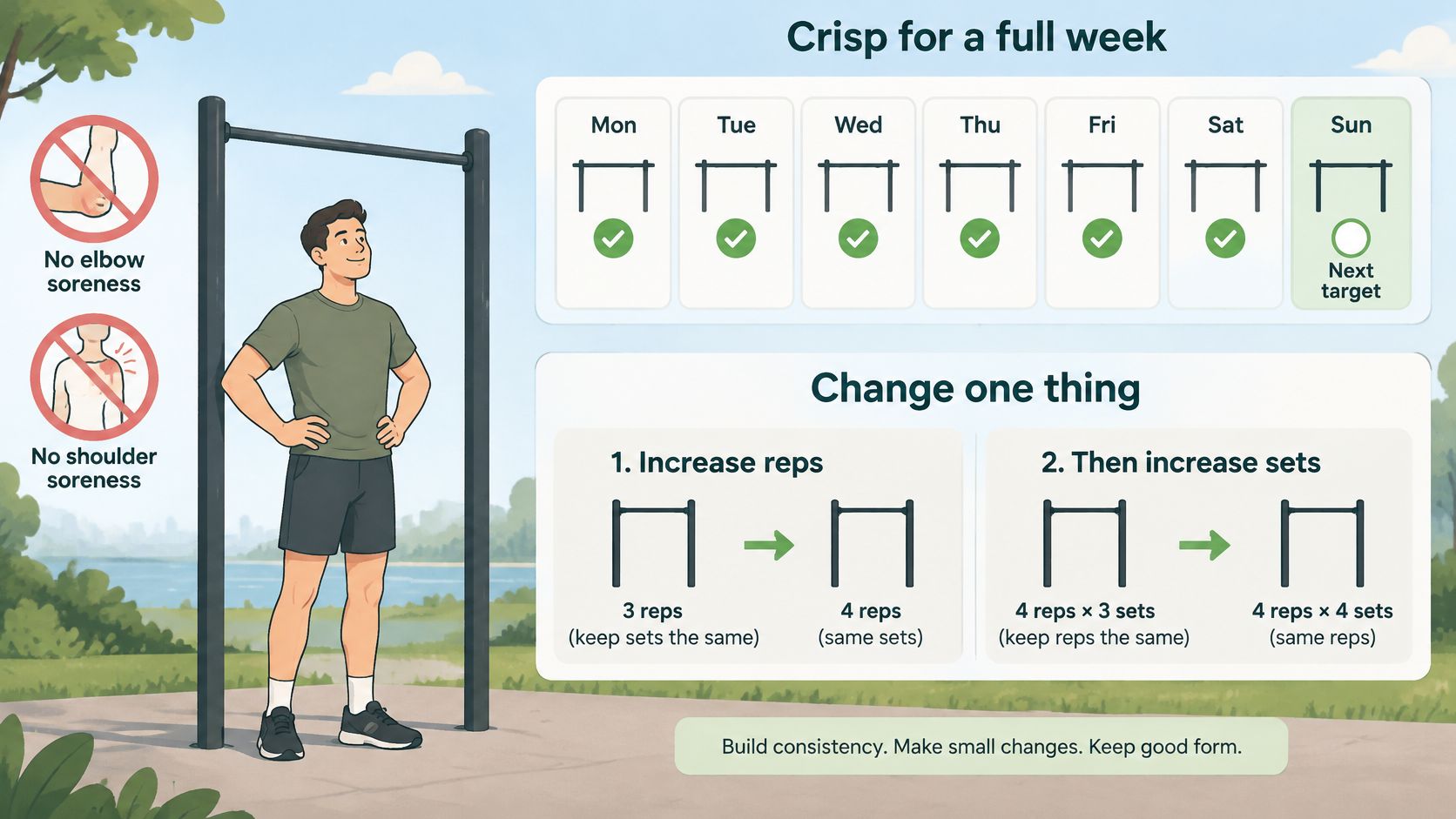
Change the dose without losing the method
Adjust set size or daily frequency, not both together. With a small maximum, adding repetitions can abruptly turn an easy set into a hard one, so holding the target steady may be the better choice.
- Keep your grip comparable: Changing width or switching between pull-ups and chin-ups makes performance harder to interpret.
- Record the decision: A bodyweight workout journal should capture why you increased, maintained, or reduced the target.
- Earn the harder week: Move up when the current week feels easy, rather than advancing automatically because the calendar changed.
Separate practice gains from strength gains
A systematic review of exercise snacks found no significant overall improvement in muscular strength versus controls, with highly inconsistent results. That doesn't establish that GTG pull-ups don't work, but it does undermine any promise that scattering easy exercise through the day reliably builds maximum strength.
Frequency also isn't a special stimulus by itself. Shark Chalk's discussion of GTG pull-ups summarizes adjacent evidence suggesting that higher frequency helps strength mainly when it permits more weekly volume; when volume is matched, frequency alone may offer little advantage. Direct controlled evidence for the GTG method remains limited.
Use the demonstration as a movement reference, not as a guaranteed progression timeline.
The practical answer is a practice layer and a strength layer. Easy sets can support technique, consistency, and pulling endurance. If your maximum stalls despite good recovery, consider programmed higher-tension work such as controlled eccentrics, pauses, or a harder variation, while reducing practice volume to accommodate it.
Don't insert demanding negatives into every snack. They belong in the workload calculation too.
Ask whether you're improving your maximum, completing more clean work, or simply becoming better at tolerating a busy schedule.
Those outcomes aren't interchangeable. Choose the progression that matches the result you want.
Recovery Signs and When to Back Off
The common warning isn't a failed repetition. It's a set that used to feel routine becoming slower, less coordinated, or unexpectedly difficult. Respond to that change before you start missing reps.
Build complete days away from pull-ups into your schedule. If your performance keeps deteriorating across successive practice opportunities, reduce the target rather than assuming more exposure will fix it.
Recovery symptoms, likely causes and the change to make
These are workload clues, not diagnoses. Similar symptoms can have different causes, particularly when pain is involved.
| Warning sign | Likely cause | Change to make |
|---|---|---|
| Sets start grinding by the third set | Set size may be too big | Lower the repetitions and reassess at the next fresh session |
| Reps slow or become uneven across the day | Daily volume may be too high | Remove a practice opportunity and hold the reduced workload |
| Grip gives out before the back | Grip fatigue | Use lighter sets and avoid adding prolonged dead hangs |
| Elbow or shoulder ache the next morning | Excessive joint load or overreach | Stop pulling until symptoms settle, then reassess the workload |
| Pain that doesn't settle within a few days | Possible injury | Stop pull-ups and see a doctor |
Don't try to diagnose elbow pain from its location alone. A sore inside elbow doesn't automatically identify a particular tendon problem, and changing grips isn't permission to train through symptoms.
Reduce effort or stop pulling
Fatigue without pain usually calls for less work: smaller sets, fewer opportunities, or a rest day. Also consider what you've added elsewhere, including carrying, climbing, and other gripping exercises.
Pain calls for a different response. Stop the provoking movement if pain is sharp, worsening, or changing how you move. Seek medical assessment for persistent pain, swelling, numbness, pronounced weakness, or difficulty using the arm normally.
Keep notes about when symptoms appear, which movements provoke them, and whether they improve with rest. Those observations can help a clinician, but they can't establish a diagnosis.
At SuperStrong, we provide a log, not a coach or medical advice, and users should check with a doctor before starting an exercise programme. A record of completed sets can help you notice a pattern; it can't determine whether continuing is safe.
The distinction is simple: reduce a target when painless performance declines. Stop and get checked when pain persists or you develop concerning symptoms.
Start Your First Week Without Overdoing It
Give your opening week a deliberately modest job: establish what you can repeat comfortably. Don't use it to chase the biggest total your schedule permits.
For a hypothetical Saturday-to-Friday start, separate assessment, rest, and practice rather than testing and immediately beginning a full day of sets. Use this pull-up schedule guide if you need help fitting pulling work around your other training.
A workable opening schedule
- Saturday, establish the baseline: Warm up, complete your strict assessment, and write down the last repetition that met your standard. Stop there rather than adding back-off work to celebrate the result.
- Sunday, leave the bar alone: Choose your conservative practice target and identify natural breaks in the coming workdays. Remove any opportunity that would force you to rush.
- Monday through Friday, practice the fixed target: Keep the same grip and range, and record completed work immediately. Don't increase the set midway through the week because the opening day felt easy.
If you're using the beginner row, choose its lower frequency rather than copying the busier schedule of someone with a larger maximum. More opportunities aren't useful if you approach them with tired hands and an increasingly reluctant pull.
Make the next decision from the record
At the end of the week, review completion, movement quality, and symptoms together. An impressive total with deteriorating technique isn't a successful baseline.
If practice stayed smooth and you feel fresh, you can schedule another strict assessment. If your maximum hasn't changed, keep the same practice target rather than forcing progression. If performance worsened, reduce the workload or rest before testing again.
When you're ready to progress, change the smallest practical part of the plan. Keep the other parts stable so you can tell whether the adjustment helped.
Today's action is to write down your strict maximum and your opening set size. Add the intended practice opportunities beside them, leaving room to record how the sets feel. You don't need to earn a larger target before you've learned to repeat the smaller one well.
SuperStrong is an iPhone app that logs bodyweight exercise sets as tiles on a wall, so your short pull-up sessions have a visible record. Bigger tiles represent more repetitions, but an easy practice set still counts. Visit SuperStrong to start logging your sets while keeping technique and readiness ahead of daily totals.