5 Minute Workout at Home: 5 Routines That Fit Any Day
 13 min
Search "5 minute workout at home" and you'll get the same advice every time: pick a routine, do it daily, trust the compounding. That advice is half right. The routine was never the bottleneck. People skip training because they believe exercise needs an hour, a gym and a written programme, so a five-minute gap between calls never registers as training time at all. Five minutes is enough, but only when the format fits the moment you're in. A kitchen floor before a meeting isn't the hallway between two of them. Nearly 31% of adults worldwide, about 1.8 billion people, didn't meet the recommended 150 minutes of moderate activity a week in 2022, according to the WHO physical activity fact sheet. The fix isn't more willpower, it's a shorter unit. Below are five formats, from a four-minute Tabata block to micro-bouts spread across a workday. Each one fits inside five minutes, needs no equipment, and suits a different kind of day.
Table of Contents
- 1. Bodyweight Tabata Intervals (4 Minutes + 1-Minute Warm-Up)
- 2. EMOM Bodyweight Ladder (Every Minute on the Minute)
- 3. Burpee Ladder Challenge
- 4. Four-Move Bodyweight Circuit (4 Rounds of 45 Seconds)
- 5. Exercise Snacks (Micro-Bouts Throughout the Day)
- Comparing the Five 5-Minute Routines at a Glance
- Pick One Format, Do It Today, and Let the Wall Show It
1. Bodyweight Tabata Intervals (4 Minutes + 1-Minute Warm-Up)
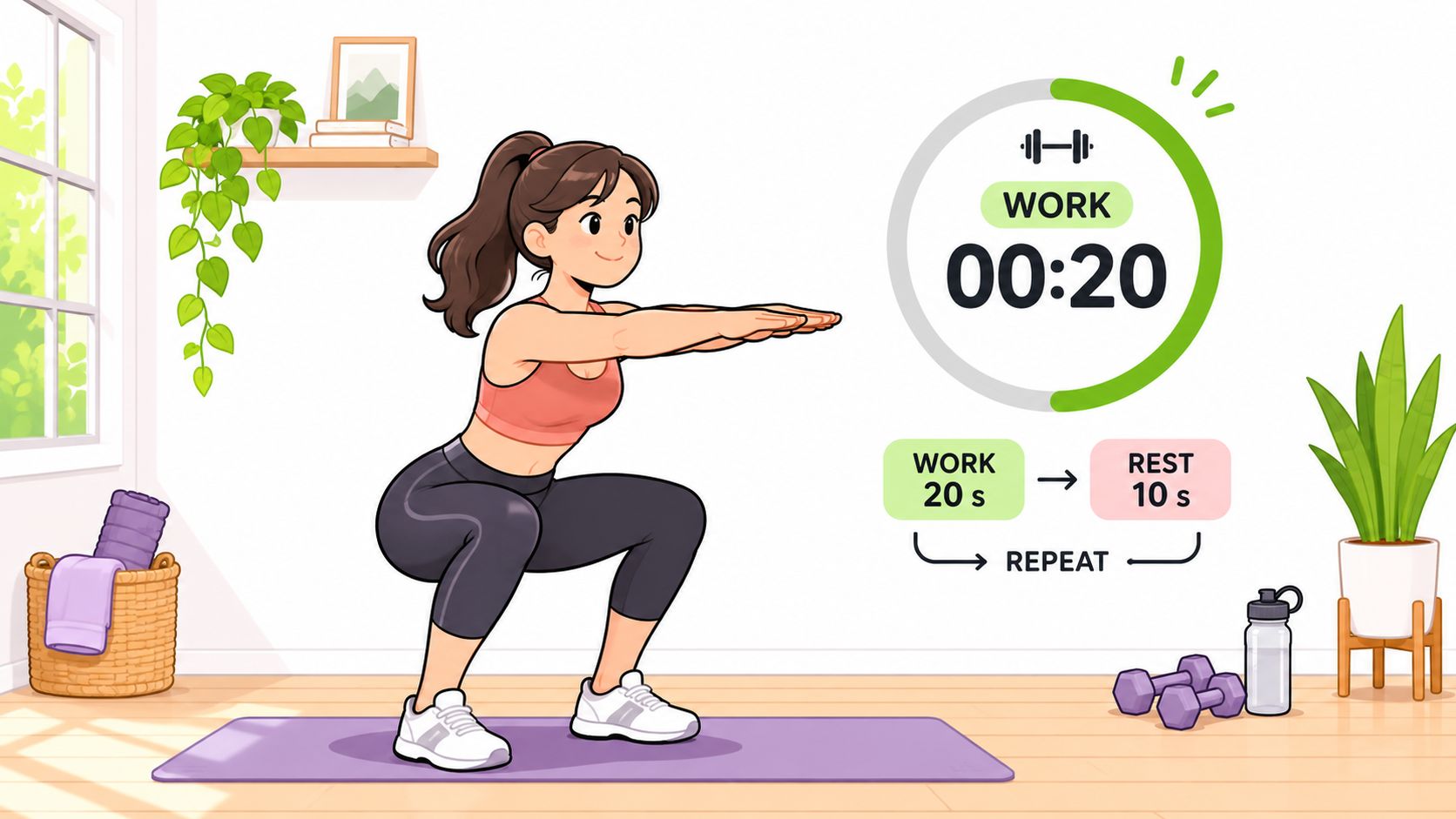
Tabata is the tightest five minutes on this list. Twenty seconds of work, ten seconds of rest, eight rounds. Four minutes of clock time, plus sixty seconds of marching and arm circles to warm up.
The format carries Izumi Tabata's name because his interval research gave it its shape. The home version drops the lab equipment and runs one bodyweight movement per round.
Choose the move before the clock starts
Pick something you can hold clean form on for the full twenty seconds. Squats, push-ups and jumping jacks survive contact with a small room. Rotating them across rounds, squats then push-ups then high knees, spreads the fatigue and keeps rounds seven and eight honest.
Practical rule: if your form breaks at second fifteen, the movement is too hard for the format. Swap it out rather than grinding through.
Intensity is why this works when the clock is so short. A 2025 review of exercise-snack dosing found these bouts typically ran from 1 to 5 minutes, happened 2 to 8 times a day, and ranged from 2 to 3 METs up to 6 to 9 METs. Tabata sits near the top of that range, which is why four minutes feels like far more than four minutes.
Worked example: eight rounds of squats at 20 seconds on, 10 seconds off, roughly 60 to 70 reps in four minutes. Next session, rotate push-ups, squats and high knees across the eight rounds.
Scale down before you scale up
- Start at four rounds. Two minutes plus the warm-up still beats skipping entirely.
- Slow the tempo instead of cutting rounds. A deliberate squat at half speed beats a sloppy sprint.
- Log reps, not just completion. The number tells you whether to raise or lower the next session.
Where it fails: sore knees, wrists or shoulders don't belong in max-effort intervals on day one. Run two rounds at about 70% effort for a week first, then build.
2. EMOM Bodyweight Ladder (Every Minute on the Minute)
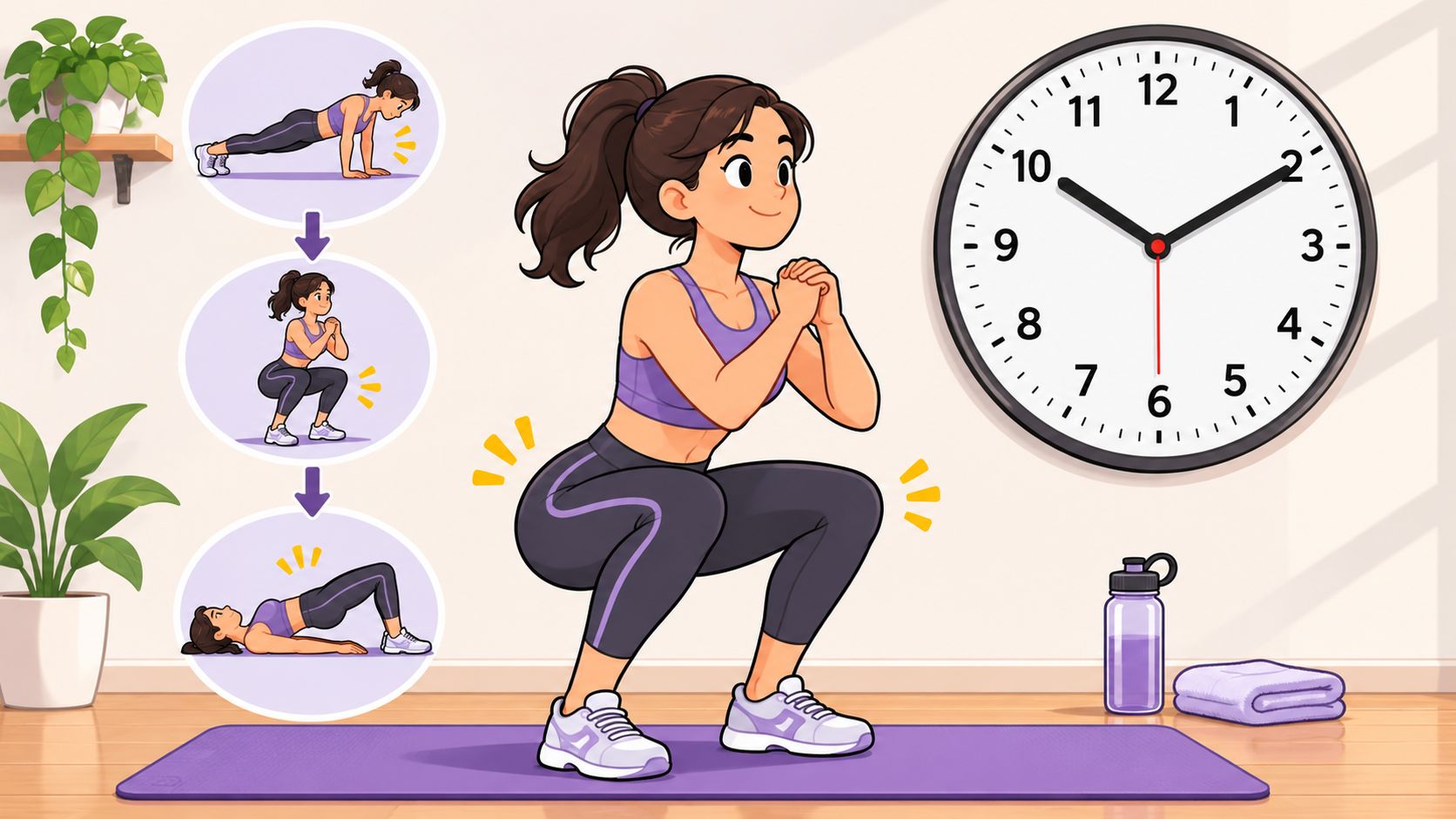
EMOM stands for every minute on the minute. Start a movement at the top of each minute, finish the reps, and whatever time remains is rest. Pick this format on days when deciding is harder than doing; the clock supplies the structure a loose circuit leaves to you.
A simple five-move sequence: minute one, five push-ups; minute two, ten squats; minute three, five glute bridges; minute four, eight rows; minute five, ten bird dogs.
The clock does the programming
Set rep targets you can finish with a few seconds to spare. If you are still moving at second fifty-five, the target is too high. The work should feel repeatable across all five minutes, with the last round looking like the first.
Phone-delivered structure can hold up outside a gym. A 2025 randomized trial of app-delivered exercise snacks enrolled 73 participants who completed the intervention, and 71 of them completed at least one follow-up measure. A timer on the counter is enough for the session itself; an app only needs to remember what each minute did.
Modifications that keep it moving
- Rows without a bar. Use a doorframe pull-up, a sturdy table edge, or the handle of a loaded bag.
- Bird dogs for the core. Opposite arm and leg, slow, no rushing the reach.
- Lower the targets in week one. Five clean push-ups beat three and a half ugly ones.
- Log completed minutes only. A record that mirrors reality is the one you will keep returning to.
When the calendar is the main problem rather than the workout, this guide to fitting exercise into a busy day covers the scheduling side.
Where it fails: EMOM punishes impatience. Treat the leftover seconds as recovery, not a record to beat, or minute four turns into a different workout.
3. Burpee Ladder Challenge
The format in a single movement, if you want to see the pace before you start:
The burpee ladder adds one rep per round. Round one is a single burpee, round two is two, and so on, with a short rest in between. Five minutes gets you to a five- or six-rep round with 15 seconds of rest between each.
Why ladders beat fixed sets
A fixed set of ten burpees is one number. A ladder is a sequence you can finish, and the total builds week to week: 1+2+3+4+5 is 15 burpees, and the next step up is 21. That arithmetic is the appeal. Minimal space, no equipment, and progress you can count on your fingers.
Short, hard efforts do shift fitness markers. A 2024 randomized controlled trial of 42 inactive young adults found six weeks of brief, vigorous stair-climbing exercise snacks improved peak oxygen uptake by about 7%, as reported by the Chapman Institute.
Worked example: five rounds of 1-2-3-4-5 with 15 seconds of rest. That's 15 burpees and about a minute of total rest, which fits inside five minutes at a controlled pace.
Form check: a burpee that turns into a sprawl isn't conditioning. End the ladder at the round where your chest still reaches the floor.
Beginner modifications
- Step-back burpee. No jump, no push-up. Step back, step in, stand tall.
- Keep rest under 15 seconds. Long rests turn one ladder into five separate sets.
- Track total reps. The weekly total is the progress signal, not how wrecked you feel.
- Stop when form breaks. Finish early and log what you did.
Where it fails: anyone with a wrist or low back issue should skip the floor version and run the ladder as squat thrusts instead.
4. Four-Move Bodyweight Circuit (4 Rounds of 45 Seconds)
Balanced beats brutal when you have one four-minute block. Four moves, 45 seconds each, 15 seconds of rest between. Push-ups, squats, glute bridges, bird dogs, in that order. That's four minutes of work and rest covering upper body, lower body, posterior chain and core with nothing but floor space.
The movement order matters
- Push-ups first, while the shoulders are fresh. Incline against a kitchen counter if the floor version stalls.
- Squats second, chair-supported if you're returning from a long break.
- Glute bridges third, slow and controlled, hips to full extension at the top.
- Bird dogs last, where a tired core shows up.
Count reps in each 45-second block and record the highest number. Repeat the circuit once more if you have eight minutes. Three days a week is enough to start, with rest days in between.
What a circuit will and won't do
It builds movement quality, consistency and a base for harder work. It won't reshape your body in a fortnight. The 2025 meta-analysis in the British Journal of Sports Medicine found no clear improvements in leg strength, body composition, blood pressure or blood lipids from short bouts. Strength progression needs overload and variation across weeks, not a harder version of the same four moves.
Worked example: Monday, Wednesday and Friday, four minutes before the first coffee. Log the push-up count each time. When 45 seconds stops being difficult, add a lever rather than more time, using these no-equipment workout variations.
5. Exercise Snacks (Micro-Bouts Throughout the Day)
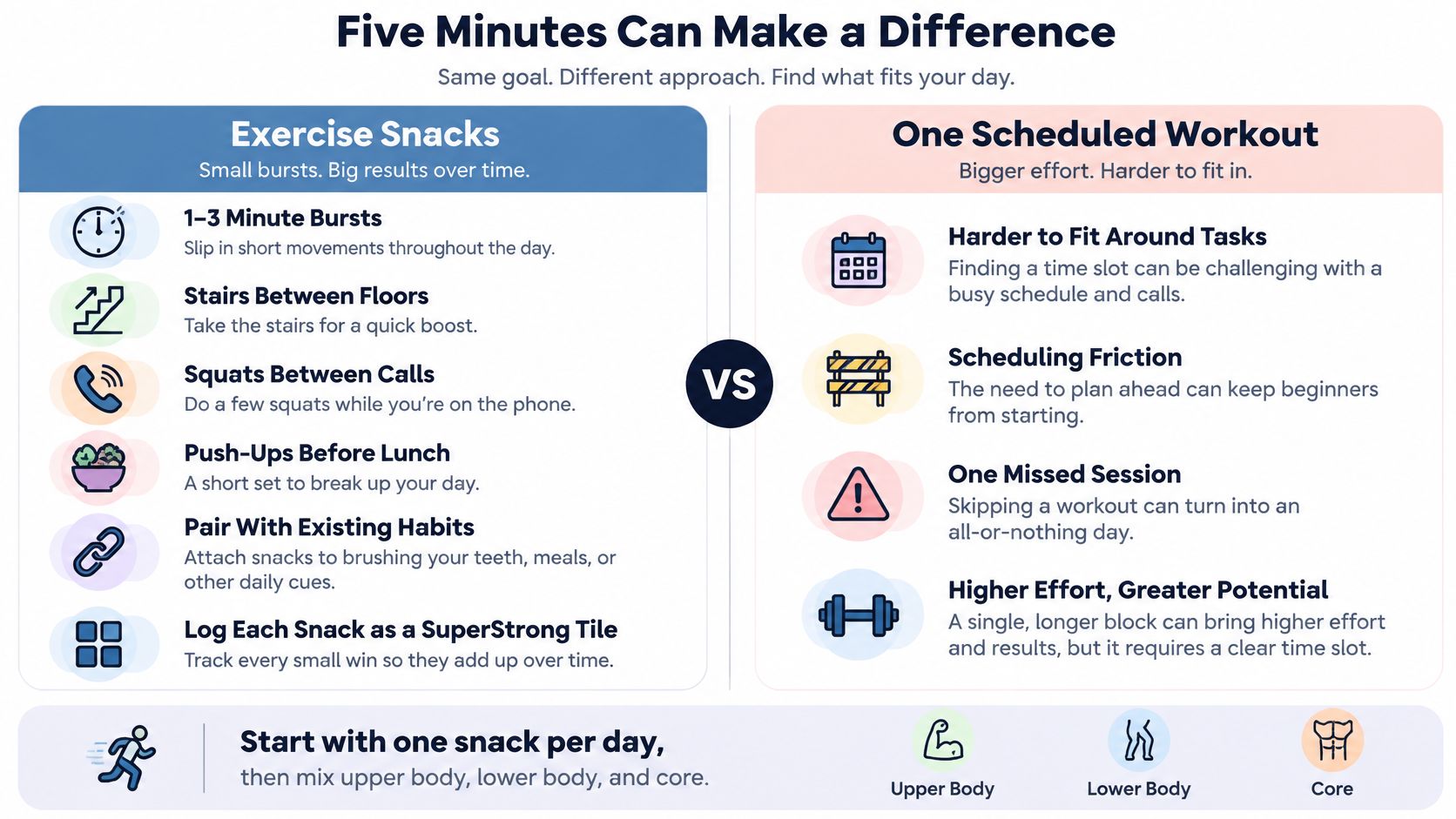
Exercise snacks are the version that fits a day rather than interrupting it. One to three minutes of effortful movement, several times over, totalling five minutes or so. Stairs instead of the lift. Ten squats while the kettle boils. A short set of push-ups before lunch.
What the evidence actually supports
The strongest data concerns vigorous incidental movement. A 2022 Nature Medicine study of roughly 25,000 UK Biobank participants who reported no leisure-time exercise found that those accumulating a median of about 3 to 4 minutes a day of vigorous intermittent lifestyle activity had approximately 38 to 40% lower all-cause mortality risk and 48 to 49% lower cardiovascular mortality risk than those who did none, as summarized in this review of the exercise-snacking research. The activity was incidental, which is precisely what a snack is.
The dose that shows up in trials is a rhythm, not a one-off: bouts of no more than five minutes, completed at least twice a day, on three to seven days a week, for roughly 4 to 12 weeks, as NBC News reported on the heart and muscle findings.
Trade-off: a snack is easier to start and easier to skip. A fixed daily trigger is what keeps the count up.
Making snacks stick
- Anchor to an existing habit. After brushing teeth, before lunch, the moment a call ends.
- Log each one. Two minutes counts as long as you record it somewhere.
- Mix the movements. Push-ups in one bout, squats in the next.
- Start with one a day. Add a second only when the first is automatic.
More patterns worth borrowing are in these exercise snack examples.
Comparing the Five 5-Minute Routines at a Glance
| Routine | Structure | Intensity | Beginner-Friendliness | Equipment Needed |
|---|---|---|---|---|
| Bodyweight Tabata Intervals (4 Minutes + 1-Minute Warm-Up) | 8 rounds of 20 seconds work and 10 seconds rest, plus a 1-minute warm-up | High | Challenging; reduce pace and choose manageable moves | None |
| EMOM Bodyweight Ladder (Every Minute on the Minute) | Five 1-minute exercise blocks; rest for the remainder of each minute | Moderate; depends on reps and pace | Adjustable, but high rep targets may feel rushed | Timer or clock |
| Burpee Ladder Challenge | Burpee reps increase or decrease by round, with short rests; about 5 minutes | High | Challenging; modify by removing jumps and push-ups | None |
| Four-Move Bodyweight Circuit (4 Rounds of 45 Seconds) | Four moves performed for 45 seconds each, with 15 seconds of rest | Moderate | Beginner-friendly with incline or knee push-ups and supported squats | Floor space; sturdy chair or counter |
| Exercise Snacks (Micro-Bouts Throughout the Day) | Multiple 1–3-minute activity bouts spread throughout the day | Variable | Very beginner-friendly; start with one short bout | None |
Pick One Format, Do It Today, and Let the Wall Show It
Five formats, one decision. Pick the one that fits the gap you have, not the one that sounds most impressive. A hallway and two free minutes means EMOM or a snack. A kitchen floor and four minutes of quiet means Tabata or the circuit. A stubborn competitive streak means the burpee ladder. Do it today, then repeat it on a simple rhythm rather than shopping for a sixth routine next week.
Tracking is what turns five minutes into visible progress. With SuperStrong, an iPhone app, each bodyweight set lands as a tile on a shared wall with up to four friends, so a Tuesday lunchtime set has a record instead of evaporating. The built-in plan runs three training days a week with four rest days and a small goal on each training day, which gives a beginner a starting cadence to scale up when it feels easy.
Two honest limits. This is a log, not a coach, and it isn't medical advice, so check with a doctor before starting an exercise programme. And no format on this list replaces a longer training week over time.
SuperStrong is built for exactly this pattern: short bodyweight sets logged against push-ups, squats, glute bridges, rows and dips, with every set becoming a tile your friends can see. If the five-minute formats above fit your day better than a gym block does, install the app, pick one routine and let the wall fill up. Start with your first set at SuperStrong.