Grease the Groove Push Ups: Sets and Daily Practice
 18 min
You're waiting for the kettle, looking at the kitchen floor, and wondering whether a few push-ups would count. Usually, you squeeze out an exhausting set, finish with your hips sagging, and leave it there. A different approach is to stop while the movement still looks easy, then return between ordinary tasks.
That's the idea behind grease the groove push ups: practice the movement without turning every attempt into a test. The useful question isn't how tired you can get. It's how much good practice you can repeat comfortably.
Table of Contents
- Push-Up Set Sizes for Your Current Max
- Why Easy Reps Grease the Movement
- How to Spread Sets Through the Day
- When to Add Reps or Back Off
- Sample Days for Three Push-Up Maxes
- What Frequent Push-Ups Will Not Replace
- Start This Week on the Low End
Push-Up Set Sizes for Your Current Max
Grease the groove means repeated submaximal practice of the same movement. You choose a manageable set size, spread your sets apart, and finish well before you couldn't complete another clean repetition.
Fitcraft's guide to greasing the groove describes working sets at roughly 40% to 60% of a strict maximum, with a maximum of 20 repetitions giving sets of about 8 to 12. It also distinguishes the likely early improvement in coordination from large increases in muscle size, while acknowledging limited direct randomized-trial evidence for this exact push-up method.
Choose your working row
Use the following as a sample planning table, not a workload you must reach immediately. The set counts are practical scheduling examples, and daily totals are arithmetic combinations of the sets and repetitions shown.
Grease the groove push-up sets by tested max
| Tested max | Reps per set | Sets in the day | Daily reps |
|---|---|---|---|
| 5 floor or incline | 2–3 | 4–6 | 8–18 |
| 8 | 3–5 | 4–6 | 12–30 |
| 10 | 4–6 | 4–6 | 16–36 |
| 15 | 6–9 | 4–6 | 24–54 |
| 20 | 8–12 | 4–6 | 32–72 |
| 30 | 12–15 | 4–6 | 48–90 |
| 40 | 16–24 | 4–5 | 64–120 |
| 50 | 20–30 | 4 | 80–120 |
The ranges use whole repetitions, so they're approximate rather than exact percentage boundaries. The row for the higher maximum deliberately stays conservative instead of chasing the largest possible working set.
Pick the row you've earned with strict technique, not the row you'd like to use. Start at its lower end, including the lower set count. A table can calculate repetitions, but it can't tell whether your shoulders have recovered from yesterday's pressing workout.
Test the movement you'll actually practice
Warm up with gentle shoulder movement and easy push-ups against a stable counter or wall. Then test a strict maximum when you feel rested and pain-free, stopping when another repetition would require a change in technique.
Keep these standards consistent:
- Depth: Lower your chest to the same comfortable depth each time.
- Body position: Keep your ribs and hips steady rather than lifting your chest ahead of your pelvis.
- Finish: Straighten your arms fully without forcing a painful elbow position.
- Setup: Use the same hand width and surface whenever you test.
Don't test on a day when your shoulders already ache. If floor push-ups leave you struggling almost immediately, use a fixed countertop or another secure incline and test that variation instead.
An incline isn't a lesser version of the plan. It lets you practice a complete movement instead of repeatedly surviving a difficult fragment.
Practical rule: The prescribed set ends before your technique changes, even when the table says you have repetitions left.
Why Easy Reps Grease the Movement
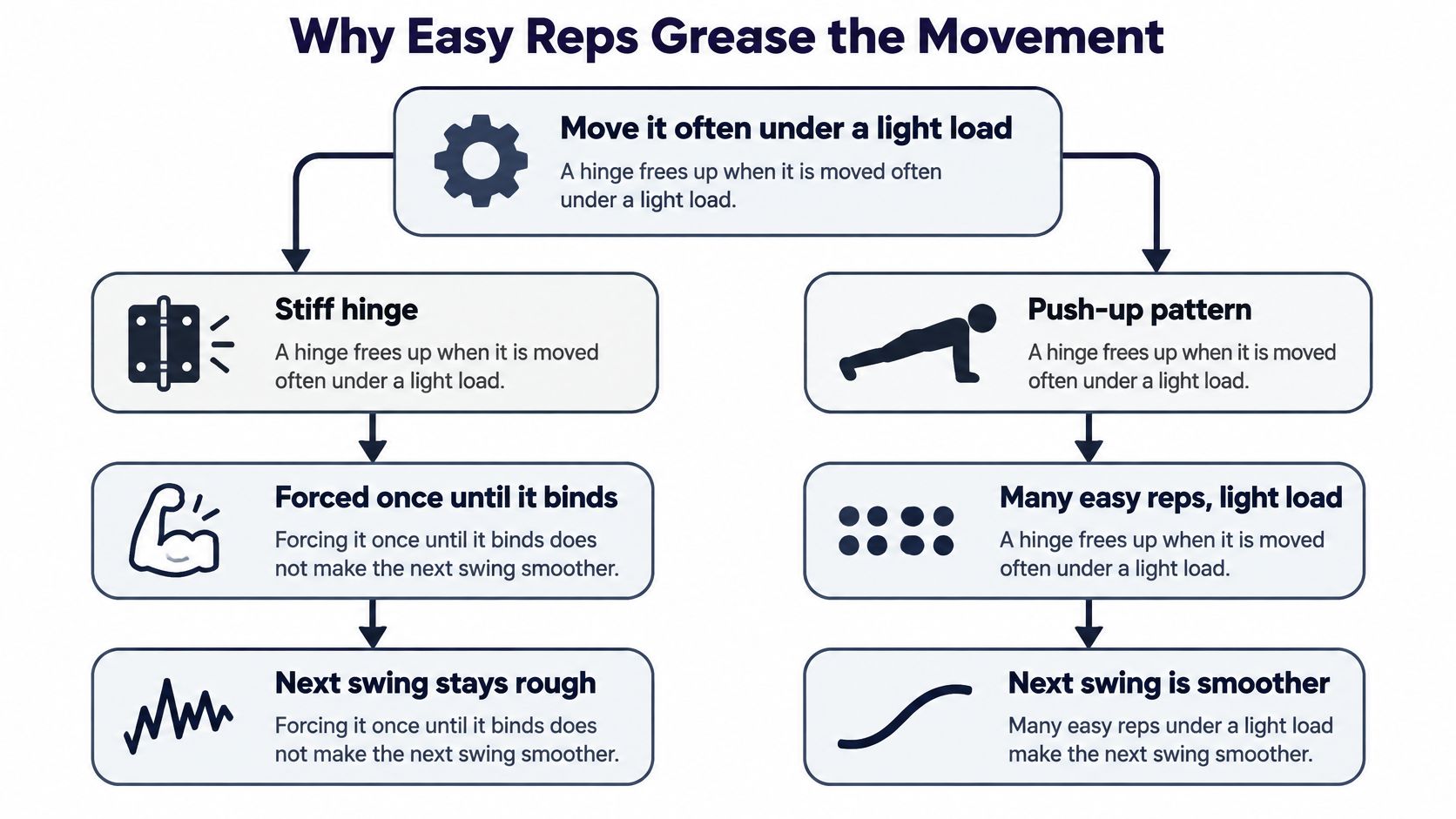
A stiff hinge is a useful picture for this method. Moving it gently and repeatedly feels different from forcing it until it binds. Your shoulders aren't mechanical hinges that need exercise as lubricant, but the comparison captures the coaching idea: repeat the movement under manageable conditions.
With push-ups, you're practicing how to lower your chest, brace your trunk, and press away from the floor together. When the effort stays comfortable, you can pay attention to those details instead of concentrating only on getting back up.
A coaching framework, not a guaranteed result
Pushgard's history of grease-the-groove training traces the method to Pavel Tsatsouline's 1999 article in MILO, whose illustrative trainee performed five easy chin-ups during basement visits and reportedly reached 20 consecutive chin-ups. That's a coaching account about chin-ups, not a controlled push-up trial.
The useful inheritance is the structure: make practice accessible, keep individual attempts manageable, and avoid turning routine encounters with the exercise into maximum-effort tests. Push-ups fit that structure because a clear patch of floor or a sturdy counter is often available at home.
There's no promised percentage improvement attached to that story. Your starting ability, technique, other training, recovery, and consistency all affect what happens next.
Practice what you want to repeat
Say you finish a short set with your chest and hips moving together. You stand up, return to your day, and later repeat the same setup. That's different from fighting through a final repetition with a shortened descent and a twisting torso.
The hard repetition isn't automatically useless. It serves a different purpose from fresh movement practice, and you shouldn't confuse the effort of finishing it with evidence that it belongs in every set.
If you're unsure what a repeatable repetition should look like, use our guide to correct push-up technique for beginners before adding more practice opportunities.
Expect improvement to look ordinary at first:
- A steadier descent: You reach your chosen depth without collapsing toward the floor.
- A coordinated press: Your hips don't lag behind your shoulders.
- A more consistent finish: Later sets resemble earlier ones.
Those are useful signs even before you retest. Choose your working amount from the set-size table rather than creating a second formula based on how motivated you feel.
How to Spread Sets Through the Day
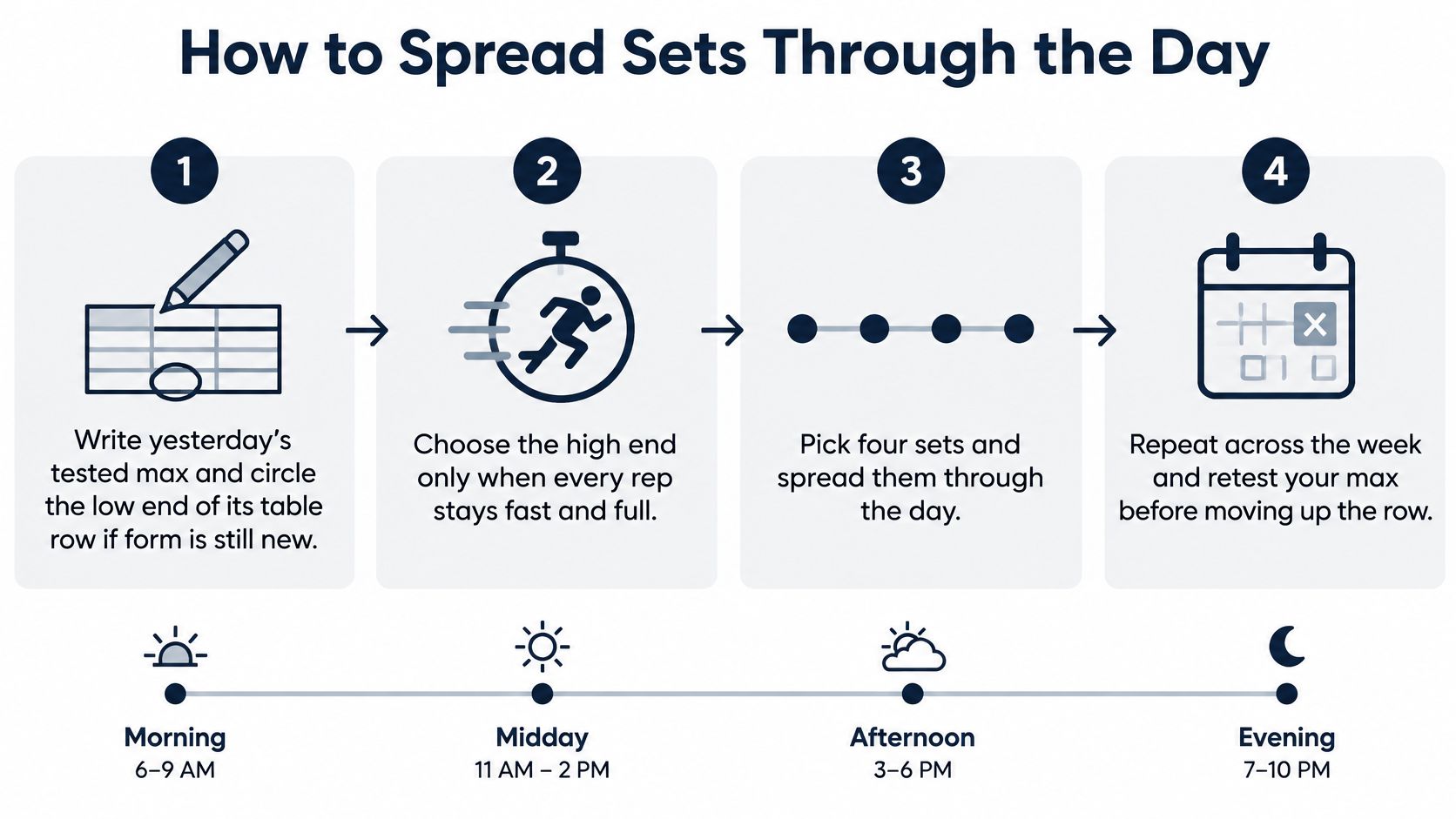
Build the day around things you already do. The kettle, the end of a call, a lunch break, and closing your laptop are more useful cues than a vague intention to exercise whenever you remember.
Use this visual as a reminder to separate planning, practice, and progression.
Make each opportunity predictable
The following is a sample routine to adapt, not a clinically validated schedule. Choose opportunities far enough apart that you begin each set feeling ready rather than partly recovered.
-
Write down your tested maximum and variation. Include whether you used the floor or a counter. Otherwise, you can accidentally compare different exercises.
-
Circle the low end of your table row. Treat the higher end as an option for later, not a target you're supposed to reach by evening.
-
Attach sets to existing events. Pick cues that happen reliably and leave you access to a suitable surface. A cue that regularly occurs while you're commuting won't help.
-
Set up deliberately. Place your hands in a comfortable position around shoulder width, brace your trunk, and check that your surface can't move.
-
Perform the planned set without rushing. Lower under control and press smoothly. Don't bounce off the bottom to make the repetitions feel easier.
-
Finish with an obvious reserve. If you're debating whether another clean repetition is possible, you've already pushed past the intended effort.
-
Return to an ordinary task before repeating. For this sample plan, leave at least a quarter of an hour between opportunities, preferably longer. The clock is a scheduling aid, not proof that you're recovered.
-
Stop once the planned practice is complete. Don't add sets just because you keep walking past the kitchen.
-
Record what you did. Note an early stop or an easier variation rather than logging the intended amount.
-
Skip further push-ups if sharp pain appears. Don't repay missed repetitions at bedtime.
Keep the cue smaller than the workout
The common slip is turning every trigger into a negotiation: perhaps more repetitions, perhaps another set, perhaps a maximum test. Decide the dose beforehand so the cue only asks you to begin.
Our guide to building habits around repeatable actions can help you choose cues that fit your actual day. If you miss a cue, continue with the next suitable opportunity rather than rearranging the evening around it.
This demonstration offers another way to visualize the method in practice.
Keep a separate eye on your recent workload. If today's plan is a sudden jump from what you normally do, shorten it before starting, even if each individual set seems easy.
Your final check is visual rather than heroic: the last repetition of the day should still resemble the first. If it doesn't, adjust tomorrow's plan instead of congratulating yourself for finishing a deteriorating set.
When to Add Reps or Back Off
Count the work you complete across the week, not just the number of times you remember to exercise. Easy sets can still add up to a substantial pressing workload.
The Move Your Bones Physical Therapy summary of resistance-training guidance illustrates this with five sets of 10 repetitions on six days, totaling 300 repetitions per week. Its guidance emphasizes accumulated volume, gradual progression, and reducing work when joint discomfort appears.
Change the smallest useful variable
Keep your initial dose unchanged long enough to judge how you tolerate it. A comfortable afternoon doesn't tell you how your wrists will feel after repeated practice days.
The timings below are sample coaching checkpoints, not proven deadlines. Progress only when the observations in the left column apply.
When to hold, progress, or reduce push-up sets
| What you notice | Change this week | Leave alone or avoid |
|---|---|---|
| Every set still crisp after 1–2 weeks | Add 1–2 reps per set or one set, not both | Keep the push-up variation |
| Same weekly total feels stale but form is clean | Add a little volume or choose a harder variation | Avoid daily max tests |
| Last reps slow or the range shortens | Drop to the low end or remove a set | Don't add repetitions |
| Sharp pain or next-day ache changes ordinary tasks | Stop painful push-ups, get it checked, and substantially reduce practice before resuming | Don't train through pain |
| A new strict max after 2–4 weeks | Recalculate the working range from the new result | Don't retain an old dose that now feels near failure |
A harder variation changes the exercise, not just the number in your notebook. Feet-raised push-ups, a closer hand position, or a more controlled descent can increase difficulty, so reduce the repetitions rather than carrying your old set size across unchanged.
Joint symptoms take priority over progression. If pain affects reaching, dressing, or supporting yourself on your hand, don't experiment with more sets to see whether you loosen up.
Distinguish a plateau from accumulated fatigue
A plateau can mean the current practice no longer challenges you enough. It can also mean you're carrying fatigue from push-ups, other pressing exercises, sport, or manual work.
Check the direction of your performance before adding anything:
- Stable and comfortable: A small progression may be reasonable.
- Worse across successive days: Reduce practice and reassess recovery.
- Painful during ordinary movement: Seek an assessment rather than relying on a programming adjustment.
Keep your totals and brief technique notes together in a bodyweight workout journal. An entry such as “stopped early because depth shortened” is more useful than a daily total alone.
Retest when you're rested and symptom-free, using the original technique standards. If your maximum has improved, the old sets represent a smaller fraction of it. If your capacity has fallen, those same sets may now be too demanding.
Progression check: Change the plan because your record supports it, not because an easy workout feels insufficient.
Sample Days for Three Push-Up Maxes
The following are hypothetical schedules, not prescribed minimums. Each person uses the same principle but chooses a workload suited to their current movement and recovery.
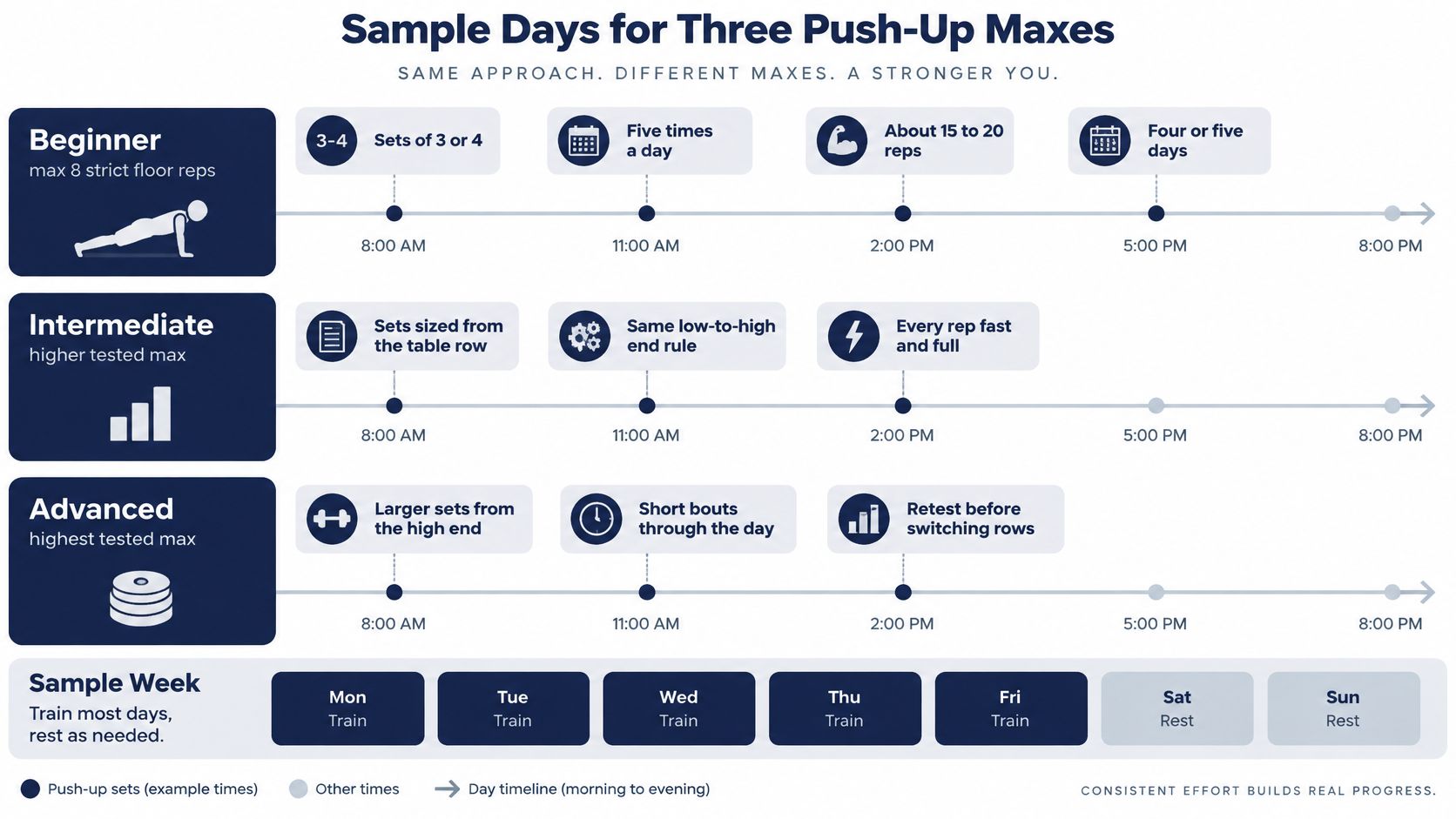
A beginner with an eight-repetition maximum
Suppose your strict floor maximum is eight. You could begin with three repetitions at each opportunity, occasionally using four when the movement remains comfortable.
A sample Tuesday might look like this:
| Everyday cue | Example time | Repetitions |
|---|---|---|
| Before breakfast | 7:30 a.m. | 3 |
| After an early work block | 9:15 a.m. | 3 |
| Before lunch | 12:30 p.m. | 4 |
| Afternoon break | 3:00 p.m. | 3 |
| Before dinner | 6:30 p.m. | 3 |
That hypothetical day totals sixteen repetitions. If even these brief floor sets become uneven, switch to a stable counter and establish the working amount for that incline rather than forcing the original plan.
The poor version squeezes several sets into the minutes before a meeting, then skips the rest of the day. That's a compressed workout, not the intended pattern of separated practice.
An intermediate with a twenty-repetition maximum
Imagine you can perform twenty strict push-ups. A sample day could use eight repetitions at six convenient breaks, totaling forty-eight repetitions, with no obligation to move toward the upper end of the table.
Choose a weekly schedule that includes time without push-ups. Don't insist on identical totals after a demanding upper-body workout or a poor night's sleep.
A strong trainee with a forty-repetition maximum
For someone whose strict maximum is forty, four sets of sixteen would total sixty-four repetitions in this example. That's already a meaningful amount of pressing practice without choosing the largest set available.
Alternatively, the trainee could replace some floor practice with a harder variation. The repetition target would then need recalibrating for that movement, not copied from the floor maximum.
These examples count push-ups only. A row using secure equipment, a squat or bridge, and suitable mobility work belong elsewhere in a balanced week; they don't become extra push-up volume.
Choose the example closest to your ability, then keep only the triggers you'll realistically encounter. A smaller schedule you can repeat is more useful than a crowded timetable you keep abandoning.
What Frequent Push-Ups Will Not Replace
Spreading the same weekly work across more sessions isn't automatically a superior training program. The Escape the Matrix guide to daily push-ups summarizes reviews finding little or no additional strength or muscle-size benefit from higher frequency when weekly volume is matched.
That doesn't make frequent practice pointless. It makes the outcome important: easier scheduling, more opportunities to rehearse a specific movement, and a manageable way to accumulate activity are different benefits from maximizing muscle growth.
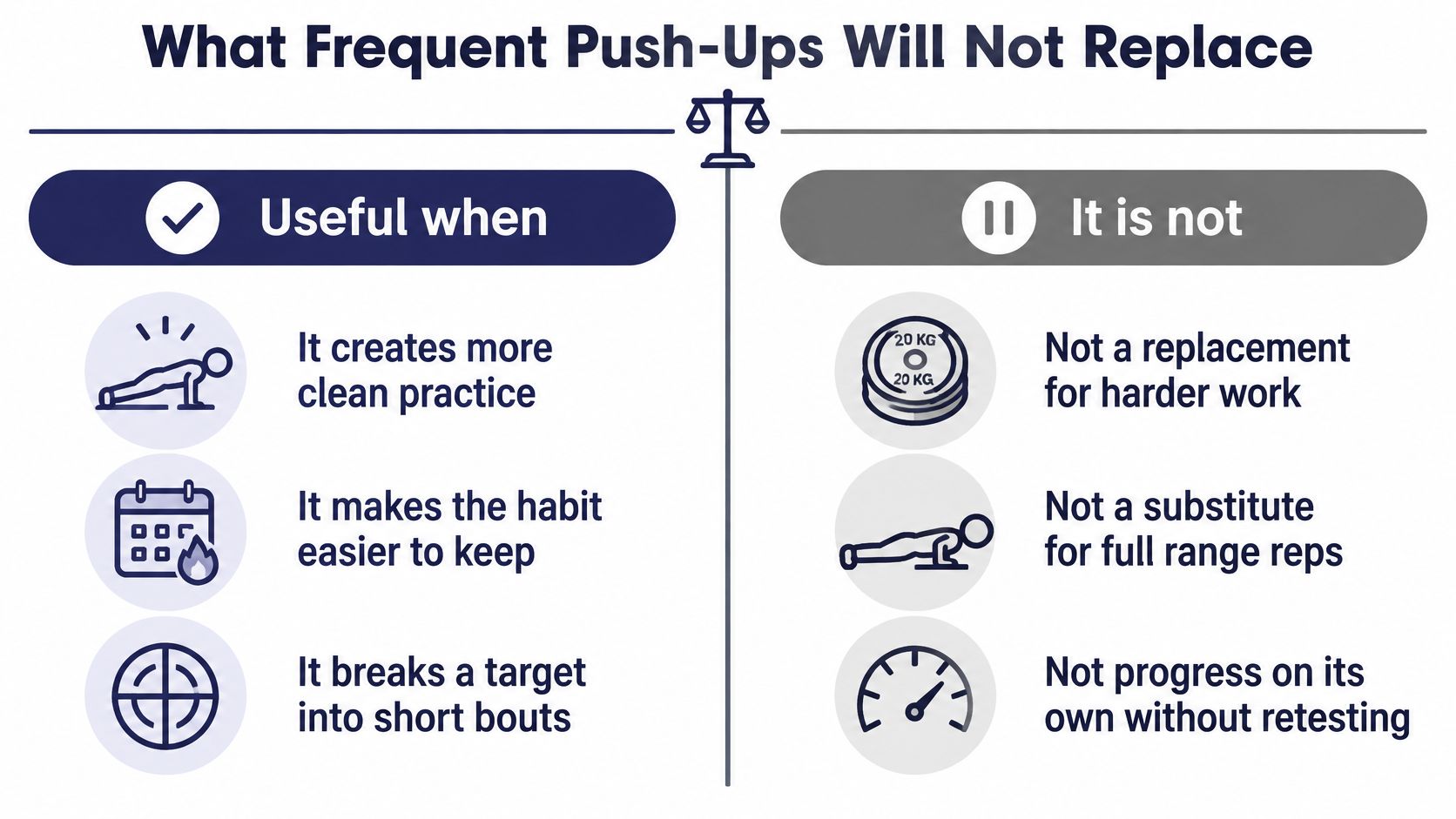
Brief exercise and easy practice aren't identical
Exercise snacks describe a broad category, not a synonym for grease-the-groove push-ups. Some involve hard efforts and breathing demands that deliberately easy push-up practice doesn't reproduce.
Yahoo Health's summary of a 2019 review covering 19 studies and 1,080 participants reported broadly comparable outcomes between accumulated and continuous exercise when total work was comparable. That supports dividing suitable exercise into shorter bouts, not a specific promise about this push-up routine.
Match the rest of training to your goal
If push-ups are currently your only exercise, broaden the week before endlessly increasing their frequency.
- For balanced strength: Include pulling and lower-body movements, with appropriate resistance and recovery.
- For muscle growth: Plan progressively challenging work and some harder sets rather than assuming easy practice covers every need.
- For maximal strength: Practice with resistance appropriate to the strength task you want to improve.
- For comfortable movement: Include mobility where you need it, rather than expecting more pressing to address every restriction.
A capable push-up trainee can still have undertrained legs or little pulling capacity. Skill at a floor exercise also doesn't establish readiness for a heavy barbell lift.
Keep easy practice in its role. If you add demanding chest, shoulder, or triceps training, reduce the extra push-up work to make room for it.
More opportunities to exercise are useful only when you can recover from the work you actually perform.
Start This Week on the Low End
Choose a dose you won't need to bargain with. Establish a pain-free baseline, select the conservative end of the matching row, and attach practice to a few reliable moments in your day.
Leave missed opportunities behind. There's no benefit in creating an evening catch-up session just to make the record look complete.
Make the record honest
A paper tick beside each completed set is enough. Add a short note when you shorten a set, change the incline, or skip practice because something hurts.
Judge the week by the quality you maintained and how you felt between practice days. Don't compare your total with someone who has a different starting maximum, training history, or schedule.
If you prefer a visible record, our SuperStrong iPhone app logs bodyweight sets as tiles on a shared wall with up to four friends. Tap the big key, choose the exercise, enter the repetitions, and confirm; eight push-ups makes a small tile, while thirty makes a big one.
Let easy remain easy
A larger tile isn't an instruction to perform more. Record the repetitions that fit your plan, including the modest sets that leave you ready to practice again.
SuperStrong is a log, not a coach, and it isn't medical advice. Check with a doctor before starting an exercise programme, particularly if you have shoulder, elbow, or wrist pain.
For a conservative start, treat the opening fortnight as a trial of the same manageable dose rather than a race to progress. Move to a harder week only when the current one feels easy, your movement stays consistent, and your joints remain comfortable.
Keep your short push-up sets visible without turning every set into a maximum test. Visit SuperStrong to explore an iPhone log that records your practice as tiles on a shared wall, and start with the easy sets you can repeat comfortably.