How to Build Habits: A Six-Step Exercise Routine
 14 min
Habit formation can take far longer than a motivational challenge suggests. In Phillippa Lally and colleagues' study in the European Journal of Social Psychology, the estimated time to reach near-maximum automaticity ranged from 18 to 254 days among participants whose results fit the researchers' model. That spread changes the question from how quickly you can finish building a habit to how you can make an action easier to repeat.
For exercise, that means choosing a manageable action, giving it a dependable place in your day, and adjusting without treating every interruption as failure. Learning how to build habits is less about proving your discipline and more about designing something you can keep doing.
Table of Contents
- Realistic Habit Timelines Based on Research
- How to Build a Habit in Six Steps
- Exercise Snacks as a Starting Point
- Setting Daily Goals and Accountability That Stick
- Fixing Plateaus, Missed Days and Stalled Habits
- Pick Your First Habit and Start This Week
Realistic Habit Timelines Based on Research
Habit formation rarely follows a fixed deadline. In Lally and colleagues' study, 96 volunteers chose a health-related behavior, such as eating, drinking, or physical activity, and tried to do it daily in a consistent context. They recorded whether they performed the action and how automatic it felt. The researchers measured automaticity, not fitness gains, enthusiasm, or perfect attendance.
Habit timelines from the research
The figures below describe the study's modeled estimates, not a deadline everyone should expect to meet.
| Source | Measure | Value |
|---|---|---|
| Lally et al. 2010, 96 volunteers | Median days to 95% of individual automaticity | 66 days |
| Lally et al. 2010, 96 volunteers | Individual range | 18 to 254 days |
| Common popular claim | Fixed deadline | 21 days, not supported by this study |
The median is the midpoint of the estimates, while the individual range shows how much timelines differed. Neither predicts exactly when your own exercise routine will feel automatic.
Near-maximum automaticity does not mean effortless behavior. Starting may involve less internal debate, while still requiring you to prepare a space, choose an exercise, and allow for recovery.
Review the experience, not just the calendar
Set an early review point, not a graduation date. After several weeks, ask whether you notice the cue more readily, begin with less negotiation, or rely less on reminders.
Progress check: Judge whether starting has become easier, not whether you've reached a supposed habit deadline.
Keep behavior and training outcomes separate. Remembering to do squats is a habit question; becoming stronger is a training question. A routine can become easier to start before it provides enough challenge to improve strength.
How to Build a Habit in Six Steps
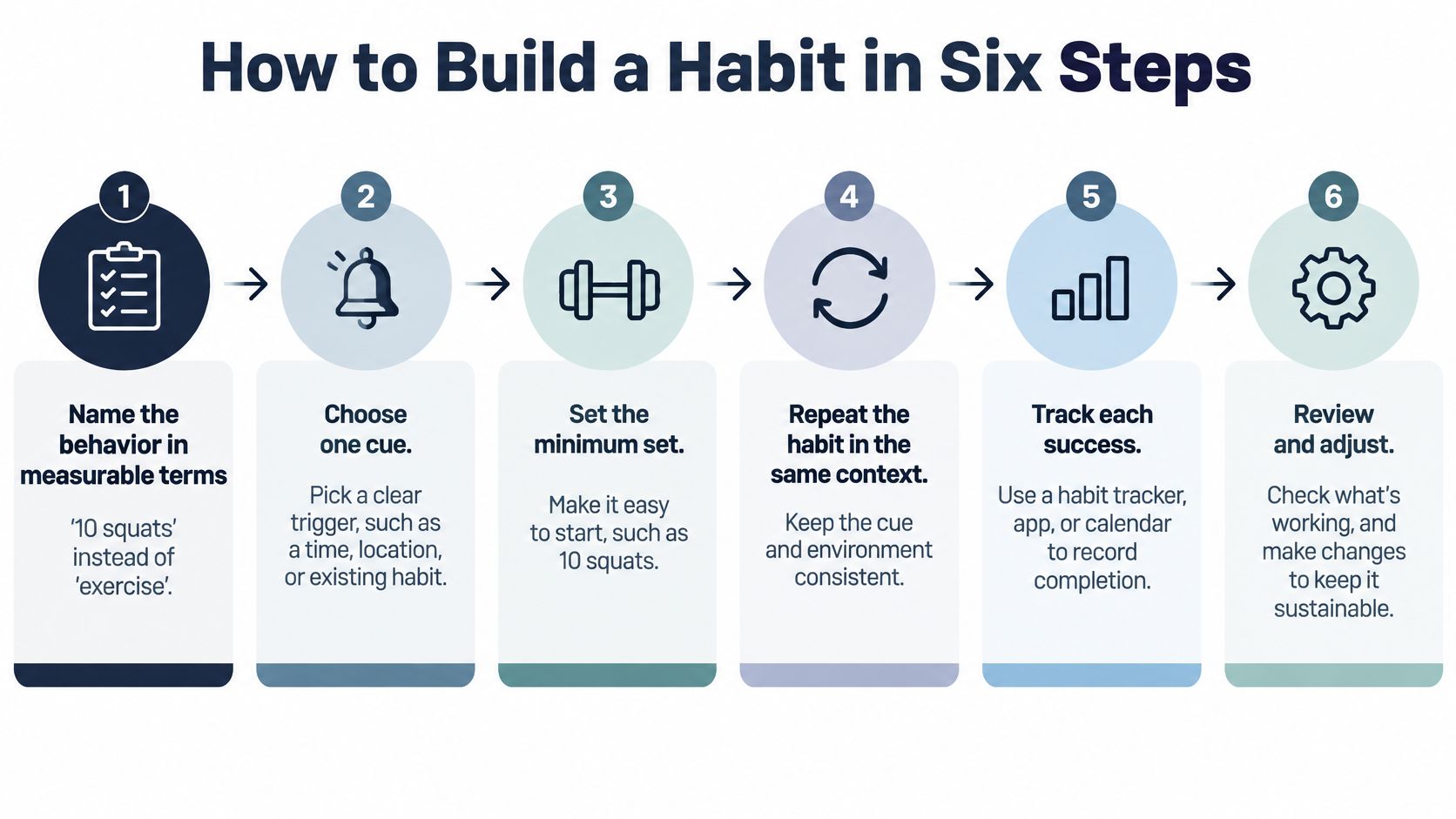
Start with a procedure you can follow when you're busy, not just when you feel motivated. Specific actions and stable contexts give you something concrete to practise; vague intentions leave the decision open every time.
Make the action repeatable
-
Name an observable behavior. Choose a measurable target, such as a small set of squats, rather than a broad ambition to exercise more. The common slip is defining success so vaguely that you can't tell whether you completed it.
-
Write an if-then cue. For example, decide that if you finish brushing your teeth on a training morning, then you'll perform your set. This connects the action to an event you can recognize, rather than depending on remembering it sometime before bed.
-
Keep that cue stable. Use the same routine and location whenever practical, so you aren't rebuilding the arrangement each day. If your schedule varies, choose a sequence, such as after waking and washing, instead of a clock time you regularly miss.
-
Lower the cost of starting. Clear a safe space and choose a version you can perform comfortably, such as wall push-ups rather than floor push-ups. Avoid choosing a minimum that already feels like a demanding workout, because it leaves no room for a difficult day.
-
Record completion immediately. Our logging process is to tap the big key, pick an exercise, set the reps or seconds for a hold, and confirm, so the tile lands on the wall. Record what you completed rather than rounding up to match your intention.
-
Increase difficulty only when execution is dependable. First look for a routine you start reliably and a set you can complete with controlled technique. The usual mistake is treating an enthusiastic session as permission to make every future session harder.
Separate the minimum from optional work
Your minimum set is the version that counts as success, not a warm-up you must follow with more. You can do extra work when it fits your capacity and recovery, but don't turn the optional portion into the new requirement.
Say you choose wall push-ups after your morning bathroom routine. Prepare the wall space beforehand, use a comfortable repetition target, and keep your logging method ready. You've removed several decisions before the cue arrives.
Enjoyment matters, too. If you dislike the movement or find the location awkward, choose a suitable alternative rather than assuming discomfort proves commitment. Keep the replacement specific enough to repeat.
A useful minimum is small enough to complete honestly, without bargaining over what counts.
At your early check-in, look for a recognizable sequence: the cue happens, you begin the planned action, and you record it promptly. That's a more useful sign than feeling excited about exercising every morning.
Exercise Snacks as a Starting Point
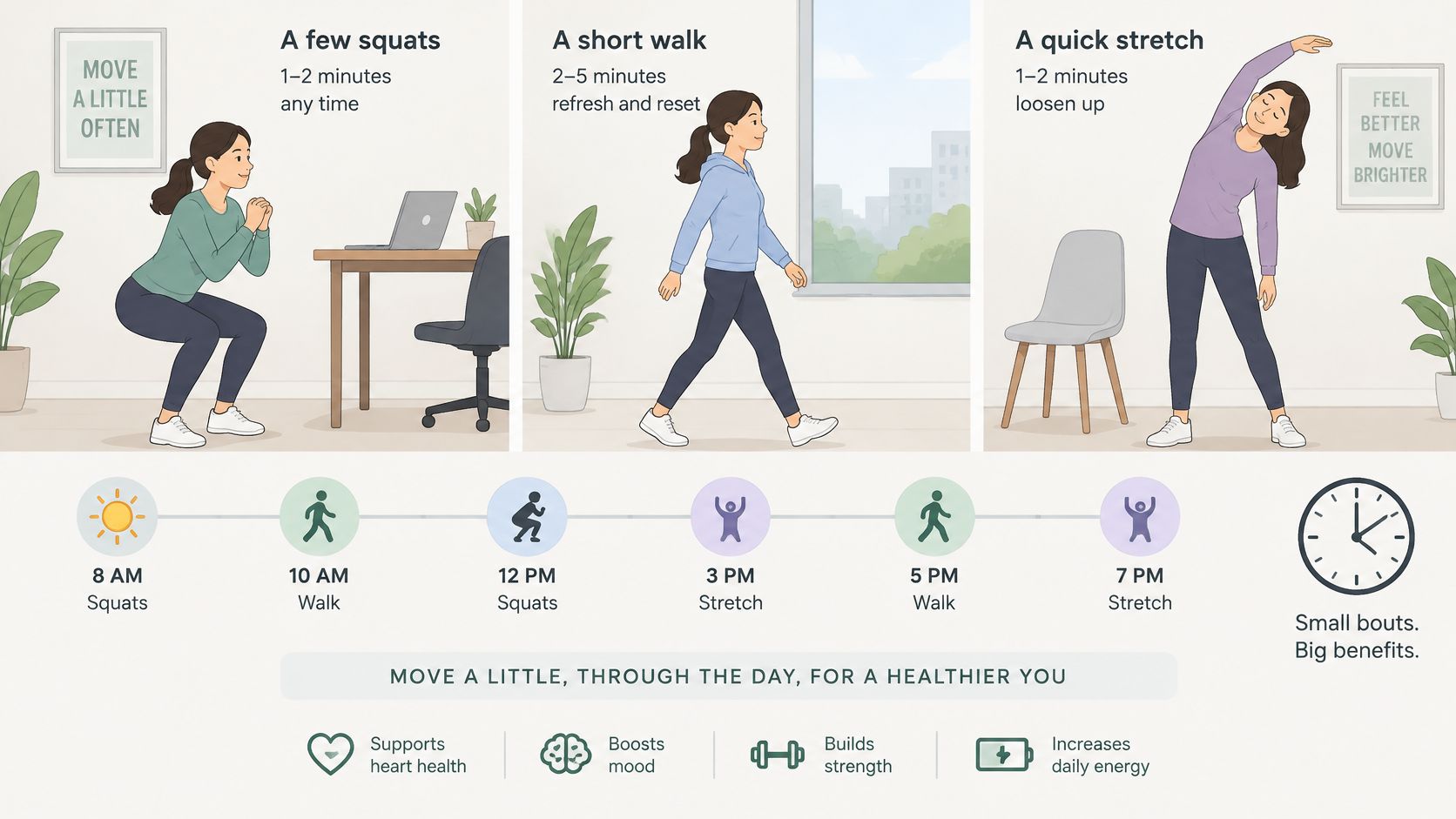
A British Journal of Sports Medicine blog synthesis described 11 randomized trials involving 414 inactive adults in Australia, Canada, China, and the United Kingdom, with interventions using bouts of five minutes or less at least twice daily. That gives exercise snacks a more concrete meaning than doing a few random movements whenever you remember.
The evidence is encouraging, but it remains relatively small and short-term. It doesn't establish that any tiny amount of movement equals a complete training program, or that every brief bodyweight set will produce the same result.
Choose a dose you can recover from
For a beginner-friendly example, use a brief morning bout and another later in the day on training days, separated by hours rather than performed back-to-back. Keep each bout comfortably manageable and allow recovery days between harder efforts. This is a practical starting arrangement, not a proven optimal prescription.
Choose movements you can perform with control, and stop the set before fatigue makes your technique deteriorate. If you're unsure what to select, these exercise snack examples can help you identify movements that fit your space.
Know what brief bouts can't promise
Use your goal to decide whether the routine is enough:
- For practising attendance: A short, repeatable bout gives you a manageable action to schedule and complete.
- For substantial strength gains: You'll need appropriate resistance, progression, and recovery, not just more scattered easy repetitions.
- For substantial endurance gains: Assess whether you're accumulating enough relevant activity, and consider structured, longer sessions.
- For progression: Increase effort only when the present target feels comfortable, and avoid changing duration, difficulty, and frequency together.
A longer session isn't automatically necessary for everyone, and adding one doesn't automatically create a balanced program. The question is whether the overall work matches your goal and current capacity.
Exercise snacks are an adherence gateway. Use them to establish participation, then periodically assess whether you need a more developed training plan.
Setting Daily Goals and Accountability That Stick
Choose a goal that reflects what you can currently do, not what you wish you could do. Our daily goal is a suggestion drawn from your own past sets, so the starting point comes from your recorded activity.
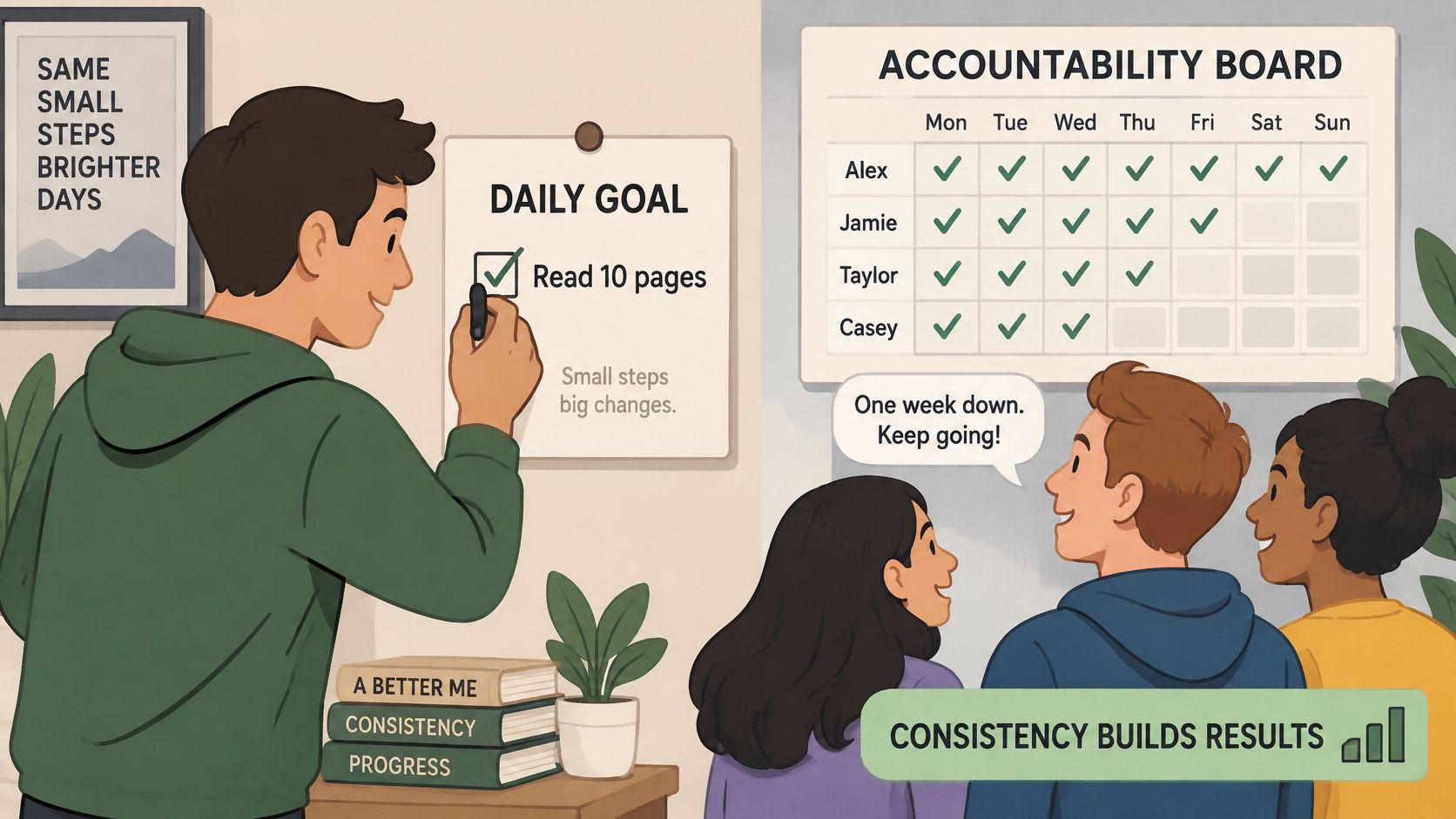
Visible accountability should make returning easier, not make you anxious about being watched. A small, familiar group can be a sensible choice when you want personal encouragement rather than a public audience.
Keep the purpose of your shared record clear.
Agree on expectations before inviting friends
Our training rhythm has three training days and four rest days, with a small goal on each training day. A planned rest day isn't a missed workout, and your group should know the difference before interpreting an empty space as a problem.
To create a shared wall, start from the Friends tab and share its invite code with up to four friends. Choose people who'll respect your schedule and respond constructively when you need to adjust.
Say a night-shift nurse and her sister want to train together without matching workout times. Each completes her own scheduled set and checks the wall when convenient. They agree to acknowledge effort without comparing totals, since their starting abilities and working hours differ.
A workout app with friends is most useful when everyone understands what support should look like. Ask whether each person wants a reminder, encouragement, or quiet visibility.
Use the video as a prompt to discuss how you'd like to share progress.
Set a simple group agreement
- Choose a grounded goal: Start from completed sets rather than someone else's numbers.
- Recognize recovery: Agree that planned rest doesn't need an explanation.
- Plan a helpful response: After an unexpected absence, ask what would make returning easier instead of demanding justification.
Accountability isn't permission to pressure someone through pain, exhaustion, or illness. Keep the relationship more important than the record.
Fixing Plateaus, Missed Days and Stalled Habits
A missed occasion doesn't erase your previous practice. The British Psychological Society's explanation of Lally's habit study emphasizes repetition in a consistent context and notes that missing an opportunity wasn't equivalent to habit failure.
Before changing the routine, identify the problem. Forgetting to start, dreading the set, and finding the exercise physically easy are different situations. They shouldn't all lead to adding more repetitions.
Habit symptoms, causes and fixes
Treat these as troubleshooting possibilities, not diagnoses. The time windows are practical review examples, not research-established deadlines.
| Symptom | Likely cause | Fix |
|---|---|---|
| Missed one or two days | Normal variation, not failure | Resume at the same minimum set on the next scheduled day |
| Skip the same slot every week | Cue is weak or has moved | Attach the set to a routine you already do every day |
| Reps feel easy for two weeks | Goal stayed too small | Move up one week in the plan |
| Dread before starting | Set too big for a bad day | Drop to the minimum version for two weeks |
| Progress stalls for several weeks | Volume added before the cue held | Keep volume, keep the cue, review at six weeks |
Check the cue first, the size of the set second, and training volume last. If you repeatedly miss a lunchtime workout because meetings overrun, increasing the target won't fix the scheduling conflict.
Adding volume before you reliably begin can make the action harder to repeat. Reduce the practical obstacle first, then assess whether the workload needs to change.
Distinguish a habit plateau from a fitness plateau
A habit plateau means starting hasn't become easier or more dependable. A fitness plateau means the physical outcome you care about isn't improving. Holding the cue steady may help the first problem, but it doesn't prove that your training dose is sufficient for the second.
Our progression rule is to move up to a harder week when the current week feels easy. Don't interpret that as permission to ignore poor technique, persistent pain, or inadequate recovery.
Troubleshooting rule: Change one variable at a time so you can tell whether the adjustment helped.
You can resume after an isolated miss at your next appropriate opportunity. Rebuilding a disrupted routine requires repeated practice, so don't judge a new cue after a single attempt.
If your interruption has become an extended absence, use a return-to-exercise approach after a long break rather than trying to repay missed sessions. Resume from your current capacity, not from a previous personal best.
Pick Your First Habit and Start This Week
Choose an action you can begin without reorganizing your life. You don't need to solve your entire fitness routine before practising a dependable start.
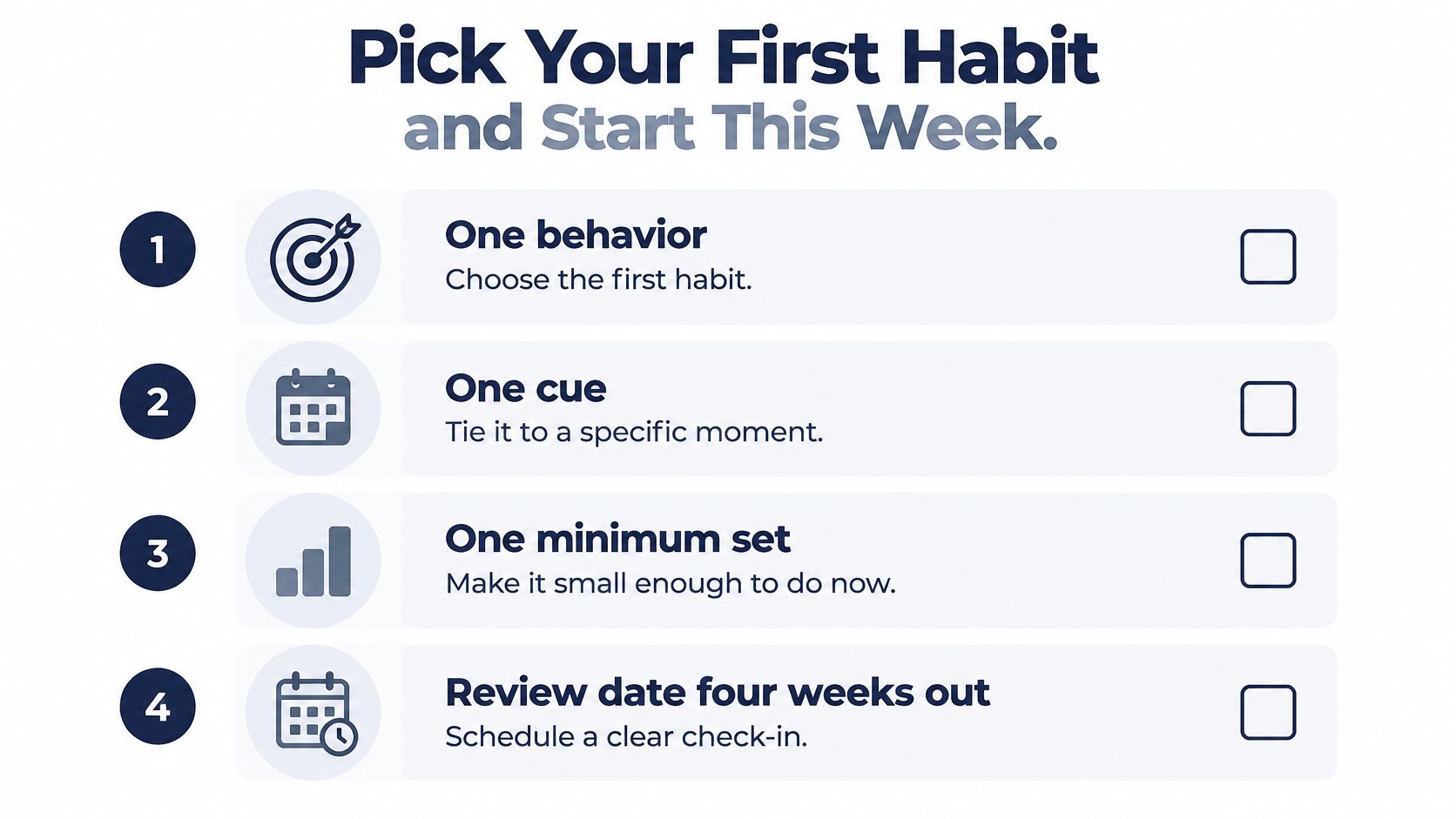
Use this checklist to turn your intention into a concrete commitment.
Make your starting decision
-
Pick an exercise and a measurable target. For example, choose a comfortable number of wall push-ups rather than a general promise to get fitter. Select something suitable for your present ability.
-
Write your cue in a complete sentence. Specify what you'll do after a routine event on a training day. Keep the sentence somewhere you'll encounter it before that event.
-
Define your minimum success. Decide what you can reasonably complete on a busy, low-motivation day. Illness, injury, or concerning symptoms call for a different decision, not pressure to preserve attendance.
-
Complete and record the first set. Log only the work you performed. Treat the record as information about your starting point, not a score of your character.
-
Schedule a review. For example, put a check-in four weeks from your start date on your calendar. Decide then whether to keep the target, simplify the arrangement, or progress.
SuperStrong is a log, not a coach, and it isn't medical advice. Check with a doctor before starting an exercise program, and seek appropriate guidance when you're unsure which movements or effort levels are suitable.
Choose your minimum today and prepare the place where you'll do it. Start with that action instead of postponing everything until you can follow a full plan.
SuperStrong is an iPhone app that records bodyweight exercise sets as tiles on a wall, giving you a visible record of completed work. Visit SuperStrong to log your first manageable set and build from what you do.