Renegade Push Ups
 13 min
You're halfway through a set, one dumbbell is glued to the floor, and your hips start trying to open up before the row even begins. That's the moment when the weakness shows, and renegade push ups reveal that they are not just a harder push-up, they're a stability test that exposes every weak link in the plank.
The movement looks simple from a distance. In practice, it asks for a strict press, a controlled row, and a torso that refuses to twist while one arm leaves the ground. That combination is why it shows up in functional fitness and MMA circles, and why it's still one of the easiest exercises to do badly and the hardest to fake well. Modern coaching sources trace its popularization to the early 2000s, with one guide describing it as a way to build core stiffness and pulling strength at the same time, and another linking its spread to strength coach John Davies, plus a 2013 magazine description of the drill performed with light dumbbells. The workout guide's history note on renegade rows
Table of Contents
- Why Renegade Push-Ups Feel Different
- Setting Up Your Position Correctly
- The Movement Sequence Explained
- Core Engagement and Anti-Rotation
- Regressions for Every Level
- Building Your Set and Rep Strategy
Why Renegade Push-Ups Feel Different
The first time someone tries renegade push ups, the surprise usually isn't the push-up. It's the row. The second surprise is how quickly the body wants to rotate when one hand leaves the floor, even if the chest strength feels fine.
The exercise changes the job your core has to do
A standard push-up lets both hands share the load. A renegade push-up forces one side to stabilize while the other side rows, which makes the torso fight rotation the whole time. That's why the movement feels heavier than a regular push-up plus a row done separately, even before the dumbbells get challenging. The value comes from the combined demand, not from chasing fatigue.
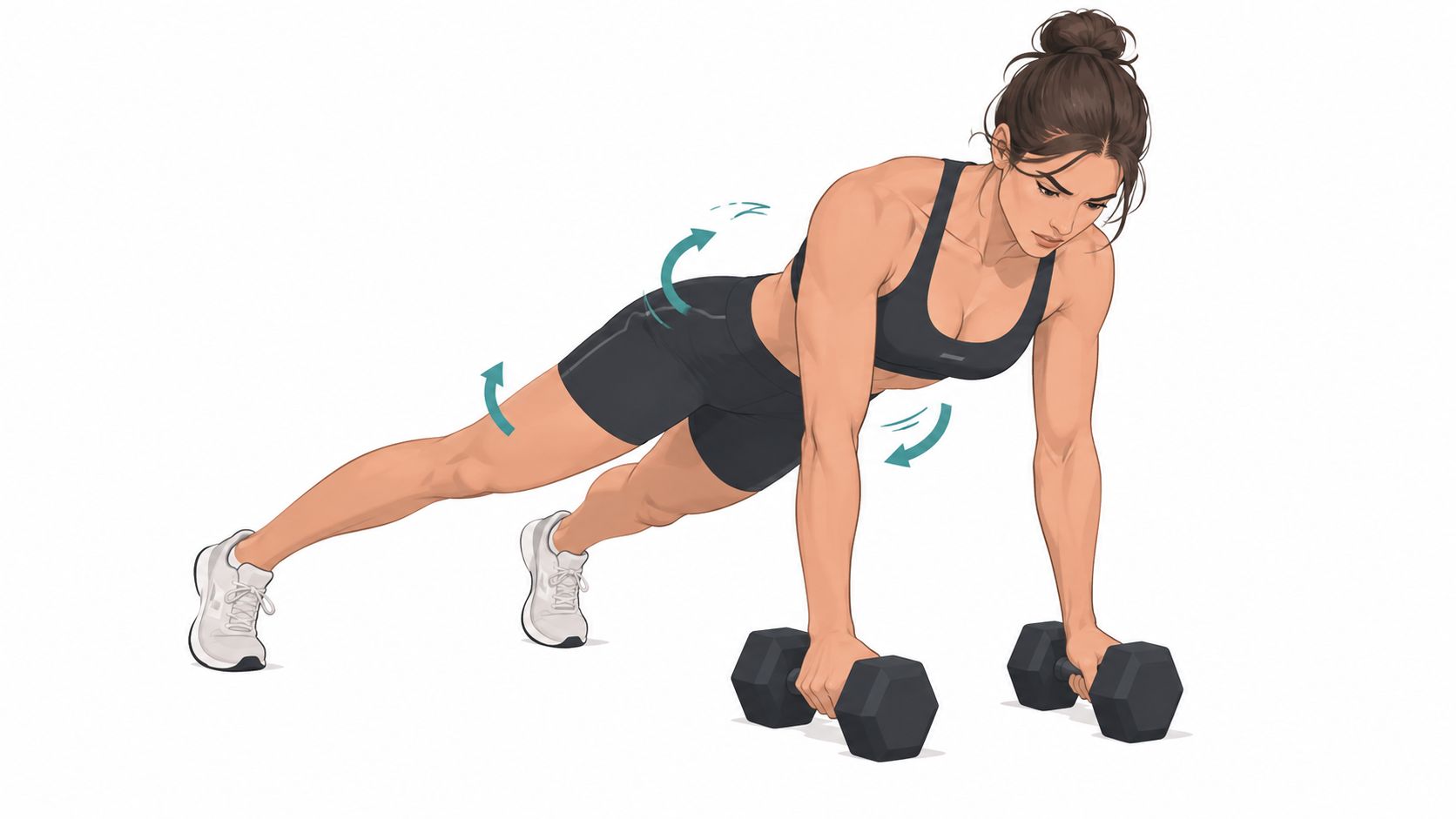
A lot of lifters misread that sensation and assume they need to go heavier. In reality, the movement punishes impatience. The more the hips twist or the shoulders shift, the less the set looks like a core drill and the more it turns into a messy compensation pattern.
Practical rule: if the plank breaks before the reps are done, the variation is too hard for that day.
Why the instability matters
The point isn't to survive instability for its own sake. The point is that the exercise makes the torso work while the upper body alternates between a bilateral press and a unilateral pull. That's the unique training effect. If you understand that, the exercise stops feeling random and starts feeling deliberate.
The best coaches treat it as a hybrid movement, not a chest builder, not a pure row, and not a balance trick. That framing matters because the core target is the anti-rotation demand, and that demand changes how you choose load, stance, and tempo. If the body can't hold shape, the exercise is telling you to simplify, not to push harder.
Setting Up Your Position Correctly
Renegade push ups start before the first rep. If the setup is sloppy, the set is already lost. The dumbbells, stance, and brace have to create a platform that doesn't collapse the moment one hand unweights.
Build the plank before you move
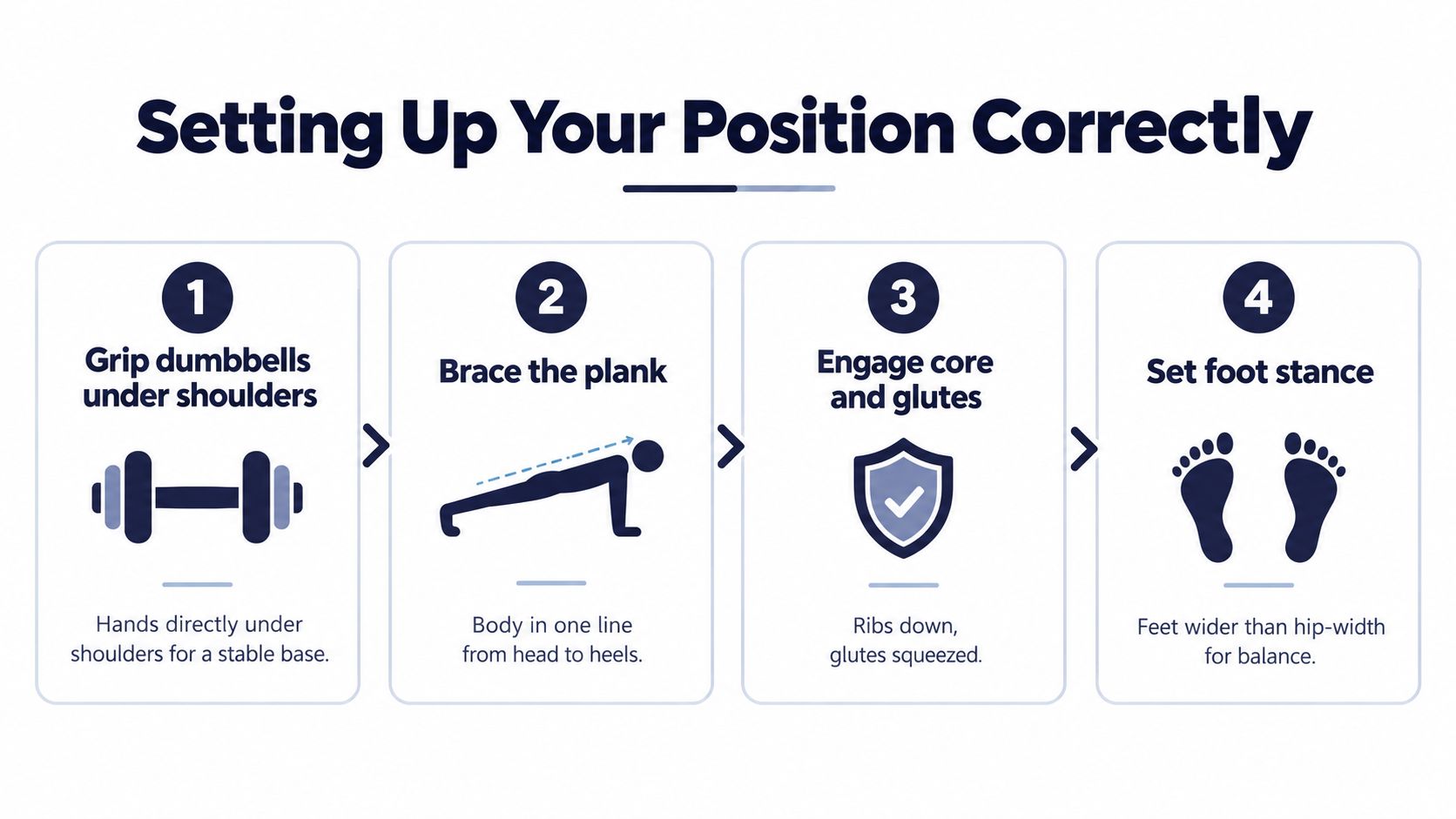
Get into a high plank with your hands on dumbbell handles or hex dumbbells, and place the shoulders directly over the wrists. Set the feet wider than hip-width, because that wider base gives you the anti-rotation control you need once one arm leaves the floor. Keep the body in a straight line from head to heels, with the ribs down and the glutes on.
If you've ever watched your low back sag in a push-up, that same fault shows up even faster here. The exercise doesn't forgive loose positioning because the row creates a pull that tries to rotate the pelvis. A stable start is what lets the rep stay clean.
Lock the sequence before the row happens
The rep should start with the push-up phase, not with a rushed tug of the dumbbell. Lower under control, keep the elbows tucked roughly 45° from the torso, and let the chest descend close to the dumbbells. Then press back up before rowing one dumbbell to the hip and returning it to the floor.
Keep the feet wider than you think you need. Most people narrow the stance too early and then blame their core when the torso twists.
The setup also tells you what kind of load you're ready for. If the dumbbells are so tall, unstable, or awkward that the shoulders drift forward, the base is wrong before the first rep. When the position is right, the movement feels hard but organized. When it's wrong, everything becomes a fight.
The Movement Sequence Explained
The sequence matters because each transition is where the torso wants to leak. A clean rep is not about muscling the dumbbell up as fast as possible, it's about keeping the whole body square while the arms alternate jobs.
Push first, then row
Lower into the push-up with the elbows tucked, not flared. That elbow path protects the shoulders and keeps the press consistent with the plank position. The chest should come close to the dumbbells while the spine stays long, the hips stay level, and the head doesn't crane forward.
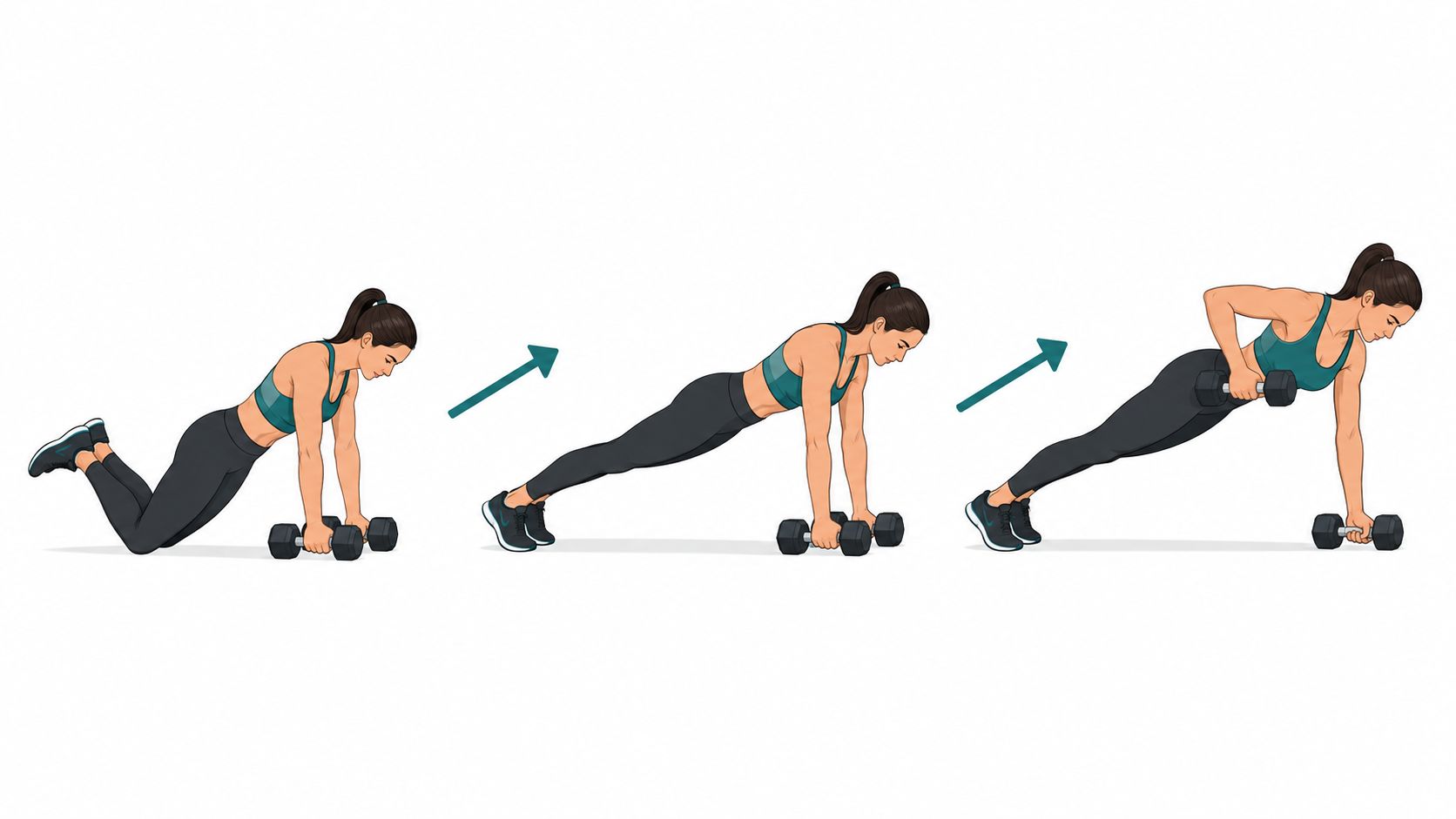
Once you reach the bottom, press back up. Only then row one dumbbell toward the hip, return it to the floor, and repeat on the other side. The order matters because the row is easier to control when you've already re-established your plank at the top of the push-up.
Slow reps expose bad habits fast
When athletes rush the sequence, they usually lose shoulder position first, then the pelvis starts to turn, then the lower back takes over. That's why slow controlled reps are more useful than fast ones. The movement is built around resisting motion, so speed strips away the very thing that makes it worthwhile.
The torso should stay square, and the rowing elbow should travel past the torso without the pelvis twisting open. If the opposite hand comes off the floor too early, the set is already drifting into compensation. Clean reps look calm because the hard part is controlling what doesn't move.
Core Engagement and Anti-Rotation
Renegade push ups earn their reputation here. The exercise is valuable because it doesn't just load the chest and triceps, it forces the trunk to resist rotation while the upper body alternates between pressing and rowing.
What actually has to fire
The obliques, transverse abdominis, quadratus lumborum, and psoas all have to hold isometrically to keep the pelvis steady. That is the technical payoff. You're not just moving weight, you're preserving alignment while one side of the body tries to pull the other side out of position.
That anti-rotation demand is also why the movement feels meaningfully harder than doing push-ups and rows separately. The core isn't a background player here. It's the part of the system that makes the whole lift possible.
Compare the full version with regressions
If the hips rotate during the row, the first adjustment is usually stance width. Expert guidance notes that widening the feet to about 40–50 cm can improve stability when rotation shows up, and that's often enough to turn a messy rep into a controlled one. If the body still twists, the load is too heavy or the variation is too advanced right now.
For some lifters, kneeling renegade push ups make the anti-rotation demand manageable without losing the pattern. For others, an elevated version on a bench or sturdy surface reduces how much bodyweight has to be controlled while the pattern stays intact. Both regressions let the athlete practice the same sequencing with less strain on the shoulders and trunk.
If the side-to-side movement is obvious, reduce the load or slow the cadence before trying to “power through” it.
A useful way to think about the exercise is this. The goal isn't to make the body wobble. The goal is to keep the wobble small enough that the core can do its job. For a related trunk-strength option, see side crunch variations, but don't treat that as a substitute for the anti-rotation challenge here.
Regressions for Every Level
Not everyone should start with the full version, and that's fine. The smartest progressions are the ones that preserve the pattern while lowering the demand enough for clean reps.
Knees or elevation, depending on the failure point
If your hips sag in a full plank, go to the knees first. That keeps the press-and-row pattern while reducing the lever that's pulling your midsection out of position. If your shoulders or wrists feel overloaded but your torso is stable, use a raised surface instead, because the angle cuts down the total bodyweight you're supporting.
A good regression should feel demanding but honest. If you can keep the chest square and the pelvis level, the variation is doing its job. If the form still breaks, you're not under-trained, you're just not at that variation yet.
Use the regression as a bridge, not a parking spot
Once clean reps happen consistently, move back toward the floor and keep the cadence controlled. Don't chase the hardest setup just to say you're doing the “real” version. The right version is the one you can repeat without losing the plank.
The same principle applies to pulling strength and body control in general, including bear crawl work that teaches coordinated bracing and limb loading. A related drill can help reinforce that mindset, and you can pair it with bear crawl exercises when you want a simpler anti-rotation bridge.
Building Your Set and Rep Strategy
The right set and rep plan depends on whether the goal is skill, strength, or just making sure the movement stays clean. If the torso is fighting to stay square, more reps aren't automatically better. Better reps are better.
Pick the dose that matches your current control
Beginners should use a low enough target that the last rep still looks the same as the first. A practical starting point is 3 sets of 5 to 8 reps per side, but only if those reps stay controlled and the plank doesn't unravel. If the core gives out before the lower end of that range, the load or variation is too aggressive.
Intermediate lifters can extend the work slightly and keep the same discipline. 3 to 4 sets of 8 to 12 reps per side makes sense only when the stance is stable and the shoulders stay packed. The dumbbells should challenge you without turning the rep into a fight for survival.
Keep the goal visible in the mirror, not in the ego
The metric that matters is not how much weight you can move with a twisted torso. The metric is how many clean reps you can perform while the body stays nearly motionless from the ribcage down. That's the difference between training the pattern and just surviving the set.
Coach's shortcut: if every rep needs a reset, the load is too heavy for the purpose.
For home training, short, repeatable sessions work better than occasional hard sessions that leave the movement sloppy. A simple bodyweight log, like the one used in bodyweight workout journal, helps keep the goal honest because it makes clean sets visible over time. SuperStrong is one option for tracking short at-home bodyweight sets on an iPhone, with a shared wall for up to four friends and a simple three-days-per-week rhythm.
The best use of renegade push ups is not as a burnout finisher done when you're exhausted. It's as a controlled drill that rewards patience, shoulder position, and trunk stiffness. If you treat it that way, the exercise does exactly what it's supposed to do, it teaches the body to press, row, and resist rotation at the same time.
If you want a simple way to track short home sessions and keep your renegade push ups honest, try SuperStrong. It turns quick bodyweight work into visible sets on a shared wall, which makes it easier to stay consistent with the kind of controlled training this movement needs.