How to Do Side Crunches Correctly: Step-by-Step Guide
 14 min
2–4 sets of 10–15 repetitions per side, performed 2–3 times per week, is a practical target for side crunches. Use a controlled 2-1-1-0 tempo and lift only about 15–25 degrees, rather than swinging through a large range.
The most popular advice about side crunches is also the reason so many people perform them badly: “twist harder.” A side crunch isn't a frantic sit-up with rotation added. It's a short, deliberate contraction of the side of your trunk, and the moment your ribs swing past your hips, your obliques stop doing the job you intended.
The waist won't change because you collected hundreds of loose repetitions. Your training will improve when you can keep the pelvis quiet, separate lateral flexion from rotation, and make each repetition look almost boring. That's the standard worth chasing.
Table of Contents
- What Side Crunches Actually Target
- How to Perform a Floor Side Crunch
- Common Mistakes That Kill Oblique Tension
- Regressions and Progressions by Level
- Fitting Side Crunches Into Short Sessions
- Closing Thoughts on Oblique Training
What Side Crunches Actually Target
Side crunches are commonly described as an oblique-focused variation of the abdominal crunch. The main action combines spinal flexion with lateral flexion, with a small amount of trunk rotation possible depending on the variation and how it's coached. That combination places emphasis on the internal and external obliques rather than treating the entire midsection as one undifferentiated muscle.
A standard crunch mainly brings the rib cage toward the pelvis in the sagittal plane. A side crunch adds a side-bending component, so the upper shoulder and rib cage move toward the same-side hip. It's not the same as hiking the hip toward the ribs, and it's not a standing side lean where the torso just collapses sideways.
Modern exercise guidance commonly places side crunches at 2–4 sets of 10–15 repetitions per side, 2–3 times per week, with 24–48 hours between direct sessions. That template is described in this oblique abdominal crunch form guide. Treat it as a starting framework, not a requirement to force volume when your form has already deteriorated.
Range is the stimulus
The obliques don't need a dramatic arc to work. A useful repetition is short, controlled, and ends when you feel the side of your trunk contract strongly. Chasing the floor with your shoulder or trying to curl into a full side fold usually adds momentum, hip movement, or spinal compensation.
Use the 2-1-1-0 tempo as your mental metronome:
- Two seconds lowering: Return slowly instead of dropping.
- One-second pause: Settle without relaxing completely.
- One second lifting: Exhale and contract toward the same-side hip.
- Zero seconds resting at the top: Keep the peak brief and deliberate.
This is a bodyweight drill, but it still benefits from the same precision you'd use for a loaded exercise. If you're looking for another low-equipment movement that challenges trunk control through a different pattern, compare it with these bear crawl exercises.
The basic idea has been familiar in home fitness for decades. A 1997 LA Times fitness article described alternating the shoulder angle toward the opposite knee as an accessible way to train the obliques and suggested 10 repetitions as a beginner starting point. The modern lesson is less about copying an old routine and more about keeping the movement controlled enough that the intended muscles remain involved.
How to Perform a Floor Side Crunch
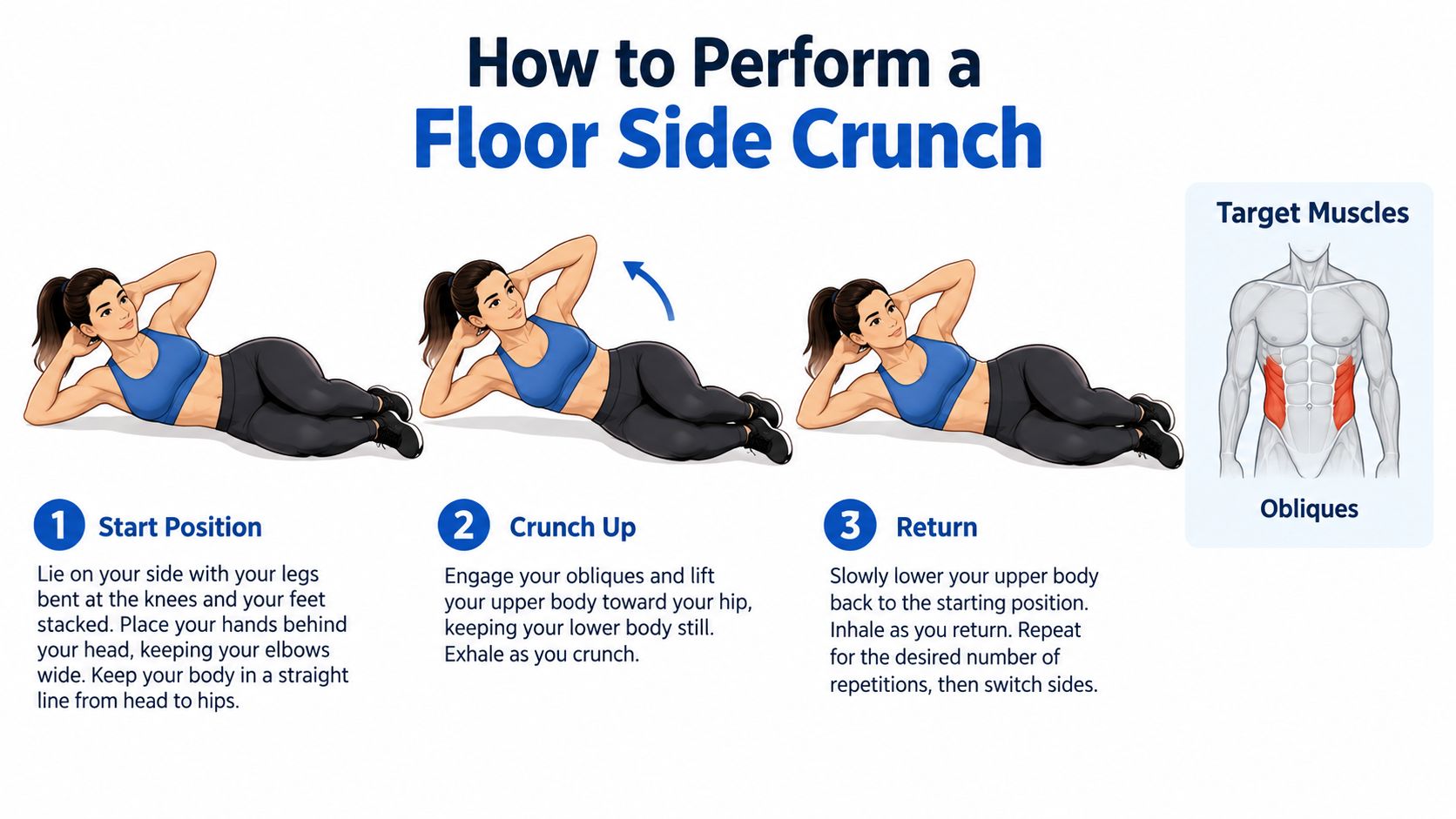
Start on your side on a firm mat. Bend your knees to about 90 degrees, stack them comfortably, and position your body so your head, rib cage, pelvis, and knees form a stable side-lying shape. Your legs should stay bent and relatively quiet throughout the set, because the floor variation is meant to reduce the temptation to turn the exercise into a hip-driven movement.
Place your lower arm wherever it allows your neck to stay relaxed. You can use the hand to support the head lightly, but don't interlace your fingers and pull. Place the upper hand across your torso or behind your head only if you can keep the shoulder from drifting forward.
Set the brace before lifting
Take a quiet breath in. As you exhale, lightly brace the abdominal wall as though you're preparing for a gentle tap to the midsection. “Lightly” matters. A maximal brace can make you rigid and encourage you to hold your breath, while no brace leaves the pelvis and ribs free to shift.
Keep both knees together and let the side of your waist contact the mat. Your starting position should already feel organized. If the upper shoulder is rolled forward, the neck is cranked upward, or the hips are falling backward, fix that before beginning the first repetition.
Make the lift small
Exhale through the lifting phase and draw the upper shoulder and rib cage toward the same-side hip. The movement should feel like the side of your trunk is shortening. You're not trying to sit up, rotate toward the ceiling, or lift the pelvis from the floor.
A controlled guide places the lateral-flexion range at roughly 15–25 degrees, with the shoulder blades rising about 5–8 centimetres from the mat at peak contraction. These figures come from this side crunch form guide. Think of them as boundaries that keep the exercise honest, not as a reason to measure every repetition with a device.
Pause briefly at the top, then lower for two seconds. Let the shoulder return toward the mat without losing all abdominal tension. If you can't control the descent, reduce the range before reducing the tempo.
Practical rule: If your lower ribs move toward the ceiling more than they move toward your hip, you're probably rotating instead of side-crunching.
Do the first few repetitions slowly enough to identify the working area. You should feel the side of the abdomen contract, with the neck and lower back staying secondary. Stop the set when you can no longer keep the knees stacked, the pelvis still, or the lifting path short.
Common Mistakes That Kill Oblique Tension
Most poor side crunches don't fail because the person lacks effort. They fail because effort gets expressed as speed. A fast trunk lean can feel intense while giving the obliques less controlled work than a smaller repetition performed with restraint.
The momentum-driven side lean
The first failure is swinging the torso up and down. The shoulder travels far beyond the point where the side of the waist contracts, and the body uses momentum to reverse direction. You may feel a strong burn, but the burn doesn't prove that the obliques controlled the movement.
Fix it by slowing the lowering phase and shortening the lift. Keep the pelvis heavy and stop as soon as the shoulder and rib cage move toward the hip. A useful self-check is to place your free hand on the top hip. If that hip rolls backward or lifts repeatedly, the movement has become a whole-body swing.
Rotating toward the ceiling
A side crunch can look impressive when the chest opens upward, but that often turns lateral flexion into rotation. The shoulder no longer travels mainly toward the same-side hip. Instead, the torso twists, the upper ribs flare, and the oblique contraction becomes harder to isolate.
Keep the chest facing the same general direction throughout the repetition. Imagine your top shoulder is sliding along a narrow track toward your hip, not peeling away from the floor. The goal isn't to eliminate every trace of trunk rotation in every variation. It's to prevent rotation from replacing the primary side-bending action.
Pulling the head and chasing range
Your hands should support the head, not create the lift. Pulling on the neck usually shifts attention away from the trunk and can make the movement uncomfortable before the obliques reach a meaningful contraction.
Stop at peak tension instead of reaching for an arbitrary end range. Expert guidance cautions against swinging past vertical, rotating upward, or using the hands to pull the head. Those errors make the repetition larger, but not necessarily better.
Standing versions create another trap. People often let the free hip sway, extend the lower back, or shift almost all their weight from side to side. For a standing side crunch, keep roughly 80–90% of your bodyweight on the stance leg, maintain about 15–20 degrees of knee flexion, and reverse the repetition over 2–3 seconds, as described in this standing side crunch form guide. If your torso snaps upright, slow the return and reduce the lean.
Regressions and Progressions by Level
Choose the version that lets you keep the pelvis stable and the ribs moving with intention. Difficulty isn't just about adding range. A smaller repetition with a pause can demand more control than a large repetition performed quickly.
| Option | Best For | Key Focus |
|---|---|---|
| Bent-knee mini-range drill | New trainees or anyone losing pelvic control | Keep the knees stacked and practice a short shoulder-to-hip lift |
| Paused side crunch | People who can lift but struggle to feel the obliques | Hold the top briefly without rotating or lifting the pelvis |
| Standard floor side crunch | Trainees who control the full prescribed tempo | Repeat the same path with steady breathing |
| Slower eccentric side crunch | People ready for more time under tension | Lower carefully while keeping the trunk organized |
| Lightly loaded side crunch | Experienced trainees with consistent technique | Add resistance only after posture and range remain unchanged |
Start with the bent-knee mini-range drill if your neck takes over, your hip lifts from the mat, or your knees separate. Perform a few slow repetitions, rest, and reassess. The right regression should make the movement clearer, not merely easier.
A paused repetition is useful when you can complete the lift but can't identify the point of peak contraction. Lift only until the side of the waist shortens, pause there, and lower without dropping. If you lose the position immediately, the pause has revealed a control limit that you should train rather than hide.
Progress without adding swing
Progression can come from cleaner repetitions before it comes from more repetitions. First maintain the prescribed tempo. Then increase the challenge by using a longer pause, a slower descent, or a small amount of external resistance that doesn't change your body position.
A loaded version should feel like the same exercise, not a side bend with a weight dangling from your hand. If the load pulls your shoulder toward the floor or encourages you to twist, it's too much for the current level.
You can also use a different core drill when repeated flexion isn't the best match for your needs. For a movement that challenges the lower body and trunk together, these scissor kicks offer a distinct option, but they shouldn't replace quality side-crunch practice if your specific goal is learning lateral flexion.
Fitting Side Crunches Into Short Sessions
Side crunches can fit into an exercise snack, but a few quick sets shouldn't be marketed as a complete fitness plan. Short bouts are most useful when they remove friction. You don't need to wait for a perfect workout window, change into elaborate gear, or perform a long abdominal circuit before doing a controlled set.
Recent research on exercise-snack interventions found benefits for cardiorespiratory fitness in physically inactive adults, while evidence for muscular endurance in older adults remained limited. A 2025 meta-analysis indexed by PubMed also reported associations with lean-mass gains, but no significant overall effects on body fat or body mass. That distinction matters. Side crunches can support consistency and local trunk strength, but they aren't a standalone fat-loss solution.
Use a repeatable trigger
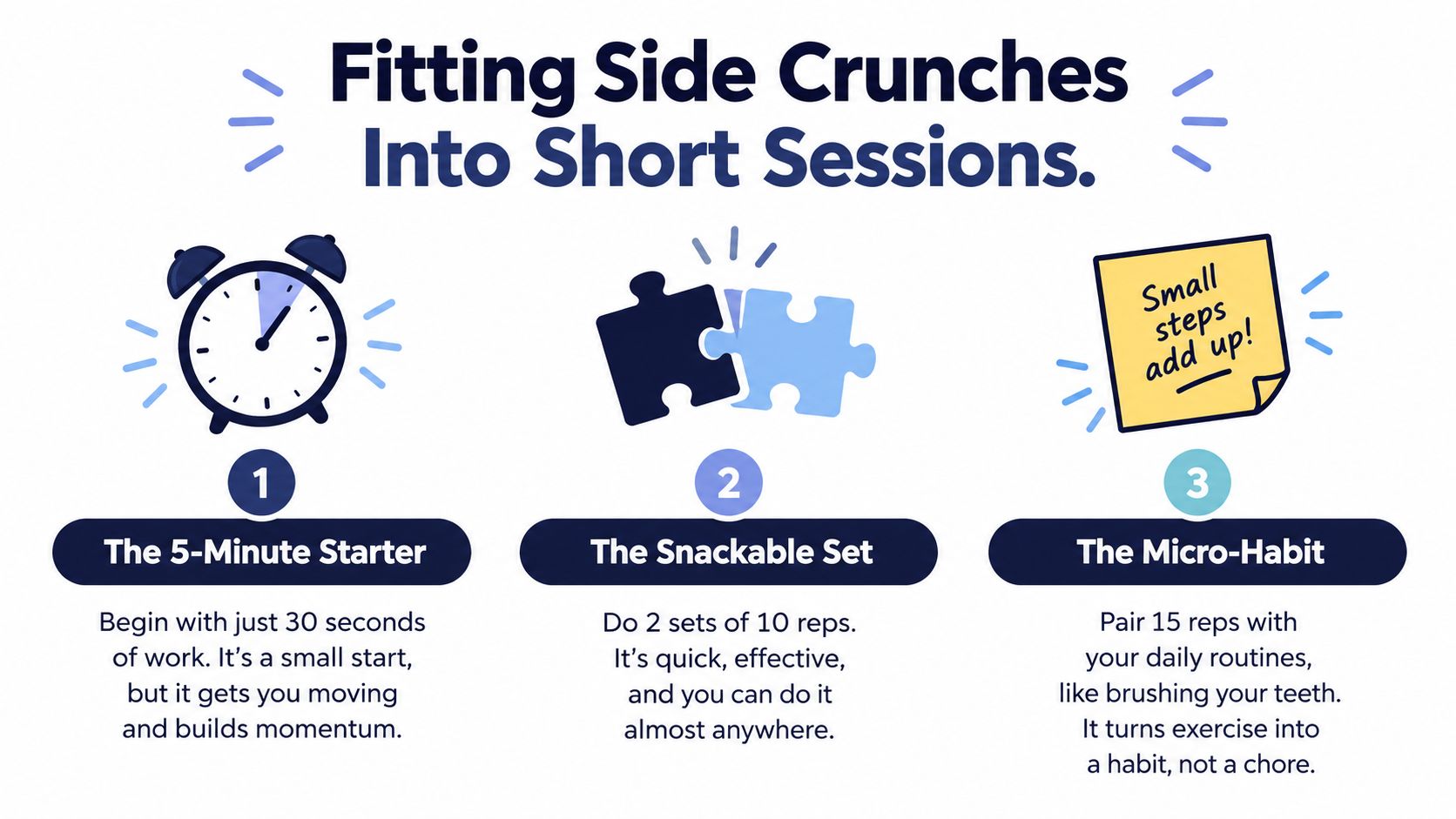
Choose a moment that already exists in your day. After a work call, before a shower, or while waiting for a meal can become a prompt for a short set. The trigger should make the exercise easier to remember, not turn every spare minute into a demand for training.
A practical pattern looks like this:
- Start with one controlled side: Perform a short set on one side, then match it on the other.
- Keep the quality ceiling: End the bout when your pelvis rolls, your neck strains, or your lift becomes a swing.
- Log the completion: Record whether you completed the set and whether the tempo stayed controlled.
- Build around recovery: Keep direct side-crunch sessions separated by adequate recovery instead of treating the movement as mandatory daily work.
The most effective exercise snack is the one you can repeat without lowering standards. A few excellent repetitions between tasks are more useful than a rushed session that reinforces the exact momentum pattern you're trying to eliminate. For a broader no-equipment structure, pair this approach with an at-home no-equipment workout that includes movements for more than one part of the body.
Closing Thoughts on Oblique Training
Side crunches are useful when you want to train controlled lateral flexion, but more oblique burn doesn't automatically mean better core function. The exercise asks the trunk to move. Many daily and athletic tasks ask the trunk to resist movement, transfer force, and keep the spine and pelvis organized while the limbs move.
That's why side crunches work best as one tool in a broader core plan. Side-position exercises such as side planks and side bridges generally produce greater external oblique and lumbar paraspinal activity than standard crunches, while producing less rectus abdominis activity overall, according to this EMG research on abdominal and trunk exercises. The comparison doesn't declare a universal winner. It shows that exercise selection changes the recruitment pattern and the type of demand placed on the trunk.
Use side crunches when you want a precise, dynamic oblique contraction. Use more stable side-position work when you want to practice resisting lateral flexion and keeping the body aligned. A balanced program can include both, alongside movements that train the front, back, hips, and shoulders to work together.
Watch the mirror, but trust the movement quality more than the sensation. Your waistline won't respond to side crunches through spot reduction, and no short routine can replace consistent training and broader lifestyle habits. Your next step is simple: perform a slow test set on each side, film one repetition from the front, and check whether your rib cage moves toward your hip without your pelvis rolling.
If you want a simple way to turn controlled bodyweight work into a repeatable home routine, visit SuperStrong. The iPhone app organizes short sets, visible progress, and private accountability with up to four friends, so you can practice movements such as side crunches without needing an hour-long gym session.